

174
6 Two-Dimensional Problems in Elasticity …
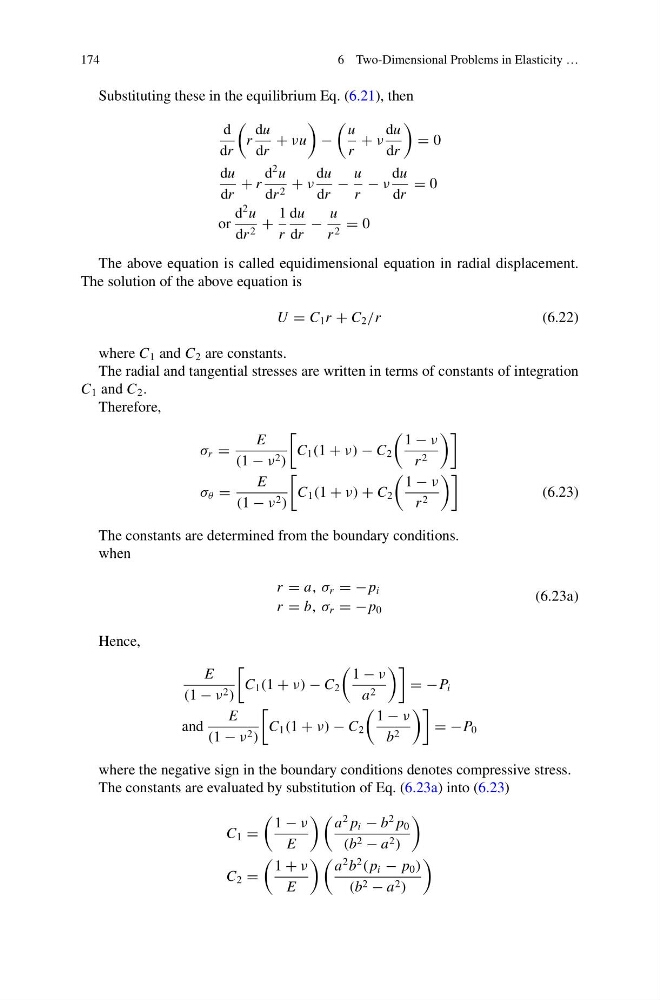
Substituting these in the equilibrium Eq. (6.21), then
d
dr
r
du
dr
+ νu
−
u
r
+ ν
du
dr
= 0
du
dr
+ r
d
2 u
dr 2 + ν
du
dr
−
u
r
− ν
du
dr
= 0
or
d
2 u
dr 2 +
1
r
du
dr
−
u
r 2 = 0
The above equation is called equidimensional equation in radial displacement.
The solution of the above equation is
U = C 1 r + C 2 /r
(6.22)
where C 1 and C 2 are constants.
The radial and tangential stresses are written in terms of constants of integration
C 1 and C 2 .
Therefore,
σ r =
E
(1 − ν 2 )
C 1 (1 + ν) − C 2
1 − ν
r 2
σ θ =
E
(1 − ν 2 )
C 1 (1 + ν) + C 2
1 − ν
r 2
(6.23)
The constants are determined from the boundary conditions.
when
r = a, σ r = −p i
r = b, σ r = −p 0
(6.23a)
Hence,
E
(1 − ν 2 )
C 1 (1 + ν) − C 2
1 − ν
a 2
= −P i
and
E
(1 − ν 2 )
C 1 (1 + ν) − C 2
1 − ν
b 2
= −P 0
where the negative sign in the boundary conditions denotes compressive stress.
The constants are evaluated by substitution of Eq. (6.23a) into (6.23)
C 1 =
1 − ν
E
a
2 p i − b
2 p 0
(b 2 − a 2 )
C 2 =
1 + ν
E
a
2 b
2
( p i − p 0 )
(b 2 − a 2 )
6 Two-Dimensional Problems in Elasticity …
Substituting these in the equilibrium Eq. (6.21), then
d
dr
r
du
dr
+ νu
−
u
r
+ ν
du
dr
= 0
du
dr
+ r
d
2 u
dr 2 + ν
du
dr
−
u
r
− ν
du
dr
= 0
or
d
2 u
dr 2 +
1
r
du
dr
−
u
r 2 = 0
The above equation is called equidimensional equation in radial displacement.
The solution of the above equation is
U = C 1 r + C 2 /r
(6.22)
where C 1 and C 2 are constants.
The radial and tangential stresses are written in terms of constants of integration
C 1 and C 2 .
Therefore,
σ r =
E
(1 − ν 2 )
C 1 (1 + ν) − C 2
1 − ν
r 2
σ θ =
E
(1 − ν 2 )
C 1 (1 + ν) + C 2
1 − ν
r 2
(6.23)
The constants are determined from the boundary conditions.
when
r = a, σ r = −p i
r = b, σ r = −p 0
(6.23a)
Hence,
E
(1 − ν 2 )
C 1 (1 + ν) − C 2
1 − ν
a 2
= −P i
and
E
(1 − ν 2 )
C 1 (1 + ν) − C 2
1 − ν
b 2
= −P 0
where the negative sign in the boundary conditions denotes compressive stress.
The constants are evaluated by substitution of Eq. (6.23a) into (6.23)
C 1 =
1 − ν
E
a
2 p i − b
2 p 0
(b 2 − a 2 )
C 2 =
1 + ν
E
a
2 b
2
( p i − p 0 )
(b 2 − a 2 )