

142
5 Two-Dimensional Problems in Cartesian Co-ordinate System
5.6 Pure Bending of a Beam
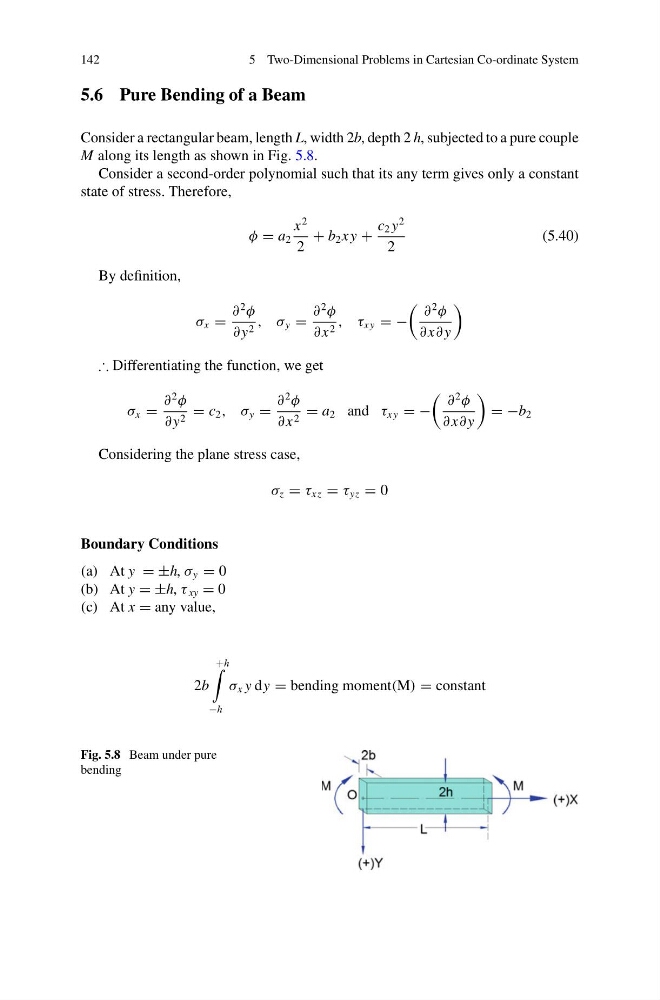
Consider a rectangular beam, length L, width 2b, depth 2 h, subjected to a pure couple
M along its length as shown in Fig. 5.8.
Consider a second-order polynomial such that its any term gives only a constant
state of stress. Therefore,
φ = a 2
x
2
2
+ b 2 x y +
c 2 y
2
2
(5.40)
By definition,
σ x =
∂
2
φ
∂ y 2 , σ y =
∂
2
φ
∂ x 2 , τ xy = −
∂
2
φ
∂ x∂ y
∴ Differentiating the function, we get
σ x =
∂
2
φ
∂ y 2 = c 2 , σ y =
∂
2
φ
∂ x 2 = a 2 and τ xy = −
∂
2
φ
∂ x∂ y
= −b 2
Considering the plane stress case,
σ z = τ xz = τ yz = 0
Boundary Conditions
(a) At y = ±h, σ y = 0
(b) At y = ±h, τ xy = 0
(c) At x = any value,
2b
+h
−h
σ x y dy = bending moment(M) = constant
Fig. 5.8 Beam under pure
bending
5 Two-Dimensional Problems in Cartesian Co-ordinate System
5.6 Pure Bending of a Beam
Consider a rectangular beam, length L, width 2b, depth 2 h, subjected to a pure couple
M along its length as shown in Fig. 5.8.
Consider a second-order polynomial such that its any term gives only a constant
state of stress. Therefore,
φ = a 2
x
2
2
+ b 2 x y +
c 2 y
2
2
(5.40)
By definition,
σ x =
∂
2
φ
∂ y 2 , σ y =
∂
2
φ
∂ x 2 , τ xy = −
∂
2
φ
∂ x∂ y
∴ Differentiating the function, we get
σ x =
∂
2
φ
∂ y 2 = c 2 , σ y =
∂
2
φ
∂ x 2 = a 2 and τ xy = −
∂
2
φ
∂ x∂ y
= −b 2
Considering the plane stress case,
σ z = τ xz = τ yz = 0
Boundary Conditions
(a) At y = ±h, σ y = 0
(b) At y = ±h, τ xy = 0
(c) At x = any value,
2b
+h
−h
σ x y dy = bending moment(M) = constant
Fig. 5.8 Beam under pure
bending