

5.6 Pure Bending of a Beam
143
∴ 2bx
+h
−h
c 2 y dy = 2bc 2 x
y
2
2
+h
−h
= 0
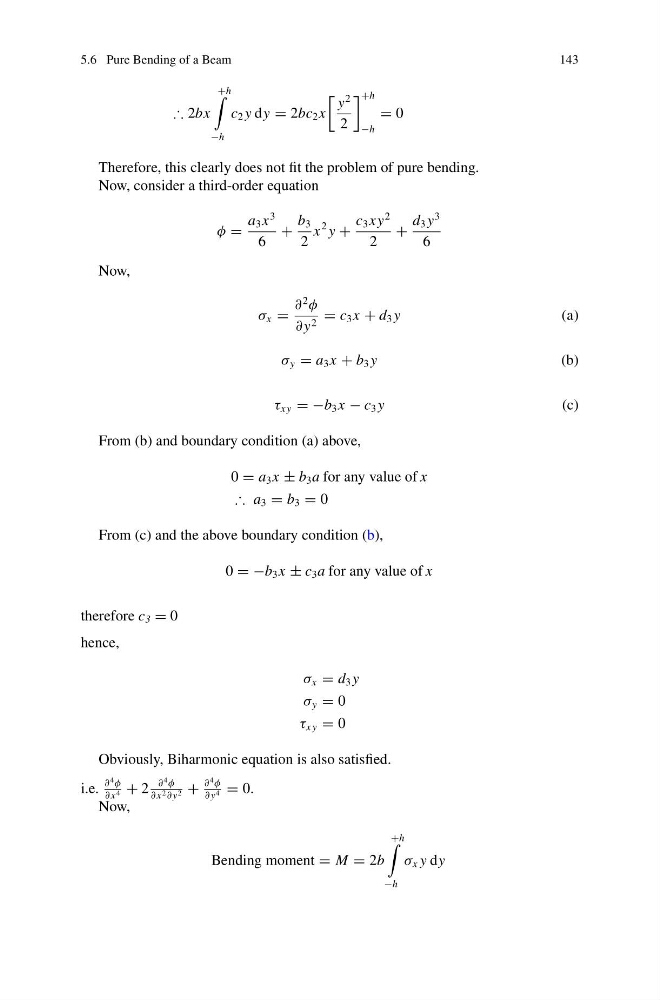
Therefore, this clearly does not fit the problem of pure bending.
Now, consider a third-order equation
φ =
a 3 x
3
6
+
b 3
2
x
2 y +
c 3 x y
2
2
+
d 3 y
3
6
Now,
σ x =
∂
2
φ
∂ y 2 = c 3 x + d 3 y
(a)
σ y = a 3 x + b 3 y
(b)
τ xy = −b 3 x − c 3 y
(c)
From (b) and boundary condition (a) above,
0 = a 3 x ± b 3 a for any value of x
∴ a 3 = b 3 = 0
From (c) and the above boundary condition (b),
0 = −b 3 x ± c 3 a for any value of x
therefore c 3 = 0
hence,
σ x = d 3 y
σ y = 0
τ xy = 0
Obviously, Biharmonic equation is also satisfied.
i.e.
∂
4 φ
∂ x 4 + 2
∂
4 φ
∂ x 2 ∂ y 2 +
∂
4 φ
∂ y 4 = 0.
Now,
Bending moment = M = 2b
+h
−h
σ x y dy
143
∴ 2bx
+h
−h
c 2 y dy = 2bc 2 x
y
2
2
+h
−h
= 0
Therefore, this clearly does not fit the problem of pure bending.
Now, consider a third-order equation
φ =
a 3 x
3
6
+
b 3
2
x
2 y +
c 3 x y
2
2
+
d 3 y
3
6
Now,
σ x =
∂
2
φ
∂ y 2 = c 3 x + d 3 y
(a)
σ y = a 3 x + b 3 y
(b)
τ xy = −b 3 x − c 3 y
(c)
From (b) and boundary condition (a) above,
0 = a 3 x ± b 3 a for any value of x
∴ a 3 = b 3 = 0
From (c) and the above boundary condition (b),
0 = −b 3 x ± c 3 a for any value of x
therefore c 3 = 0
hence,
σ x = d 3 y
σ y = 0
τ xy = 0
Obviously, Biharmonic equation is also satisfied.
i.e.
∂
4 φ
∂ x 4 + 2
∂
4 φ
∂ x 2 ∂ y 2 +
∂
4 φ
∂ y 4 = 0.
Now,
Bending moment = M = 2b
+h
−h
σ x y dy