

136
5 Two-Dimensional Problems in Cartesian Co-ordinate System
for solving two-dimensional problems is discussed in the next article. The inverse
method requires examination of the assumed solutions with a view towards finding
one which will satisfy the governing equations and the boundary conditions.
The semi-inverse method requires the assumption of a partial solution, formed
by expressing stress, strain, displacement, or stress function in terms of known
or undetermined coefficients. The governing equations are thus rendered more
manageable.
5.5 Solution of Two-Dimensional Problems by the Use
of Polynomials
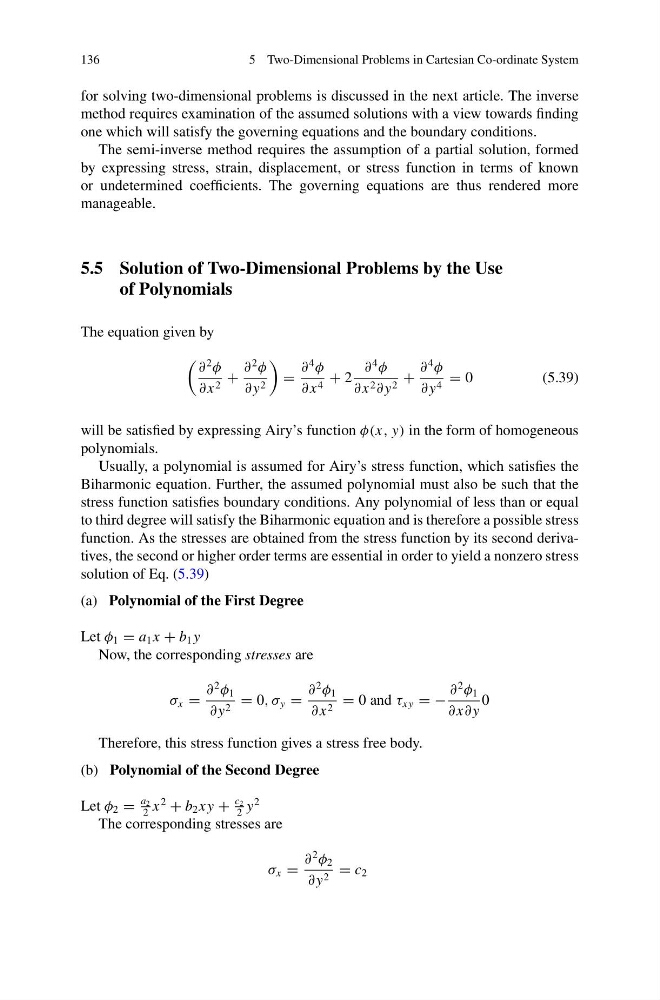
The equation given by
∂
2
φ
∂ x 2 +
∂
2
φ
∂ y 2
=
∂
4
φ
∂ x 4 + 2
∂
4
φ
∂ x 2 ∂ y 2 +
∂
4
φ
∂ y 4 = 0
(5.39)
will be satisfied by expressing Airy’s function φ(x, y) in the form of homogeneous
polynomials.
Usually, a polynomial is assumed for Airy’s stress function, which satisfies the
Biharmonic equation. Further, the assumed polynomial must also be such that the
stress function satisfies boundary conditions. Any polynomial of less than or equal
to third degree will satisfy the Biharmonic equation and is therefore a possible stress
function. As the stresses are obtained from the stress function by its second derivatives, the second or higher order terms are essential in order to yield a nonzero stress
solution of Eq. (5.39)
(a) Polynomial of the First Degree
Let φ 1 = a 1 x + b 1 y
Now, the corresponding stresses are
σ x =
∂
2
φ 1
∂ y 2 = 0, σ y =
∂
2
φ 1
∂ x 2 = 0 and τ xy = −
∂
2
φ 1
∂ x∂ y
0
Therefore, this stress function gives a stress free body.
(b) Polynomial of the Second Degree
Let φ 2 =
a 2
2
x
2
+ b 2 x y +
c 2
2
y
2
The corresponding stresses are
σ x =
∂
2
φ 2
∂ y 2 = c 2
5 Two-Dimensional Problems in Cartesian Co-ordinate System
for solving two-dimensional problems is discussed in the next article. The inverse
method requires examination of the assumed solutions with a view towards finding
one which will satisfy the governing equations and the boundary conditions.
The semi-inverse method requires the assumption of a partial solution, formed
by expressing stress, strain, displacement, or stress function in terms of known
or undetermined coefficients. The governing equations are thus rendered more
manageable.
5.5 Solution of Two-Dimensional Problems by the Use
of Polynomials
The equation given by
∂
2
φ
∂ x 2 +
∂
2
φ
∂ y 2
=
∂
4
φ
∂ x 4 + 2
∂
4
φ
∂ x 2 ∂ y 2 +
∂
4
φ
∂ y 4 = 0
(5.39)
will be satisfied by expressing Airy’s function φ(x, y) in the form of homogeneous
polynomials.
Usually, a polynomial is assumed for Airy’s stress function, which satisfies the
Biharmonic equation. Further, the assumed polynomial must also be such that the
stress function satisfies boundary conditions. Any polynomial of less than or equal
to third degree will satisfy the Biharmonic equation and is therefore a possible stress
function. As the stresses are obtained from the stress function by its second derivatives, the second or higher order terms are essential in order to yield a nonzero stress
solution of Eq. (5.39)
(a) Polynomial of the First Degree
Let φ 1 = a 1 x + b 1 y
Now, the corresponding stresses are
σ x =
∂
2
φ 1
∂ y 2 = 0, σ y =
∂
2
φ 1
∂ x 2 = 0 and τ xy = −
∂
2
φ 1
∂ x∂ y
0
Therefore, this stress function gives a stress free body.
(b) Polynomial of the Second Degree
Let φ 2 =
a 2
2
x
2
+ b 2 x y +
c 2
2
y
2
The corresponding stresses are
σ x =
∂
2
φ 2
∂ y 2 = c 2