

5.5 Solution of Two-Dimensional Problems …
137
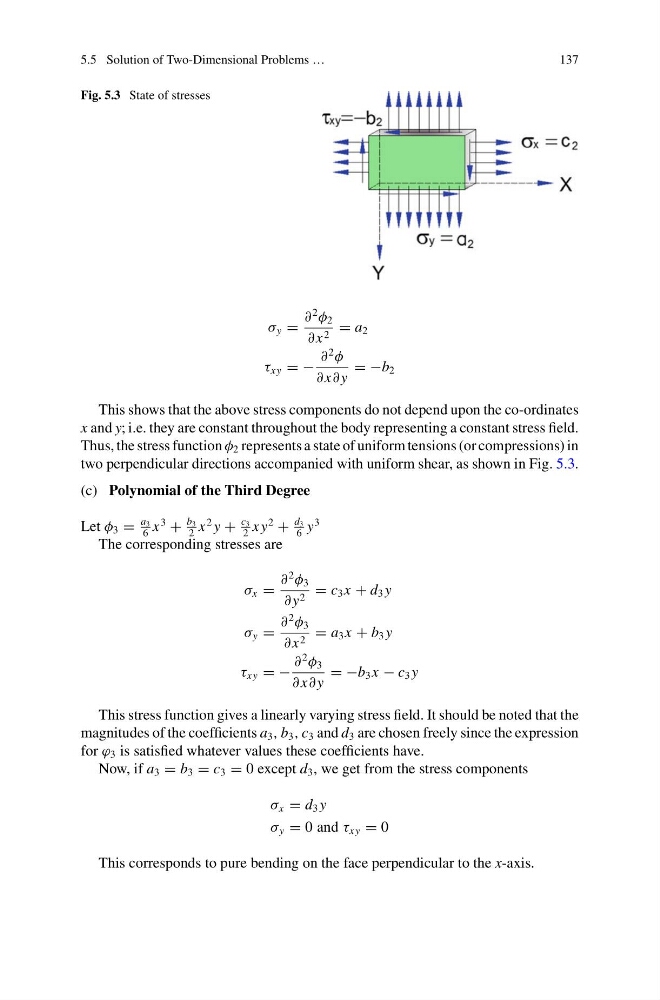
Fig. 5.3 State of stresses
σ y =
∂
2
φ 2
∂ x 2 = a 2
τ xy = −
∂
2
φ
∂ x∂ y
= −b 2
This shows that the above stress components do not depend upon the co-ordinates
x and y; i.e. they are constant throughout the body representing a constant stress field.
Thus, the stress function φ 2 represents a state of uniform tensions (or compressions) in
two perpendicular directions accompanied with uniform shear, as shown in Fig. 5.3.
(c) Polynomial of the Third Degree
Let φ 3 =
a 3
6
x
3
+
b 3
2
x
2 y +
c 3
2
x y
2
+
d 3
6
y
3
The corresponding stresses are
σ x =
∂
2
φ 3
∂ y 2 = c 3 x + d 3 y
σ y =
∂
2
φ 3
∂ x 2 = a 3 x + b 3 y
τ xy = −
∂
2
φ 3
∂ x∂ y
= −b 3 x − c 3 y
This stress function gives a linearly varying stress field. It should be noted that the
magnitudes of the coefficients a 3 , b 3 , c 3 and d 3 are chosen freely since the expression
for ϕ 3 is satisfied whatever values these coefficients have.
Now, if a 3 = b 3 = c 3 = 0 except d 3 , we get from the stress components
σ x = d 3 y
σ y = 0 and τ xy = 0
This corresponds to pure bending on the face perpendicular to the x-axis.
137
Fig. 5.3 State of stresses
σ y =
∂
2
φ 2
∂ x 2 = a 2
τ xy = −
∂
2
φ
∂ x∂ y
= −b 2
This shows that the above stress components do not depend upon the co-ordinates
x and y; i.e. they are constant throughout the body representing a constant stress field.
Thus, the stress function φ 2 represents a state of uniform tensions (or compressions) in
two perpendicular directions accompanied with uniform shear, as shown in Fig. 5.3.
(c) Polynomial of the Third Degree
Let φ 3 =
a 3
6
x
3
+
b 3
2
x
2 y +
c 3
2
x y
2
+
d 3
6
y
3
The corresponding stresses are
σ x =
∂
2
φ 3
∂ y 2 = c 3 x + d 3 y
σ y =
∂
2
φ 3
∂ x 2 = a 3 x + b 3 y
τ xy = −
∂
2
φ 3
∂ x∂ y
= −b 3 x − c 3 y
This stress function gives a linearly varying stress field. It should be noted that the
magnitudes of the coefficients a 3 , b 3 , c 3 and d 3 are chosen freely since the expression
for ϕ 3 is satisfied whatever values these coefficients have.
Now, if a 3 = b 3 = c 3 = 0 except d 3 , we get from the stress components
σ x = d 3 y
σ y = 0 and τ xy = 0
This corresponds to pure bending on the face perpendicular to the x-axis.