

5.4 Airy’s Stress Function
135
2(1 − v)
∂
4
τ xy
∂ x∂ y
− (1 − v)
∂
2
σ x
∂ y 2 +
∂
2
σ y
∂ x 2
+ v
∂
2
∂ x 2 +
∂
2
∂ y 2
= 0
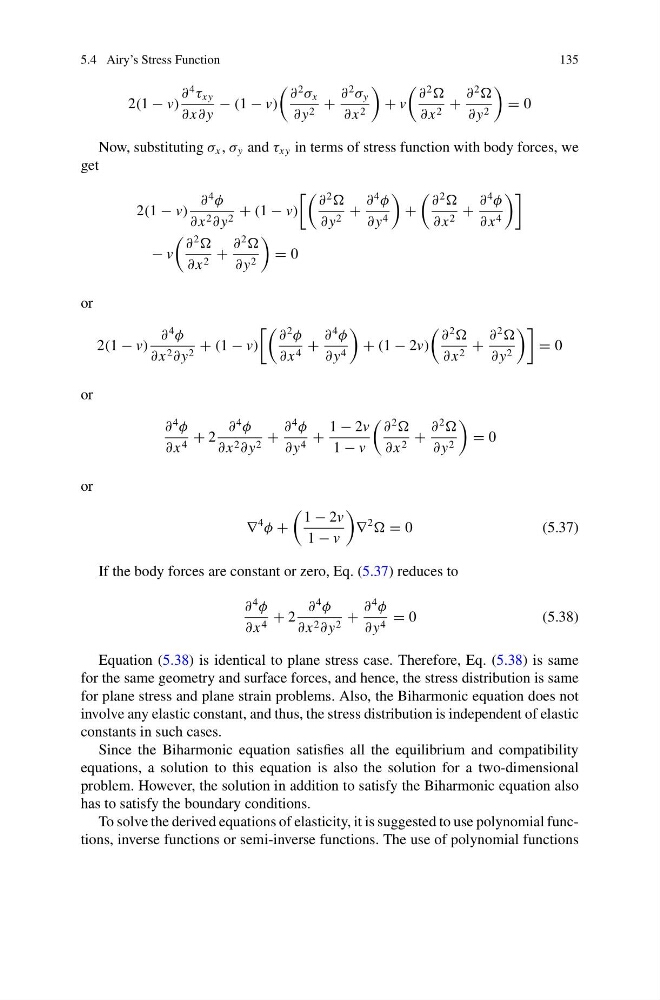
Now, substituting σ x , σ y and τ xy in terms of stress function with body forces, we
get
2(1 − v)
∂
4
φ
∂ x 2 ∂ y 2 + (1 − v)
∂
2
∂ y 2 +
∂
4
φ
∂ y 4
+
∂
2
∂ x 2 +
∂
4
φ
∂ x 4
− v
∂
2
∂ x 2 +
∂
2
∂ y 2
= 0
or
2(1 − v)
∂
4
φ
∂ x 2 ∂ y 2 + (1 − v)
∂
2
φ
∂ x 4 +
∂
4
φ
∂ y 4
+ (1 − 2v)
∂
2
∂ x 2 +
∂
2
∂ y 2
= 0
or
∂
4
φ
∂ x 4 + 2
∂
4
φ
∂ x 2 ∂ y 2 +
∂
4
φ
∂ y 4 +
1 − 2v
1 − v
∂
2
∂ x 2 +
∂
2
∂ y 2
= 0
or
∇
4
φ +
1 − 2v
1 − v
∇
2
= 0
(5.37)
If the body forces are constant or zero, Eq. (5.37) reduces to
∂
4
φ
∂ x 4 + 2
∂
4
φ
∂ x 2 ∂ y 2 +
∂
4
φ
∂ y 4 = 0
(5.38)
Equation (5.38) is identical to plane stress case. Therefore, Eq. (5.38) is same
for the same geometry and surface forces, and hence, the stress distribution is same
for plane stress and plane strain problems. Also, the Biharmonic equation does not
involve any elastic constant, and thus, the stress distribution is independent of elastic
constants in such cases.
Since the Biharmonic equation satisfies all the equilibrium and compatibility
equations, a solution to this equation is also the solution for a two-dimensional
problem. However, the solution in addition to satisfy the Biharmonic equation also
has to satisfy the boundary conditions.
To solve the derived equations of elasticity, it is suggested to use polynomial functions, inverse functions or semi-inverse functions. The use of polynomial functions
135
2(1 − v)
∂
4
τ xy
∂ x∂ y
− (1 − v)
∂
2
σ x
∂ y 2 +
∂
2
σ y
∂ x 2
+ v
∂
2
∂ x 2 +
∂
2
∂ y 2
= 0
Now, substituting σ x , σ y and τ xy in terms of stress function with body forces, we
get
2(1 − v)
∂
4
φ
∂ x 2 ∂ y 2 + (1 − v)
∂
2
∂ y 2 +
∂
4
φ
∂ y 4
+
∂
2
∂ x 2 +
∂
4
φ
∂ x 4
− v
∂
2
∂ x 2 +
∂
2
∂ y 2
= 0
or
2(1 − v)
∂
4
φ
∂ x 2 ∂ y 2 + (1 − v)
∂
2
φ
∂ x 4 +
∂
4
φ
∂ y 4
+ (1 − 2v)
∂
2
∂ x 2 +
∂
2
∂ y 2
= 0
or
∂
4
φ
∂ x 4 + 2
∂
4
φ
∂ x 2 ∂ y 2 +
∂
4
φ
∂ y 4 +
1 − 2v
1 − v
∂
2
∂ x 2 +
∂
2
∂ y 2
= 0
or
∇
4
φ +
1 − 2v
1 − v
∇
2
= 0
(5.37)
If the body forces are constant or zero, Eq. (5.37) reduces to
∂
4
φ
∂ x 4 + 2
∂
4
φ
∂ x 2 ∂ y 2 +
∂
4
φ
∂ y 4 = 0
(5.38)
Equation (5.38) is identical to plane stress case. Therefore, Eq. (5.38) is same
for the same geometry and surface forces, and hence, the stress distribution is same
for plane stress and plane strain problems. Also, the Biharmonic equation does not
involve any elastic constant, and thus, the stress distribution is independent of elastic
constants in such cases.
Since the Biharmonic equation satisfies all the equilibrium and compatibility
equations, a solution to this equation is also the solution for a two-dimensional
problem. However, the solution in addition to satisfy the Biharmonic equation also
has to satisfy the boundary conditions.
To solve the derived equations of elasticity, it is suggested to use polynomial functions, inverse functions or semi-inverse functions. The use of polynomial functions