

3.4 Phase Space Fields
47
where
d
3 p :=
1
3!
ε i jk d p
i
∧ d p
j
∧ d p
k
.
(3.4.36)
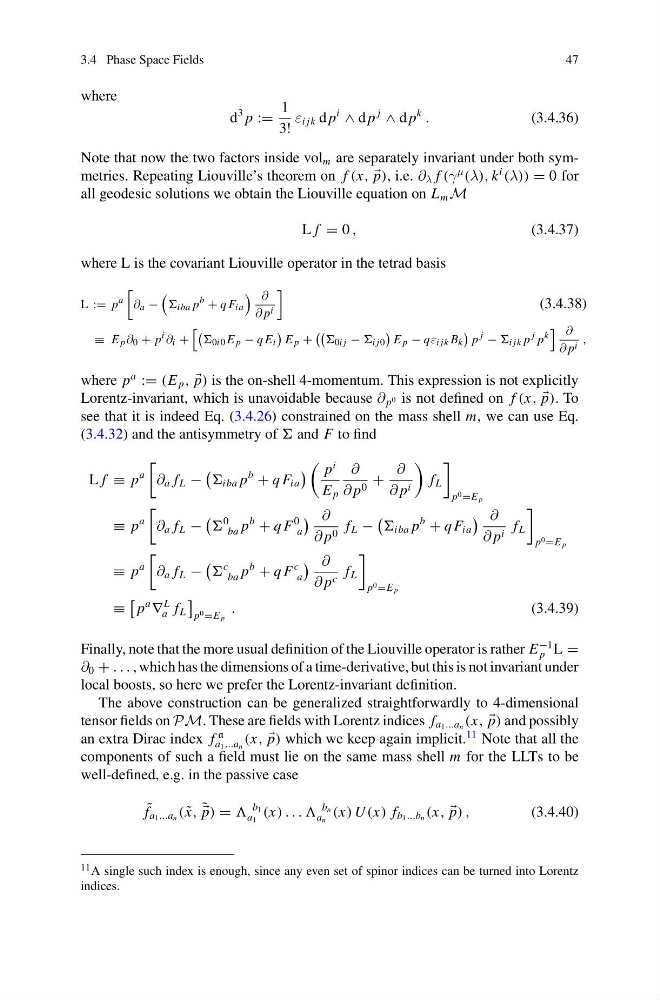
Note that now the two factors inside vol m are separately invariant under both symmetries. Repeating Liouville’s theorem on f (x,
p), i.e. ∂ λ f (γ
μ
(λ), k
i
(λ)) = 0 for
all geodesic solutions we obtain the Liouville equation on L m M
L f = 0 ,
(3.4.37)
where L is the covariant Liouville operator in the tetrad basis
L := p
a
∂ a −
iba p
b + q F ia
∂
∂ p i
(3.4.38)
≡ E p ∂ 0 + p
i ∂ i +
0i0 E p − q E i
E p +
0i j − i j0
E p − qε i jk B k
p
j − i jk p
j p
k
∂
∂ p i ,
where p
a
:= (E p ,
p) is the on-shell 4-momentum. This expression is not explicitly
Lorentz-invariant, which is unavoidable because ∂ p 0 is not defined on f (x,
p). To
see that it is indeed Eq. (3.4.26) constrained on the mass shell m, we can use Eq.
(3.4.32) and the antisymmetry of and F to find
L f ≡ p
a
∂ a f L −
iba p
b
+ q F ia
p
i
E p
∂
∂ p 0 +
∂
∂ p i
f L
p 0 =E p
≡ p
a
∂ a f L −
0
ba p
b
+ q F
0
a
∂
∂ p 0 f L −
iba p
b
+ q F ia
∂
∂ p i f L
p 0 =E p
≡ p
a
∂ a f L −
c
ba p
b
+ q F
c
a
∂
∂ p c f L
p 0 =E p
≡
p
a
∇
L
a f L
p 0 =E p
.
(3.4.39)
Finally, note that the more usual definition of the Liouville operator is rather E
−1
p L =
∂ 0 + . . . , which has the dimensions of a time-derivative, but this is not invariant under
local boosts, so here we prefer the Lorentz-invariant definition.
The above construction can be generalized straightforwardly to 4-dimensional
tensor fields on PM. These are fields with Lorentz indices f a 1 ...a n (x,
p) and possibly
an extra Dirac index f
a
a 1 ...a n
(x,
p) which we keep again implicit.
11 Note that all the
components of such a field must lie on the same mass shell m for the LLTs to be
well-defined, e.g. in the passive case
˜
f a 1 ...a n ( ˜
x, ˜
p) =
b 1
a 1
(x) . . . .
b n
a n
(x) U (x) f b 1 ...b n (x,
p) ,
(3.4.40)
11 A single such index is enough, since any even set of spinor indices can be turned into Lorentz
indices.
47
where
d
3 p :=
1
3!
ε i jk d p
i
∧ d p
j
∧ d p
k
.
(3.4.36)
Note that now the two factors inside vol m are separately invariant under both symmetries. Repeating Liouville’s theorem on f (x,
p), i.e. ∂ λ f (γ
μ
(λ), k
i
(λ)) = 0 for
all geodesic solutions we obtain the Liouville equation on L m M
L f = 0 ,
(3.4.37)
where L is the covariant Liouville operator in the tetrad basis
L := p
a
∂ a −
iba p
b + q F ia
∂
∂ p i
(3.4.38)
≡ E p ∂ 0 + p
i ∂ i +
0i0 E p − q E i
E p +
0i j − i j0
E p − qε i jk B k
p
j − i jk p
j p
k
∂
∂ p i ,
where p
a
:= (E p ,
p) is the on-shell 4-momentum. This expression is not explicitly
Lorentz-invariant, which is unavoidable because ∂ p 0 is not defined on f (x,
p). To
see that it is indeed Eq. (3.4.26) constrained on the mass shell m, we can use Eq.
(3.4.32) and the antisymmetry of and F to find
L f ≡ p
a
∂ a f L −
iba p
b
+ q F ia
p
i
E p
∂
∂ p 0 +
∂
∂ p i
f L
p 0 =E p
≡ p
a
∂ a f L −
0
ba p
b
+ q F
0
a
∂
∂ p 0 f L −
iba p
b
+ q F ia
∂
∂ p i f L
p 0 =E p
≡ p
a
∂ a f L −
c
ba p
b
+ q F
c
a
∂
∂ p c f L
p 0 =E p
≡
p
a
∇
L
a f L
p 0 =E p
.
(3.4.39)
Finally, note that the more usual definition of the Liouville operator is rather E
−1
p L =
∂ 0 + . . . , which has the dimensions of a time-derivative, but this is not invariant under
local boosts, so here we prefer the Lorentz-invariant definition.
The above construction can be generalized straightforwardly to 4-dimensional
tensor fields on PM. These are fields with Lorentz indices f a 1 ...a n (x,
p) and possibly
an extra Dirac index f
a
a 1 ...a n
(x,
p) which we keep again implicit.
11 Note that all the
components of such a field must lie on the same mass shell m for the LLTs to be
well-defined, e.g. in the passive case
˜
f a 1 ...a n ( ˜
x, ˜
p) =
b 1
a 1
(x) . . . .
b n
a n
(x) U (x) f b 1 ...b n (x,
p) ,
(3.4.40)
11 A single such index is enough, since any even set of spinor indices can be turned into Lorentz
indices.