

46
3 Mathematical Framework
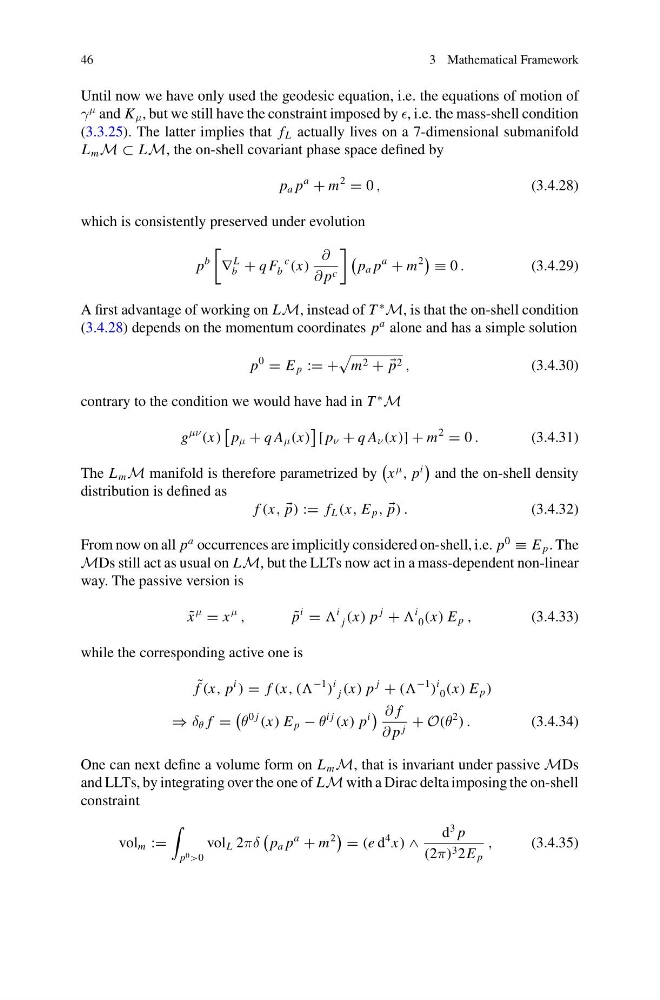
Until now we have only used the geodesic equation, i.e. the equations of motion of
γ
μ and K μ , but we still have the constraint imposed by , i.e. the mass-shell condition
(3.3.25). The latter implies that f L actually lives on a 7-dimensional submanifold
L m M ⊂ LM, the on-shell covariant phase space defined by
p a p
a
+ m
2
= 0 ,
(3.4.28)
which is consistently preserved under evolution
p
b
∇
L
b + q F
c
b (x)
∂
∂ p c
p a p
a
+ m
2
≡ 0 .
(3.4.29)
A first advantage of working on LM, instead of T
∗
M, is that the on-shell condition
(3.4.28) depends on the momentum coordinates p
a alone and has a simple solution
p
0
= E p := +
m 2 + +
p 2 ,
(3.4.30)
contrary to the condition we would have had in T
∗
M
g
μν
(x)
p μ + q A μ (x)
[ p ν + q A ν (x)] + m
2
= 0 .
(3.4.31)
The L m M manifold is therefore parametrized by
x
μ
, p
i
and the on-shell density
distribution is defined as
f (x,
p) := f L (x, E p ,
p) .
(3.4.32)
From now on all p
a occurrences are implicitly considered on-shell, i.e. p
0
≡ E p . The
MDs still act as usual on LM, but the LLTs now act in a mass-dependent non-linear
way. The passive version is
˜
x
μ
= x
μ
,
˜
p
i
=
i
j (x) p
j
+
i
0 (x) E p ,
(3.4.33)
while the corresponding active one is
˜
f (x, p
i
) = f (x, ((
−1
)
i
j (x) p
j
+ ((
−1
)
i
0 (x) E p )
⇒ δ θ f =
θ
0 j
(x) E p − θ
i j
(x) p
i
∂ f
∂ p j + O(θ
2
) .
(3.4.34)
One can next define a volume form on L m M, that is invariant under passive MDs
and LLTs, by integrating over the one of LM with a Dirac delta imposing the on-shell
constraint
vol m :=
p 0 >0
vol L 2πδ
p a p
a
+ m
2
= (e d
4 x) ∧
d
3 p
(2π) 3 2E p
,
(3.4.35)
3 Mathematical Framework
Until now we have only used the geodesic equation, i.e. the equations of motion of
γ
μ and K μ , but we still have the constraint imposed by , i.e. the mass-shell condition
(3.3.25). The latter implies that f L actually lives on a 7-dimensional submanifold
L m M ⊂ LM, the on-shell covariant phase space defined by
p a p
a
+ m
2
= 0 ,
(3.4.28)
which is consistently preserved under evolution
p
b
∇
L
b + q F
c
b (x)
∂
∂ p c
p a p
a
+ m
2
≡ 0 .
(3.4.29)
A first advantage of working on LM, instead of T
∗
M, is that the on-shell condition
(3.4.28) depends on the momentum coordinates p
a alone and has a simple solution
p
0
= E p := +
m 2 + +
p 2 ,
(3.4.30)
contrary to the condition we would have had in T
∗
M
g
μν
(x)
p μ + q A μ (x)
[ p ν + q A ν (x)] + m
2
= 0 .
(3.4.31)
The L m M manifold is therefore parametrized by
x
μ
, p
i
and the on-shell density
distribution is defined as
f (x,
p) := f L (x, E p ,
p) .
(3.4.32)
From now on all p
a occurrences are implicitly considered on-shell, i.e. p
0
≡ E p . The
MDs still act as usual on LM, but the LLTs now act in a mass-dependent non-linear
way. The passive version is
˜
x
μ
= x
μ
,
˜
p
i
=
i
j (x) p
j
+
i
0 (x) E p ,
(3.4.33)
while the corresponding active one is
˜
f (x, p
i
) = f (x, ((
−1
)
i
j (x) p
j
+ ((
−1
)
i
0 (x) E p )
⇒ δ θ f =
θ
0 j
(x) E p − θ
i j
(x) p
i
∂ f
∂ p j + O(θ
2
) .
(3.4.34)
One can next define a volume form on L m M, that is invariant under passive MDs
and LLTs, by integrating over the one of LM with a Dirac delta imposing the on-shell
constraint
vol m :=
p 0 >0
vol L 2πδ
p a p
a
+ m
2
= (e d
4 x) ∧
d
3 p
(2π) 3 2E p
,
(3.4.35)