

3.4 Phase Space Fields
45
˜
f L (x, (x) p) = f L (x, p) ,
(3.4.20)
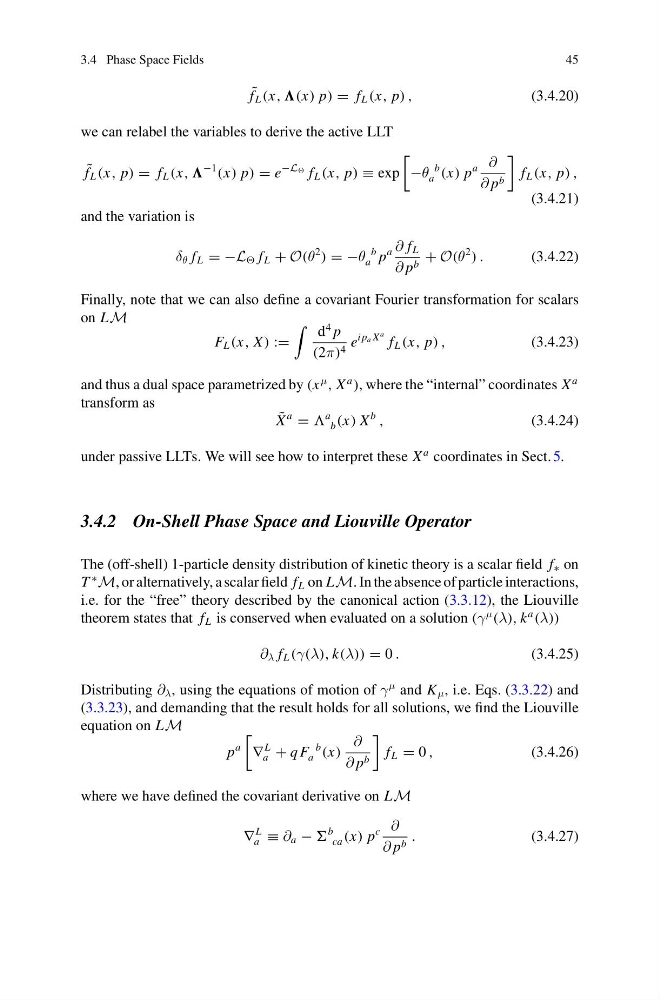
we can relabel the variables to derive the active LLT
˜
f L (x, p) = f L (x,
−1
(x) p) = e
−L f L (x, p) ≡ exp
−θ
b
a (x) p
a ∂
∂ p b
f L (x, p) ,
(3.4.21)
and the variation is
δ θ f L = −L f L + O(θ
2
) = −θ
b
a p
a ∂ f L
∂ p b + O(θ
2
) .
(3.4.22)
Finally, note that we can also define a covariant Fourier transformation for scalars
on LM
F L (x, X ) :=
d
4 p
(2π) 4 e
i p a X
a f L (x, p) ,
(3.4.23)
and thus a dual space parametrized by (x
μ
, X
a
), where the “internal” coordinates X
a
transform as
˜
X
a
=
a
b (x) X
b
,
(3.4.24)
under passive LLTs. We will see how to interpret these X
a coordinates in Sect. 5.
3.4.2 On-Shell Phase Space and Liouville Operator
The (off-shell) 1-particle density distribution of kinetic theory is a scalar field f ∗ on
T
∗
M, or alternatively, a scalar field f L on LM. In the absence of particle interactions,
i.e. for the “free” theory described by the canonical action (3.3.12), the Liouville
theorem states that f L is conserved when evaluated on a solution (γ
μ
(λ), k
a
(λ))
∂ λ f L (γ(λ), k(λ)) = 0 .
(3.4.25)
Distributing ∂ λ , using the equations of motion of γ
μ and K μ , i.e. Eqs. (3.3.22) and
(3.3.23), and demanding that the result holds for all solutions, we find the Liouville
equation on LM
p
a
∇
L
a + q F
b
a (x)
∂
∂ p b
f L = 0 ,
(3.4.26)
where we have defined the covariant derivative on LM
∇
L
a ≡ ∂ a −
b
ca (x) p
c ∂
∂ p b .
(3.4.27)
45
˜
f L (x, (x) p) = f L (x, p) ,
(3.4.20)
we can relabel the variables to derive the active LLT
˜
f L (x, p) = f L (x,
−1
(x) p) = e
−L f L (x, p) ≡ exp
−θ
b
a (x) p
a ∂
∂ p b
f L (x, p) ,
(3.4.21)
and the variation is
δ θ f L = −L f L + O(θ
2
) = −θ
b
a p
a ∂ f L
∂ p b + O(θ
2
) .
(3.4.22)
Finally, note that we can also define a covariant Fourier transformation for scalars
on LM
F L (x, X ) :=
d
4 p
(2π) 4 e
i p a X
a f L (x, p) ,
(3.4.23)
and thus a dual space parametrized by (x
μ
, X
a
), where the “internal” coordinates X
a
transform as
˜
X
a
=
a
b (x) X
b
,
(3.4.24)
under passive LLTs. We will see how to interpret these X
a coordinates in Sect. 5.
3.4.2 On-Shell Phase Space and Liouville Operator
The (off-shell) 1-particle density distribution of kinetic theory is a scalar field f ∗ on
T
∗
M, or alternatively, a scalar field f L on LM. In the absence of particle interactions,
i.e. for the “free” theory described by the canonical action (3.3.12), the Liouville
theorem states that f L is conserved when evaluated on a solution (γ
μ
(λ), k
a
(λ))
∂ λ f L (γ(λ), k(λ)) = 0 .
(3.4.25)
Distributing ∂ λ , using the equations of motion of γ
μ and K μ , i.e. Eqs. (3.3.22) and
(3.3.23), and demanding that the result holds for all solutions, we find the Liouville
equation on LM
p
a
∇
L
a + q F
b
a (x)
∂
∂ p b
f L = 0 ,
(3.4.26)
where we have defined the covariant derivative on LM
∇
L
a ≡ ∂ a −
b
ca (x) p
c ∂
∂ p b .
(3.4.27)