

48
3 Mathematical Framework
where the coordinates are related by the LLT (3.4.33), and must also have the same
charge q for the U(1)GTs to be well-defined
˜
f a 1 ...a n (x,
p) = e
iqθ(x) f a 1 ...a n (x,
p) .
(3.4.41)
Evaluating such a tensor on a given geodesic solution (γ(λ),
k(λ)) one obtains a
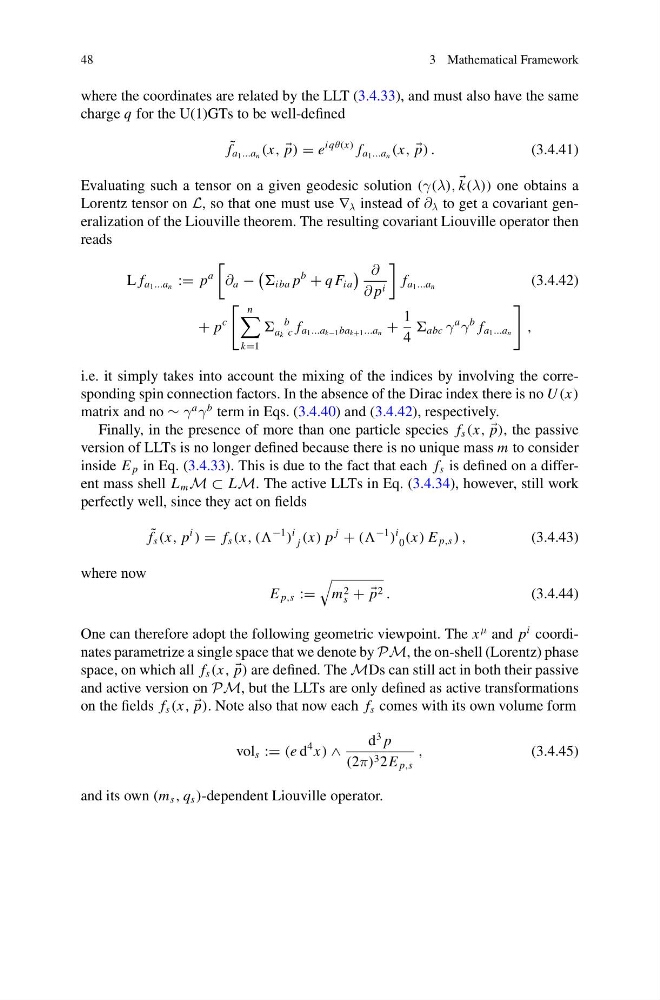
Lorentz tensor on L, so that one must use ∇ λ instead of ∂ λ to get a covariant generalization of the Liouville theorem. The resulting covariant Liouville operator then
reads
L f a 1 ...a n := p
a
∂ a −
iba p
b
+ q F ia
∂
∂ p i
f a 1 ...a n
(3.4.42)
+ p
c
n
k=1
b
a k c f a 1 ...a k−1 ba k+1 ...a n +
1
4
abc γ
a
γ
b f a 1 ...a n
,
i.e. it simply takes into account the mixing of the indices by involving the corresponding spin connection factors. In the absence of the Dirac index there is no U (x)
matrix and no ∼ γ
a
γ
b term in Eqs. (3.4.40) and (3.4.42), respectively.
Finally, in the presence of more than one particle species f s (x,
p), the passive
version of LLTs is no longer defined because there is no unique mass m to consider
inside E p in Eq. (3.4.33). This is due to the fact that each f s is defined on a different mass shell L m M ⊂ LM. The active LLTs in Eq. (3.4.34), however, still work
perfectly well, since they act on fields
˜
f s (x, p
i
) = f s (x, ((
−1
)
i
j (x) p
j
+ ((
−1
)
i
0 (x) E p,s ) ,
(3.4.43)
where now
E p,s :=
m 2
s + +
p 2 .
(3.4.44)
One can therefore adopt the following geometric viewpoint. The x
μ and p
i coordinates parametrize a single space that we denote by PM, the on-shell (Lorentz) phase
space, on which all f s (x,
p) are defined. The MDs can still act in both their passive
and active version on PM, but the LLTs are only defined as active transformations
on the fields f s (x,
p). Note also that now each f s comes with its own volume form
vol s := (e d
4 x) ∧
d
3 p
(2π) 3 2E p,s
,
(3.4.45)
and its own (m s , q s )-dependent Liouville operator.
3 Mathematical Framework
where the coordinates are related by the LLT (3.4.33), and must also have the same
charge q for the U(1)GTs to be well-defined
˜
f a 1 ...a n (x,
p) = e
iqθ(x) f a 1 ...a n (x,
p) .
(3.4.41)
Evaluating such a tensor on a given geodesic solution (γ(λ),
k(λ)) one obtains a
Lorentz tensor on L, so that one must use ∇ λ instead of ∂ λ to get a covariant generalization of the Liouville theorem. The resulting covariant Liouville operator then
reads
L f a 1 ...a n := p
a
∂ a −
iba p
b
+ q F ia
∂
∂ p i
f a 1 ...a n
(3.4.42)
+ p
c
n
k=1
b
a k c f a 1 ...a k−1 ba k+1 ...a n +
1
4
abc γ
a
γ
b f a 1 ...a n
,
i.e. it simply takes into account the mixing of the indices by involving the corresponding spin connection factors. In the absence of the Dirac index there is no U (x)
matrix and no ∼ γ
a
γ
b term in Eqs. (3.4.40) and (3.4.42), respectively.
Finally, in the presence of more than one particle species f s (x,
p), the passive
version of LLTs is no longer defined because there is no unique mass m to consider
inside E p in Eq. (3.4.33). This is due to the fact that each f s is defined on a different mass shell L m M ⊂ LM. The active LLTs in Eq. (3.4.34), however, still work
perfectly well, since they act on fields
˜
f s (x, p
i
) = f s (x, ((
−1
)
i
j (x) p
j
+ ((
−1
)
i
0 (x) E p,s ) ,
(3.4.43)
where now
E p,s :=
m 2
s + +
p 2 .
(3.4.44)
One can therefore adopt the following geometric viewpoint. The x
μ and p
i coordinates parametrize a single space that we denote by PM, the on-shell (Lorentz) phase
space, on which all f s (x,
p) are defined. The MDs can still act in both their passive
and active version on PM, but the LLTs are only defined as active transformations
on the fields f s (x,
p). Note also that now each f s comes with its own volume form
vol s := (e d
4 x) ∧
d
3 p
(2π) 3 2E p,s
,
(3.4.45)
and its own (m s , q s )-dependent Liouville operator.