

3.2 Space-Time Fields
31
MD symmetry manifests itself as the Bianchi identity ∇ a R
ab
≡ ∇
b R/2 and thus
energy-momentum conservation
∇ a T
ab
= 0 ,
(3.2.53)
when the equations of motion are satisfied, while the LLT symmetry manifests itself
as the vanishing of the antisymmetric part R [ab] ≡ 0 and thus leads to
T [ab] = 0 ,
(3.2.54)
again when the equations of motion are satisfied.
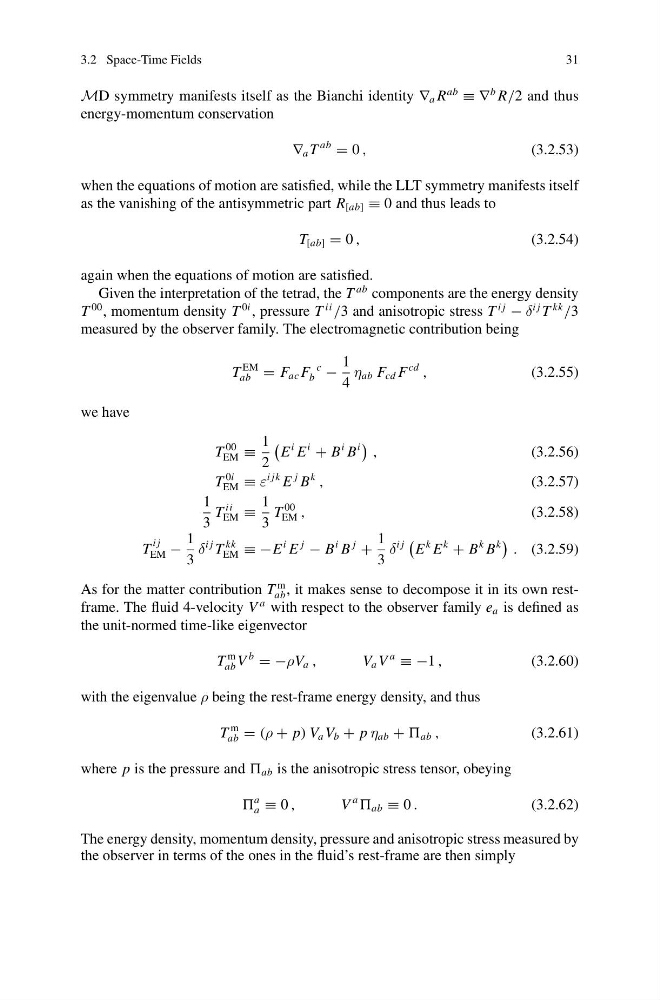
Given the interpretation of the tetrad, the T
ab components are the energy density
T
00 , momentum density T
0i , pressure T
ii
/3 and anisotropic stress T
i j
− δ
i j T
kk
/3
measured by the observer family. The electromagnetic contribution being
T
EM
ab = F ac F
c
b −
1
4
η ab F cd F
cd
,
(3.2.55)
we have
T
00
EM ≡
1
2
E
i E
i
+ B
i B
i
,
(3.2.56)
T
0i
EM ≡ ε
i jk E
j B
k
,
(3.2.57)
1
3
T
ii
EM ≡
1
3
T
00
EM ,
(3.2.58)
T
i j
EM −
1
3
δ
i j T
kk
EM ≡ −E
i E
j
− B
i B
j
+
1
3
δ
i j
E
k E
k
+ B
k B
k
. (3.2.59)
As for the matter contribution T
m
ab , it makes sense to decompose it in its own restframe. The fluid 4-velocity V
a with respect to the observer family e a is defined as
the unit-normed time-like eigenvector
T
m
ab V
b
= −ρV a ,
V a V
a
≡ −1 ,
(3.2.60)
with the eigenvalue ρ being the rest-frame energy density, and thus
T
m
ab = (ρ + p) V a V b + p η ab + ab ,
(3.2.61)
where p is the pressure and ab is the anisotropic stress tensor, obeying
a
a ≡ 0 ,
V
a
ab ≡ 0 .
(3.2.62)
The energy density, momentum density, pressure and anisotropic stress measured by
the observer in terms of the ones in the fluid’s rest-frame are then simply
31
MD symmetry manifests itself as the Bianchi identity ∇ a R
ab
≡ ∇
b R/2 and thus
energy-momentum conservation
∇ a T
ab
= 0 ,
(3.2.53)
when the equations of motion are satisfied, while the LLT symmetry manifests itself
as the vanishing of the antisymmetric part R [ab] ≡ 0 and thus leads to
T [ab] = 0 ,
(3.2.54)
again when the equations of motion are satisfied.
Given the interpretation of the tetrad, the T
ab components are the energy density
T
00 , momentum density T
0i , pressure T
ii
/3 and anisotropic stress T
i j
− δ
i j T
kk
/3
measured by the observer family. The electromagnetic contribution being
T
EM
ab = F ac F
c
b −
1
4
η ab F cd F
cd
,
(3.2.55)
we have
T
00
EM ≡
1
2
E
i E
i
+ B
i B
i
,
(3.2.56)
T
0i
EM ≡ ε
i jk E
j B
k
,
(3.2.57)
1
3
T
ii
EM ≡
1
3
T
00
EM ,
(3.2.58)
T
i j
EM −
1
3
δ
i j T
kk
EM ≡ −E
i E
j
− B
i B
j
+
1
3
δ
i j
E
k E
k
+ B
k B
k
. (3.2.59)
As for the matter contribution T
m
ab , it makes sense to decompose it in its own restframe. The fluid 4-velocity V
a with respect to the observer family e a is defined as
the unit-normed time-like eigenvector
T
m
ab V
b
= −ρV a ,
V a V
a
≡ −1 ,
(3.2.60)
with the eigenvalue ρ being the rest-frame energy density, and thus
T
m
ab = (ρ + p) V a V b + p η ab + ab ,
(3.2.61)
where p is the pressure and ab is the anisotropic stress tensor, obeying
a
a ≡ 0 ,
V
a
ab ≡ 0 .
(3.2.62)
The energy density, momentum density, pressure and anisotropic stress measured by
the observer in terms of the ones in the fluid’s rest-frame are then simply