

30
3 Mathematical Framework
where
S EH =
1
16πG
d
4 x e
e
μ
a e
ν
b R
ab
μν − 2
,
(3.2.46)
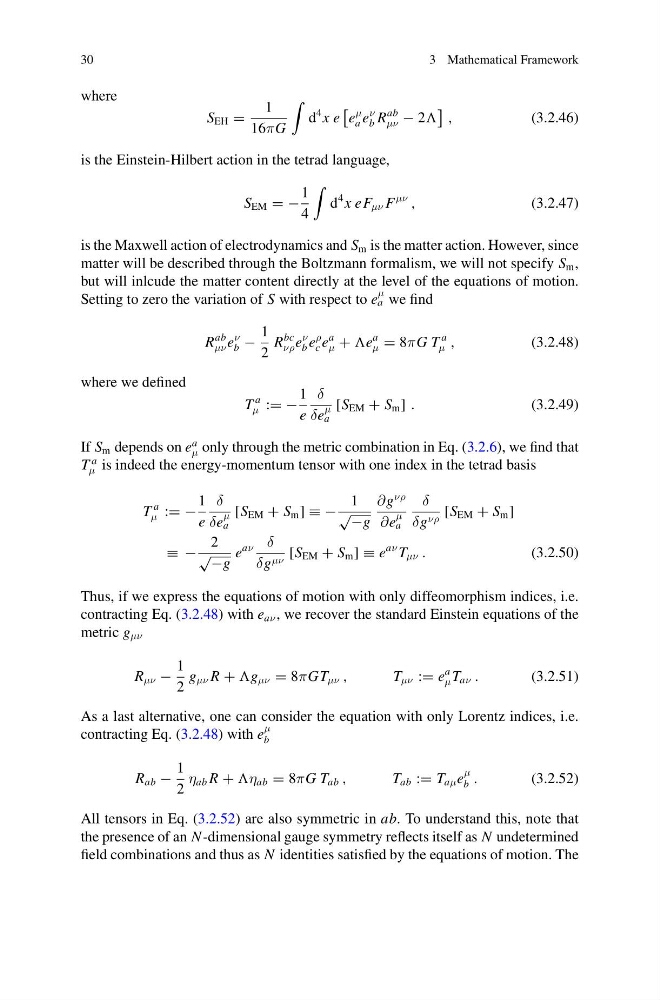
is the Einstein-Hilbert action in the tetrad language,
S EM = −
1
4
d
4 x eF μν F
μν
,
(3.2.47)
is the Maxwell action of electrodynamics and S m is the matter action. However, since
matter will be described through the Boltzmann formalism, we will not specify S m ,
but will inlcude the matter content directly at the level of the equations of motion.
Setting to zero the variation of S with respect to e
μ
a we find
R
ab
μν e
ν
b −
1
2
R
bc
νρ e
ν
b e
ρ
c e
a
μ + e
a
μ = 8πG T
a
μ ,
(3.2.48)
where we defined
T
a
μ := −
1
e
δ
δe
μ
a
[S EM + S m ] .
(3.2.49)
If S m depends on e
a
μ only through the metric combination in Eq. (3.2.6), we find that
T
a
μ is indeed the energy-momentum tensor with one index in the tetrad basis
T
a
μ := −
1
e
δ
δe
μ
a
[S EM + S m ] ≡ −
1
√
−g
∂g
νρ
∂e
μ
a
δ
δg νρ [S EM + S m ]
≡ −
2
√
−g
e
aν δ
δg μν [S EM + S m ] ≡ e
aν T μν .
(3.2.50)
Thus, if we express the equations of motion with only diffeomorphism indices, i.e.
contracting Eq. (3.2.48) with e aν , we recover the standard Einstein equations of the
metric g μν
R μν −
1
2
g μν R + g μν = 8πGT μν ,
T μν := e
a
μ T aν .
(3.2.51)
As a last alternative, one can consider the equation with only Lorentz indices, i.e.
contracting Eq. (3.2.48) with e
μ
b
R ab −
1
2
η ab R + η ab = 8πG T ab ,
T ab := T aμ e
μ
b .
(3.2.52)
All tensors in Eq. (3.2.52) are also symmetric in ab. To understand this, note that
the presence of an N -dimensional gauge symmetry reflects itself as N undetermined
field combinations and thus as N identities satisfied by the equations of motion. The
3 Mathematical Framework
where
S EH =
1
16πG
d
4 x e
e
μ
a e
ν
b R
ab
μν − 2
,
(3.2.46)
is the Einstein-Hilbert action in the tetrad language,
S EM = −
1
4
d
4 x eF μν F
μν
,
(3.2.47)
is the Maxwell action of electrodynamics and S m is the matter action. However, since
matter will be described through the Boltzmann formalism, we will not specify S m ,
but will inlcude the matter content directly at the level of the equations of motion.
Setting to zero the variation of S with respect to e
μ
a we find
R
ab
μν e
ν
b −
1
2
R
bc
νρ e
ν
b e
ρ
c e
a
μ + e
a
μ = 8πG T
a
μ ,
(3.2.48)
where we defined
T
a
μ := −
1
e
δ
δe
μ
a
[S EM + S m ] .
(3.2.49)
If S m depends on e
a
μ only through the metric combination in Eq. (3.2.6), we find that
T
a
μ is indeed the energy-momentum tensor with one index in the tetrad basis
T
a
μ := −
1
e
δ
δe
μ
a
[S EM + S m ] ≡ −
1
√
−g
∂g
νρ
∂e
μ
a
δ
δg νρ [S EM + S m ]
≡ −
2
√
−g
e
aν δ
δg μν [S EM + S m ] ≡ e
aν T μν .
(3.2.50)
Thus, if we express the equations of motion with only diffeomorphism indices, i.e.
contracting Eq. (3.2.48) with e aν , we recover the standard Einstein equations of the
metric g μν
R μν −
1
2
g μν R + g μν = 8πGT μν ,
T μν := e
a
μ T aν .
(3.2.51)
As a last alternative, one can consider the equation with only Lorentz indices, i.e.
contracting Eq. (3.2.48) with e
μ
b
R ab −
1
2
η ab R + η ab = 8πG T ab ,
T ab := T aμ e
μ
b .
(3.2.52)
All tensors in Eq. (3.2.52) are also symmetric in ab. To understand this, note that
the presence of an N -dimensional gauge symmetry reflects itself as N undetermined
field combinations and thus as N identities satisfied by the equations of motion. The