

32
3 Mathematical Framework
T 00
m ≡ ρ
1 + V i V i
+ pV i V i + ii ,
(3.2.63)
T 0i
m ≡
(ρ + p)
1 + V k V k
δ i j + i j
V j
1 + V l V l
,
(3.2.64)
1
3
T ii
m ≡ p +
1
3
(ρ + p) V i V i + ii
,
(3.2.65)
T
i j
m −
1
3
δ i j T kk
m ≡ (ρ + p) V i V j + i j −
1
3
δ i j
(ρ + p) V k V k + kk
, (3.2.66)
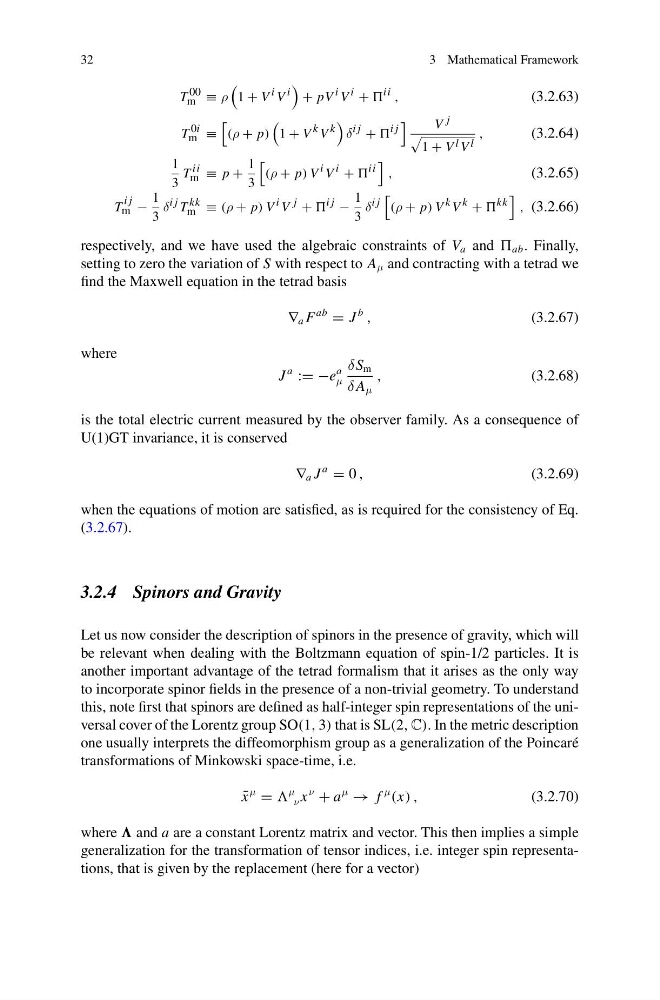
respectively, and we have used the algebraic constraints of V a and ab . Finally,
setting to zero the variation of S with respect to A μ and contracting with a tetrad we
find the Maxwell equation in the tetrad basis
∇ a F
ab
= J
b
,
(3.2.67)
where
J
a
:= −e
a
μ
δS m
δ A μ
,
(3.2.68)
is the total electric current measured by the observer family. As a consequence of
U(1)GT invariance, it is conserved
∇ a J
a
= 0 ,
(3.2.69)
when the equations of motion are satisfied, as is required for the consistency of Eq.
(3.2.67).
3.2.4 Spinors and Gravity
Let us now consider the description of spinors in the presence of gravity, which will
be relevant when dealing with the Boltzmann equation of spin-1/2 particles. It is
another important advantage of the tetrad formalism that it arises as the only way
to incorporate spinor fields in the presence of a non-trivial geometry. To understand
this, note first that spinors are defined as half-integer spin representations of the universal cover of the Lorentz group SO(1, 3) that is SL(2, C). In the metric description
one usually interprets the diffeomorphism group as a generalization of the Poincaré
transformations of Minkowski space-time, i.e.
˜
x
μ
=
μ
ν x
ν
+ a
μ
→ f
μ
(x) ,
(3.2.70)
where and a are a constant Lorentz matrix and vector. This then implies a simple
generalization for the transformation of tensor indices, i.e. integer spin representations, that is given by the replacement (here for a vector)
3 Mathematical Framework
T 00
m ≡ ρ
1 + V i V i
+ pV i V i + ii ,
(3.2.63)
T 0i
m ≡
(ρ + p)
1 + V k V k
δ i j + i j
V j
1 + V l V l
,
(3.2.64)
1
3
T ii
m ≡ p +
1
3
(ρ + p) V i V i + ii
,
(3.2.65)
T
i j
m −
1
3
δ i j T kk
m ≡ (ρ + p) V i V j + i j −
1
3
δ i j
(ρ + p) V k V k + kk
, (3.2.66)
respectively, and we have used the algebraic constraints of V a and ab . Finally,
setting to zero the variation of S with respect to A μ and contracting with a tetrad we
find the Maxwell equation in the tetrad basis
∇ a F
ab
= J
b
,
(3.2.67)
where
J
a
:= −e
a
μ
δS m
δ A μ
,
(3.2.68)
is the total electric current measured by the observer family. As a consequence of
U(1)GT invariance, it is conserved
∇ a J
a
= 0 ,
(3.2.69)
when the equations of motion are satisfied, as is required for the consistency of Eq.
(3.2.67).
3.2.4 Spinors and Gravity
Let us now consider the description of spinors in the presence of gravity, which will
be relevant when dealing with the Boltzmann equation of spin-1/2 particles. It is
another important advantage of the tetrad formalism that it arises as the only way
to incorporate spinor fields in the presence of a non-trivial geometry. To understand
this, note first that spinors are defined as half-integer spin representations of the universal cover of the Lorentz group SO(1, 3) that is SL(2, C). In the metric description
one usually interprets the diffeomorphism group as a generalization of the Poincaré
transformations of Minkowski space-time, i.e.
˜
x
μ
=
μ
ν x
ν
+ a
μ
→ f
μ
(x) ,
(3.2.70)
where and a are a constant Lorentz matrix and vector. This then implies a simple
generalization for the transformation of tensor indices, i.e. integer spin representations, that is given by the replacement (here for a vector)