

112
5 General-Relativistic Matrix Kinetic Theory
affects the n A component and that the physical observables are independent of that
quantity. On the other hand, the internal rotation (5.8.11) does not lead to a gauge
transformation for A a (X ), because the corresponding field strength
F ab :=
∂ A b
∂ X a −
∂ A a
∂ X b ,
(5.8.13)
is not invariant, but gets rotated. The transformed gauge field is still a plane wave
solution, but a physically distinct one, so the physical observables will generically
not be invariant under (5.8.11), but rather covariant. In the case of the Sachs basis
too, the Sachs rotations change the angular basis on the observer sky, which is why
we had to fix this freedom in order to match the basis the observer really uses.
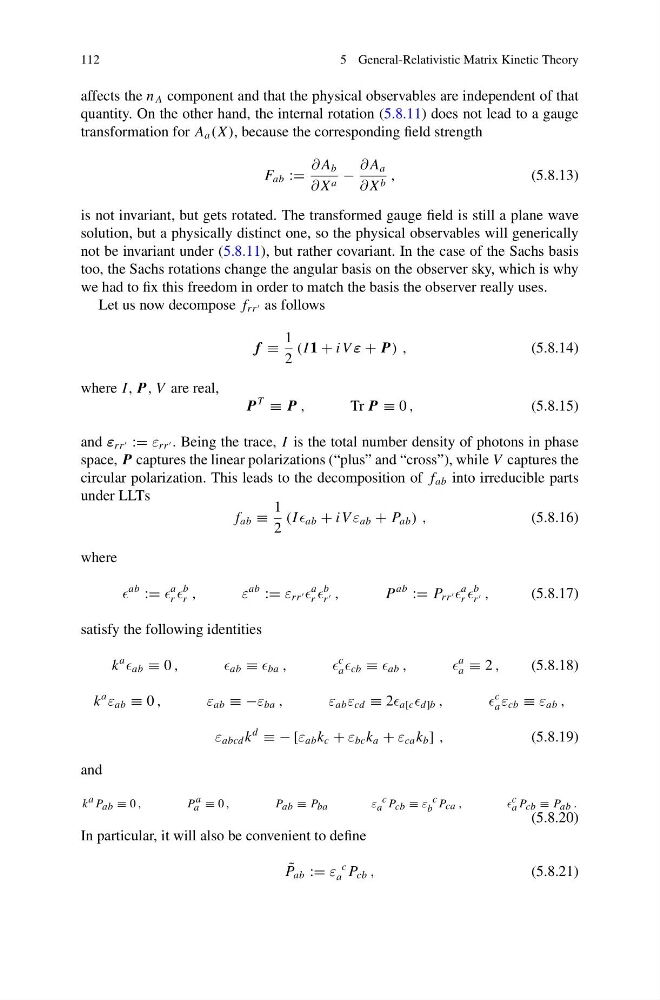
Let us now decompose f rr as follows
f ≡
1
2
(I 1 + i V ε + P) ,
(5.8.14)
where I, P, V are real,
P
T
≡ P ,
Tr P ≡ 0 ,
(5.8.15)
and ε rr := ε rr . Being the trace, I is the total number density of photons in phase
space, P captures the linear polarizations (“plus” and “cross”), while V captures the
circular polarization. This leads to the decomposition of f ab into irreducible parts
under LLTs
f ab ≡
1
2
(I ab + i V ε ab + P ab ) ,
(5.8.16)
where
ab
:=
a
r
b
r ,
ε
ab
:= ε rr
a
r
b
r ,
P
ab
:= P rr
a
r
b
r ,
(5.8.17)
satisfy the following identities
k
a
ab ≡ 0 ,
ab ≡ ba ,
c
a cb ≡ ab ,
a
a ≡ 2 ,
(5.8.18)
k
a
ε ab ≡ 0 ,
ε ab ≡ −ε ba ,
ε ab ε cd ≡ 2 a[c d]b ,
c
a ε cb ≡ ε ab ,
ε abcd k
d
≡ − [ε ab k c + ε bc k a + ε ca k b ] ,
(5.8.19)
and
k a P ab ≡ 0 ,
P a
a ≡ 0 ,
P ab ≡ P ba
ε c
a P cb ≡ ε c
b P ca ,
c
a P cb ≡ P ab .
(5.8.20)
In particular, it will also be convenient to define
˜
P ab := ε
c
a P cb ,
(5.8.21)
5 General-Relativistic Matrix Kinetic Theory
affects the n A component and that the physical observables are independent of that
quantity. On the other hand, the internal rotation (5.8.11) does not lead to a gauge
transformation for A a (X ), because the corresponding field strength
F ab :=
∂ A b
∂ X a −
∂ A a
∂ X b ,
(5.8.13)
is not invariant, but gets rotated. The transformed gauge field is still a plane wave
solution, but a physically distinct one, so the physical observables will generically
not be invariant under (5.8.11), but rather covariant. In the case of the Sachs basis
too, the Sachs rotations change the angular basis on the observer sky, which is why
we had to fix this freedom in order to match the basis the observer really uses.
Let us now decompose f rr as follows
f ≡
1
2
(I 1 + i V ε + P) ,
(5.8.14)
where I, P, V are real,
P
T
≡ P ,
Tr P ≡ 0 ,
(5.8.15)
and ε rr := ε rr . Being the trace, I is the total number density of photons in phase
space, P captures the linear polarizations (“plus” and “cross”), while V captures the
circular polarization. This leads to the decomposition of f ab into irreducible parts
under LLTs
f ab ≡
1
2
(I ab + i V ε ab + P ab ) ,
(5.8.16)
where
ab
:=
a
r
b
r ,
ε
ab
:= ε rr
a
r
b
r ,
P
ab
:= P rr
a
r
b
r ,
(5.8.17)
satisfy the following identities
k
a
ab ≡ 0 ,
ab ≡ ba ,
c
a cb ≡ ab ,
a
a ≡ 2 ,
(5.8.18)
k
a
ε ab ≡ 0 ,
ε ab ≡ −ε ba ,
ε ab ε cd ≡ 2 a[c d]b ,
c
a ε cb ≡ ε ab ,
ε abcd k
d
≡ − [ε ab k c + ε bc k a + ε ca k b ] ,
(5.8.19)
and
k a P ab ≡ 0 ,
P a
a ≡ 0 ,
P ab ≡ P ba
ε c
a P cb ≡ ε c
b P ca ,
c
a P cb ≡ P ab .
(5.8.20)
In particular, it will also be convenient to define
˜
P ab := ε
c
a P cb ,
(5.8.21)