

5.8 Liouville-Transported Wave-Functions and Tensor Distributions
111
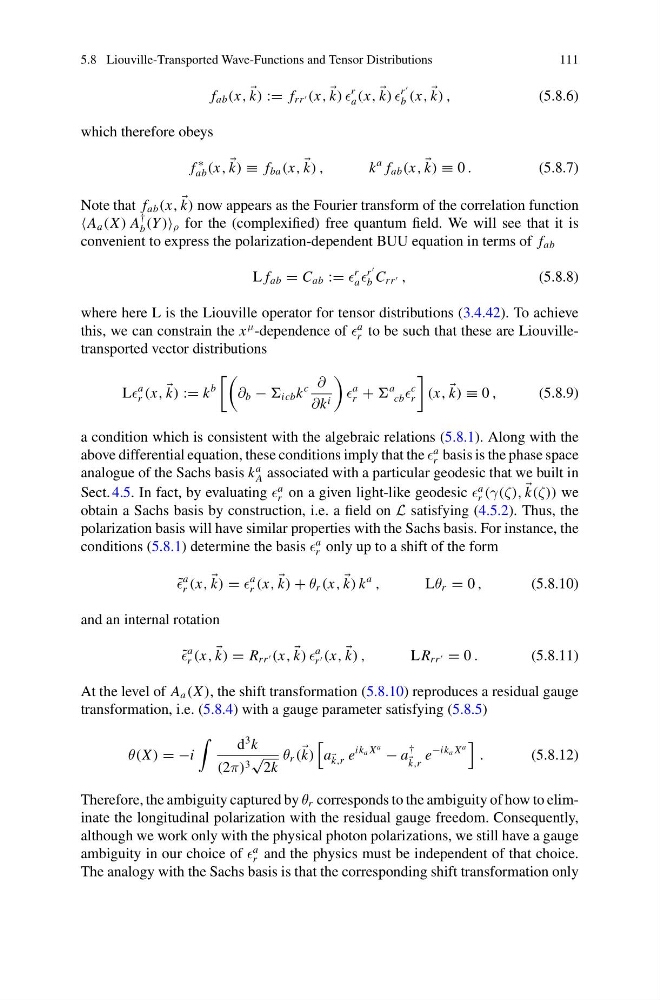
f ab (x,
k) := f rr (x,
k)
r
a (x,
k)
r
b (x,
k) ,
(5.8.6)
which therefore obeys
f
∗
ab (x,
k) ≡ f ba (x,
k) ,
k
a f ab (x,
k) ≡ 0 .
(5.8.7)
Note that f ab (x,
k) now appears as the Fourier transform of the correlation function
A a (X ) A
†
b (Y ) ρ for the (complexified) free quantum field. We will see that it is
convenient to express the polarization-dependent BUU equation in terms of f ab
L f ab = C ab :=
r
a
r
b C rr ,
(5.8.8)
where here L is the Liouville operator for tensor distributions (3.4.42). To achieve
this, we can constrain the x
μ -dependence of
a
r to be such that these are Liouvilletransported vector distributions
L
a
r (x,
k) := k
b
∂ b − icb k
c ∂
∂k i
a
r +
a
cb
c
r
(x,
k) ≡ 0 ,
(5.8.9)
a condition which is consistent with the algebraic relations (5.8.1). Along with the
above differential equation, these conditions imply that the
a
r basis is the phase space
analogue of the Sachs basis k
a
A associated with a particular geodesic that we built in
Sect. 4.5. In fact, by evaluating
a
r on a given light-like geodesic
a
r (γ(ζ),
k(ζ)) we
obtain a Sachs basis by construction, i.e. a field on L satisfying (4.5.2). Thus, the
polarization basis will have similar properties with the Sachs basis. For instance, the
conditions (5.8.1) determine the basis
a
r only up to a shift of the form
˜
a
r (x,
k) =
a
r (x,
k) + θ r (x,
k) k
a
,
Lθ r = 0 ,
(5.8.10)
and an internal rotation
˜
a
r (x,
k) = R rr (x,
k)
a
r (x,
k) ,
LR rr = 0 .
(5.8.11)
At the level of A a (X ), the shift transformation (5.8.10) reproduces a residual gauge
transformation, i.e. (5.8.4) with a gauge parameter satisfying (5.8.5)
θ(X ) = −i
d
3 k
(2π) 3
√
2k
θ r (
k)
a
k,r e
ik a X
a − a
†
k,r
e
−ik a X
a
.
(5.8.12)
Therefore, the ambiguity captured by θ r corresponds to the ambiguity of how to eliminate the longitudinal polarization with the residual gauge freedom. Consequently,
although we work only with the physical photon polarizations, we still have a gauge
ambiguity in our choice of
a
r and the physics must be independent of that choice.
The analogy with the Sachs basis is that the corresponding shift transformation only
111
f ab (x,
k) := f rr (x,
k)
r
a (x,
k)
r
b (x,
k) ,
(5.8.6)
which therefore obeys
f
∗
ab (x,
k) ≡ f ba (x,
k) ,
k
a f ab (x,
k) ≡ 0 .
(5.8.7)
Note that f ab (x,
k) now appears as the Fourier transform of the correlation function
A a (X ) A
†
b (Y ) ρ for the (complexified) free quantum field. We will see that it is
convenient to express the polarization-dependent BUU equation in terms of f ab
L f ab = C ab :=
r
a
r
b C rr ,
(5.8.8)
where here L is the Liouville operator for tensor distributions (3.4.42). To achieve
this, we can constrain the x
μ -dependence of
a
r to be such that these are Liouvilletransported vector distributions
L
a
r (x,
k) := k
b
∂ b − icb k
c ∂
∂k i
a
r +
a
cb
c
r
(x,
k) ≡ 0 ,
(5.8.9)
a condition which is consistent with the algebraic relations (5.8.1). Along with the
above differential equation, these conditions imply that the
a
r basis is the phase space
analogue of the Sachs basis k
a
A associated with a particular geodesic that we built in
Sect. 4.5. In fact, by evaluating
a
r on a given light-like geodesic
a
r (γ(ζ),
k(ζ)) we
obtain a Sachs basis by construction, i.e. a field on L satisfying (4.5.2). Thus, the
polarization basis will have similar properties with the Sachs basis. For instance, the
conditions (5.8.1) determine the basis
a
r only up to a shift of the form
˜
a
r (x,
k) =
a
r (x,
k) + θ r (x,
k) k
a
,
Lθ r = 0 ,
(5.8.10)
and an internal rotation
˜
a
r (x,
k) = R rr (x,
k)
a
r (x,
k) ,
LR rr = 0 .
(5.8.11)
At the level of A a (X ), the shift transformation (5.8.10) reproduces a residual gauge
transformation, i.e. (5.8.4) with a gauge parameter satisfying (5.8.5)
θ(X ) = −i
d
3 k
(2π) 3
√
2k
θ r (
k)
a
k,r e
ik a X
a − a
†
k,r
e
−ik a X
a
.
(5.8.12)
Therefore, the ambiguity captured by θ r corresponds to the ambiguity of how to eliminate the longitudinal polarization with the residual gauge freedom. Consequently,
although we work only with the physical photon polarizations, we still have a gauge
ambiguity in our choice of
a
r and the physics must be independent of that choice.
The analogy with the Sachs basis is that the corresponding shift transformation only