

5.5 The Collision Term
105
Here we have used the fact that f ss ≡ 0 if m s = m s and the distributional identity
(δ
(4)
( p))
2
≡ δ
(4)
(0)δ
(4)
( p) ,
δ
(4)
( p = 0) ≡
V T
(2π) 4 ,
(5.5.20)
which is how the singular V T in the denominator is canceled, just as in the textbook
computation of cross-sections and decay rates in QFT. In Appendix 6.3 we show that
the contraction pattern of discrete indices in Eqs. (5.5.18) and (5.5.19) allows for a
compact formulation in terms of generalized matrix products.
Let us now consider the nature of the F
± terms more closely. By definition, the
involved amplitudes contain at least one particle whose momentum is unaffected by
the collision, so these are partially forward scattering processes. We must distinguish
two cases: either
p is among the unaffected momenta, or it is not. In the former case,
a close inspection of the equations, along with the use of f ss ≡ 0 when |s| = |s
|
and m s = m s , shows that any such term appearing in C
+ is canceled by a term
in C
− , and vice-versa. This can be understood intuitively by the fact that, if the
p particle scatters forward, then there is no difference between the “creation” and
“annihilation” processes. As for the ones in which the
p particle is affected, they
can only enter as higher-order corrections to the proper ones. Indeed, to every proper
process m → n, there corresponds an infinite tower of processes involving m + k →
n + k amplitudes, where the k extra dummy particles have the same initial and final
momenta. These are therefore of higher order in the coupling constants of the QFT
and can be neglected to a first approximation.
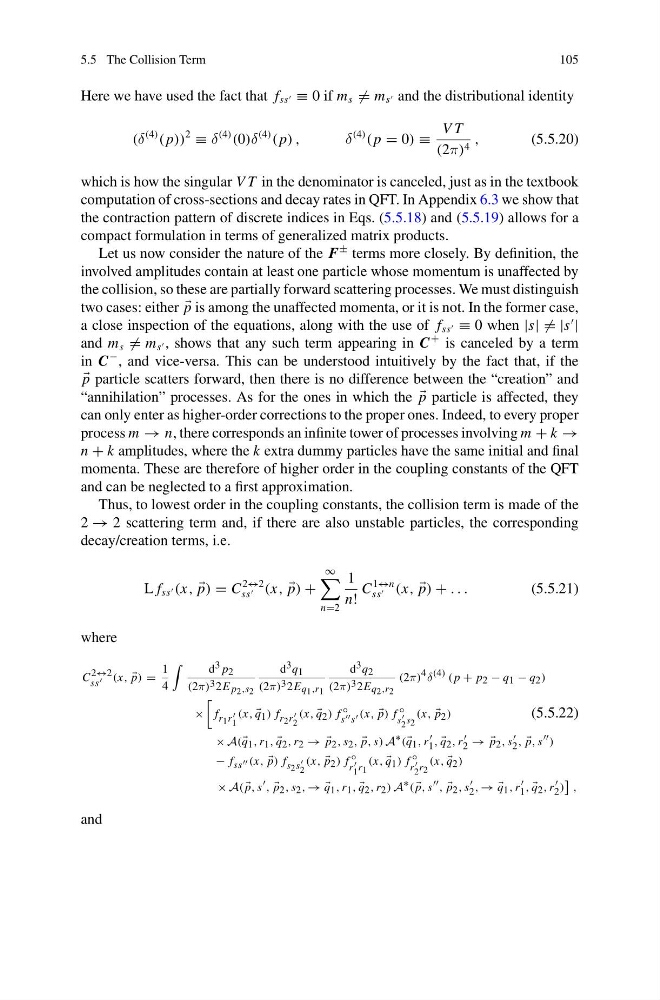
Thus, to lowest order in the coupling constants, the collision term is made of the
2 → 2 scattering term and, if there are also unstable particles, the corresponding
decay/creation terms, i.e.
L f ss (x,
p) = C
2↔2
ss (x,
p) +
∞
n=2
1
n!
C
1↔n
ss (x,
p) + . . .
(5.5.21)
where
C 2↔2
ss (x,
p) =
1
4
d 3 p 2
(2π) 3 2E p 2 ,s 2
d 3 q 1
(2π) 3 2E q 1 ,r 1
d 3 q 2
(2π) 3 2E q 2 ,r 2
(2π) 4 δ (4) ( p + p 2 − q 1 − q 2 )
×
f r 1 r
1
(x,
q 1 ) f r 2 r
2
(x,
q 2 ) f ◦
s s (x,
p) f ◦
s
2 s 2
(x,
p 2 )
(5.5.22)
× A( q 1 , r 1 ,
q 2 , r 2 → →
p 2 , s 2 ,
p, s) A ∗ ( q 1 , r
1 ,
q 2 , r
2 → →
p 2 , s
2 ,
p, s )
− f ss (x,
p) f s 2 s
2
(x,
p 2 ) f ◦
r
1 r 1
(x,
q 1 ) f ◦
r
2 r 2
(x,
q 2 )
× A(
p, s ,
p 2 , s 2 , → →
q 1 , r 1 ,
q 2 , r 2 ) A ∗ (
p, s ,
p 2 , s
2 , → →
q 1 , r
1 ,
q 2 , r
2 )
,
and
105
Here we have used the fact that f ss ≡ 0 if m s = m s and the distributional identity
(δ
(4)
( p))
2
≡ δ
(4)
(0)δ
(4)
( p) ,
δ
(4)
( p = 0) ≡
V T
(2π) 4 ,
(5.5.20)
which is how the singular V T in the denominator is canceled, just as in the textbook
computation of cross-sections and decay rates in QFT. In Appendix 6.3 we show that
the contraction pattern of discrete indices in Eqs. (5.5.18) and (5.5.19) allows for a
compact formulation in terms of generalized matrix products.
Let us now consider the nature of the F
± terms more closely. By definition, the
involved amplitudes contain at least one particle whose momentum is unaffected by
the collision, so these are partially forward scattering processes. We must distinguish
two cases: either
p is among the unaffected momenta, or it is not. In the former case,
a close inspection of the equations, along with the use of f ss ≡ 0 when |s| = |s
|
and m s = m s , shows that any such term appearing in C
+ is canceled by a term
in C
− , and vice-versa. This can be understood intuitively by the fact that, if the
p particle scatters forward, then there is no difference between the “creation” and
“annihilation” processes. As for the ones in which the
p particle is affected, they
can only enter as higher-order corrections to the proper ones. Indeed, to every proper
process m → n, there corresponds an infinite tower of processes involving m + k →
n + k amplitudes, where the k extra dummy particles have the same initial and final
momenta. These are therefore of higher order in the coupling constants of the QFT
and can be neglected to a first approximation.
Thus, to lowest order in the coupling constants, the collision term is made of the
2 → 2 scattering term and, if there are also unstable particles, the corresponding
decay/creation terms, i.e.
L f ss (x,
p) = C
2↔2
ss (x,
p) +
∞
n=2
1
n!
C
1↔n
ss (x,
p) + . . .
(5.5.21)
where
C 2↔2
ss (x,
p) =
1
4
d 3 p 2
(2π) 3 2E p 2 ,s 2
d 3 q 1
(2π) 3 2E q 1 ,r 1
d 3 q 2
(2π) 3 2E q 2 ,r 2
(2π) 4 δ (4) ( p + p 2 − q 1 − q 2 )
×
f r 1 r
1
(x,
q 1 ) f r 2 r
2
(x,
q 2 ) f ◦
s s (x,
p) f ◦
s
2 s 2
(x,
p 2 )
(5.5.22)
× A( q 1 , r 1 ,
q 2 , r 2 → →
p 2 , s 2 ,
p, s) A ∗ ( q 1 , r
1 ,
q 2 , r
2 → →
p 2 , s
2 ,
p, s )
− f ss (x,
p) f s 2 s
2
(x,
p 2 ) f ◦
r
1 r 1
(x,
q 1 ) f ◦
r
2 r 2
(x,
q 2 )
× A(
p, s ,
p 2 , s 2 , → →
q 1 , r 1 ,
q 2 , r 2 ) A ∗ (
p, s ,
p 2 , s
2 , → →
q 1 , r
1 ,
q 2 , r
2 )
,
and