

104
5 General-Relativistic Matrix Kinetic Theory
p k ≡ (E pk ,sk ,
p k ) ,
p
k ≡ (E p
k ,s
k
,
p
k ) ,
q k ≡ (E qk ,rk ,
q k ) ,
q
k ≡ (E q
k ,r
k
,
q
k ) ,
(5.5.17)
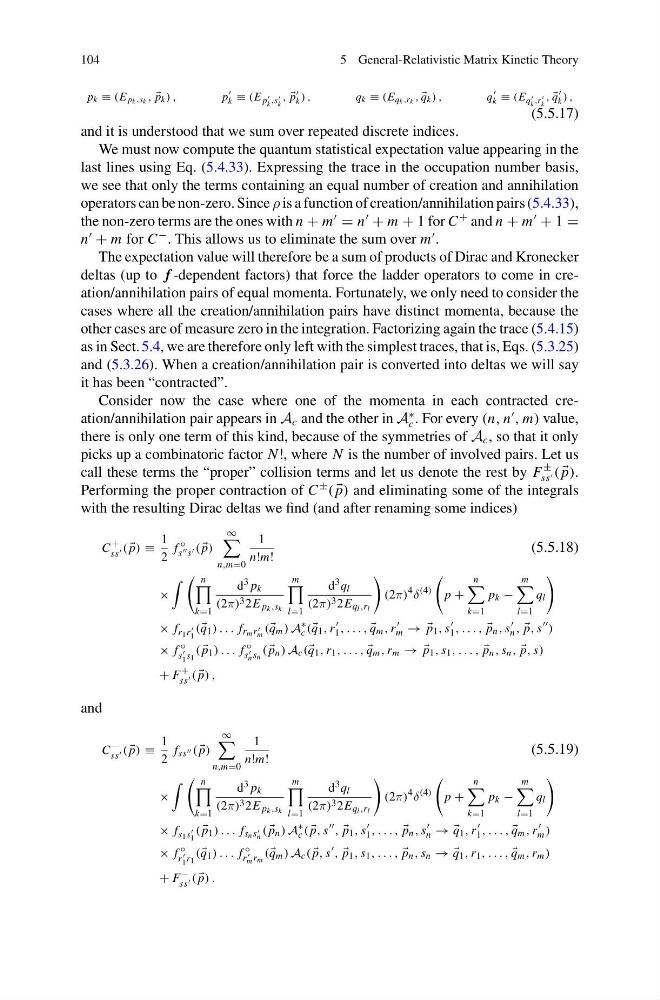
and it is understood that we sum over repeated discrete indices.
We must now compute the quantum statistical expectation value appearing in the
last lines using Eq. (5.4.33). Expressing the trace in the occupation number basis,
we see that only the terms containing an equal number of creation and annihilation
operators can be non-zero. Since ρ is a function of creation/annihilation pairs (5.4.33),
the non-zero terms are the ones with n + m
= n
+ m + 1 for C
+ and n + m
+ 1 =
n
+ m for C
− . This allows us to eliminate the sum over m
.
The expectation value will therefore be a sum of products of Dirac and Kronecker
deltas (up to f -dependent factors) that force the ladder operators to come in creation/annihilation pairs of equal momenta. Fortunately, we only need to consider the
cases where all the creation/annihilation pairs have distinct momenta, because the
other cases are of measure zero in the integration. Factorizing again the trace (5.4.15)
as in Sect. 5.4, we are therefore only left with the simplest traces, that is, Eqs. (5.3.25)
and (5.3.26). When a creation/annihilation pair is converted into deltas we will say
it has been “contracted”.
Consider now the case where one of the momenta in each contracted creation/annihilation pair appears in A c and the other in A
∗
c . For every (n, n
, m) value,
there is only one term of this kind, because of the symmetries of A c , so that it only
picks up a combinatoric factor N !, where N is the number of involved pairs. Let us
call these terms the “proper” collision terms and let us denote the rest by F
±
ss (
p).
Performing the proper contraction of C
±
(
p) and eliminating some of the integrals
with the resulting Dirac deltas we find (and after renaming some indices)
C
+
ss (
p) ≡
1
2
f
◦
s s (
p)
∞
n,m=0
1
n!m!
(5.5.18)
×
n
k=1
d 3 p k
(2π) 3 2E p k ,s k
m
l=1
d 3 q l
(2π) 3 2E q l ,r l
(2π)
4 δ
(4)
p +
n
k=1
p k −
m
l=1
q l
× f r1r
1
( q 1 ) . . . f rm r
m
( q m ) A
∗
c ( q 1 , r
1 , . . . ,
q m , r
m → →
p 1 , s
1 , . . . ,
p n , s
n ,
p, s
)
× f
◦
s
1 s1 (
p 1 ) . . . f
◦
s
n sn (
p n ) A c ( q 1 , r 1 , . . . ,
q m , r m → →
p 1 , s 1 , . . . ,
p n , s n ,
p, s)
+ F
+
ss (
p) ,
and
C
−
ss (
p) ≡
1
2
f ss (
p)
∞
n,m=0
1
n!m!
(5.5.19)
×
n
k=1
d 3 p k
(2π) 3 2E p k ,s k
m
l=1
d 3 q l
(2π) 3 2E q l ,r l
(2π)
4 δ
(4)
p +
n
k=1
p k −
m
l=1
q l
× f s1s
1
(
p 1 ) . . . f sn s
n
(
p n ) A
∗
c (
p, s
,
p 1 , s
1 , . . . ,
p n , s
n → →
q 1 , r
1 , . . . ,
q m , r
m )
× f
◦
r
1 r1 ( q 1 ) . . . f
◦
r
m rm ( q m ) A c (
p, s
,
p 1 , s 1 , . . . ,
p n , s n → →
q 1 , r 1 , . . . ,
q m , r m )
+ F
−
ss (
p) .
5 General-Relativistic Matrix Kinetic Theory
p k ≡ (E pk ,sk ,
p k ) ,
p
k ≡ (E p
k ,s
k
,
p
k ) ,
q k ≡ (E qk ,rk ,
q k ) ,
q
k ≡ (E q
k ,r
k
,
q
k ) ,
(5.5.17)
and it is understood that we sum over repeated discrete indices.
We must now compute the quantum statistical expectation value appearing in the
last lines using Eq. (5.4.33). Expressing the trace in the occupation number basis,
we see that only the terms containing an equal number of creation and annihilation
operators can be non-zero. Since ρ is a function of creation/annihilation pairs (5.4.33),
the non-zero terms are the ones with n + m
= n
+ m + 1 for C
+ and n + m
+ 1 =
n
+ m for C
− . This allows us to eliminate the sum over m
.
The expectation value will therefore be a sum of products of Dirac and Kronecker
deltas (up to f -dependent factors) that force the ladder operators to come in creation/annihilation pairs of equal momenta. Fortunately, we only need to consider the
cases where all the creation/annihilation pairs have distinct momenta, because the
other cases are of measure zero in the integration. Factorizing again the trace (5.4.15)
as in Sect. 5.4, we are therefore only left with the simplest traces, that is, Eqs. (5.3.25)
and (5.3.26). When a creation/annihilation pair is converted into deltas we will say
it has been “contracted”.
Consider now the case where one of the momenta in each contracted creation/annihilation pair appears in A c and the other in A
∗
c . For every (n, n
, m) value,
there is only one term of this kind, because of the symmetries of A c , so that it only
picks up a combinatoric factor N !, where N is the number of involved pairs. Let us
call these terms the “proper” collision terms and let us denote the rest by F
±
ss (
p).
Performing the proper contraction of C
±
(
p) and eliminating some of the integrals
with the resulting Dirac deltas we find (and after renaming some indices)
C
+
ss (
p) ≡
1
2
f
◦
s s (
p)
∞
n,m=0
1
n!m!
(5.5.18)
×
n
k=1
d 3 p k
(2π) 3 2E p k ,s k
m
l=1
d 3 q l
(2π) 3 2E q l ,r l
(2π)
4 δ
(4)
p +
n
k=1
p k −
m
l=1
q l
× f r1r
1
( q 1 ) . . . f rm r
m
( q m ) A
∗
c ( q 1 , r
1 , . . . ,
q m , r
m → →
p 1 , s
1 , . . . ,
p n , s
n ,
p, s
)
× f
◦
s
1 s1 (
p 1 ) . . . f
◦
s
n sn (
p n ) A c ( q 1 , r 1 , . . . ,
q m , r m → →
p 1 , s 1 , . . . ,
p n , s n ,
p, s)
+ F
+
ss (
p) ,
and
C
−
ss (
p) ≡
1
2
f ss (
p)
∞
n,m=0
1
n!m!
(5.5.19)
×
n
k=1
d 3 p k
(2π) 3 2E p k ,s k
m
l=1
d 3 q l
(2π) 3 2E q l ,r l
(2π)
4 δ
(4)
p +
n
k=1
p k −
m
l=1
q l
× f s1s
1
(
p 1 ) . . . f sn s
n
(
p n ) A
∗
c (
p, s
,
p 1 , s
1 , . . . ,
p n , s
n → →
q 1 , r
1 , . . . ,
q m , r
m )
× f
◦
r
1 r1 ( q 1 ) . . . f
◦
r
m rm ( q m ) A c (
p, s
,
p 1 , s 1 , . . . ,
p n , s n → →
q 1 , r 1 , . . . ,
q m , r m )
+ F
−
ss (
p) .