

3.4 Homogeneous Catalysts for the Production of Methanol …
63
3.4.1 Transformation of Methane into Methanol Derivatives
via Methyl Radicals
The methyl radical intermediate is known to play a key role in some methane conversion reactions to methanol. Furthermore, radical processes have also been reported to
accomplish the oxidation of methane to methanol derivatives under mild conditions,
especially at relatively moderate temperatures (<473 K).
The EnCl 3 -Zn-trifluoroacetic acid-catalytic system has been reported for the oxidation of methane with molecular oxygen and the subsequent methyl esterification
mediated by trifluoroacetic acid (CF 3 COOCH 3 ) [66, 67]. The oxidation by this catalytic system proceeded at 313 K, and a TON of 5.3 was achieved for the production
of CF 3 COOCH 3 , and that for carbon dioxide was about 25 after 1 h of reaction.
According to the selectivities obtained during the oxidations of several alkanes, the
production of methyl radical intermediates during the oxidation of methane was proposed. Furthermore, the generation of the active oxygen species from the divalent
europium and superoxide was suggested by electrochemical studies. Based on these
experiments, in the catalytic system, En
3+ is reduced to En
2+ by Zn
0 , followed by the
reaction with an oxygen molecule to generate active oxygen species on europium.
Then, the active oxygen species oxidize methane to methanol and trifluoroacetic
acid to carbon dioxide. The TON of the catalytic reaction could be enhanced to 10
in 1 h reaction with the use of Ti(IV) oxide or Ti(IV) oxyacetylacetonate [68]. This
enhancement was considered to originate from the electron transfer between Eu
3+ and
Zn
0 by Ti
4+ , which enhances the generation of active oxygen species on europium.
In the V-containing heteropolyacid system H 5 PV 2 Mo 10 O 40 /K 2 S 2 O 8 /TFAA and
TFA, methane was converted into methyl trifluoroacetate in 95% yield at 353 K [69].
A possible mechanism for this reaction involves the generation of •CH 3 through the
abstraction of H from methane by V(V)=O, followed by oxidation of the methyl
radical to a methyl cation and the formation of the methyl ester. However, the use
of expensive K 2 S 2 O 8 and the corrosive nature of CF 3 CO 2 H are not acceptable for
industrial applications.
3.4.2 Electrophilic Methane Activation and Transformation
to Methanol Derivatives
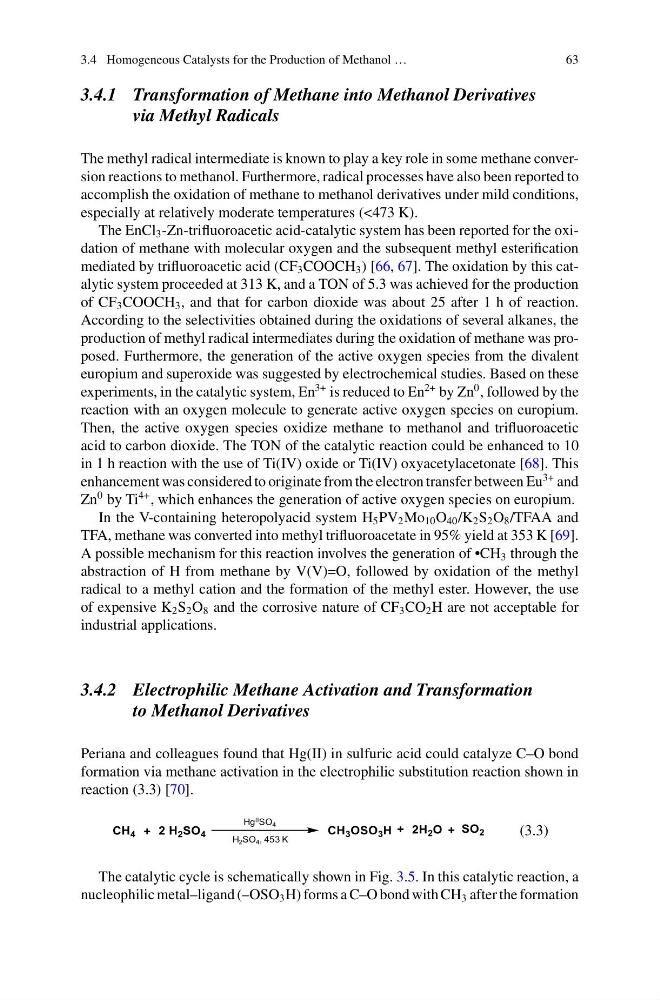
Periana and colleagues found that Hg(II) in sulfuric acid could catalyze C–O bond
formation via methane activation in the electrophilic substitution reaction shown in
reaction (3.3) [70].
(3.3)
Hg II SO 4
H 2 SO 4 , 453 K
The catalytic cycle is schematically shown in Fig. 3.5. In this catalytic reaction, a
nucleophilic metal–ligand (–OSO 3 H) forms a C–O bond with CH 3 after the formation
63
3.4.1 Transformation of Methane into Methanol Derivatives
via Methyl Radicals
The methyl radical intermediate is known to play a key role in some methane conversion reactions to methanol. Furthermore, radical processes have also been reported to
accomplish the oxidation of methane to methanol derivatives under mild conditions,
especially at relatively moderate temperatures (<473 K).
The EnCl 3 -Zn-trifluoroacetic acid-catalytic system has been reported for the oxidation of methane with molecular oxygen and the subsequent methyl esterification
mediated by trifluoroacetic acid (CF 3 COOCH 3 ) [66, 67]. The oxidation by this catalytic system proceeded at 313 K, and a TON of 5.3 was achieved for the production
of CF 3 COOCH 3 , and that for carbon dioxide was about 25 after 1 h of reaction.
According to the selectivities obtained during the oxidations of several alkanes, the
production of methyl radical intermediates during the oxidation of methane was proposed. Furthermore, the generation of the active oxygen species from the divalent
europium and superoxide was suggested by electrochemical studies. Based on these
experiments, in the catalytic system, En
3+ is reduced to En
2+ by Zn
0 , followed by the
reaction with an oxygen molecule to generate active oxygen species on europium.
Then, the active oxygen species oxidize methane to methanol and trifluoroacetic
acid to carbon dioxide. The TON of the catalytic reaction could be enhanced to 10
in 1 h reaction with the use of Ti(IV) oxide or Ti(IV) oxyacetylacetonate [68]. This
enhancement was considered to originate from the electron transfer between Eu
3+ and
Zn
0 by Ti
4+ , which enhances the generation of active oxygen species on europium.
In the V-containing heteropolyacid system H 5 PV 2 Mo 10 O 40 /K 2 S 2 O 8 /TFAA and
TFA, methane was converted into methyl trifluoroacetate in 95% yield at 353 K [69].
A possible mechanism for this reaction involves the generation of •CH 3 through the
abstraction of H from methane by V(V)=O, followed by oxidation of the methyl
radical to a methyl cation and the formation of the methyl ester. However, the use
of expensive K 2 S 2 O 8 and the corrosive nature of CF 3 CO 2 H are not acceptable for
industrial applications.
3.4.2 Electrophilic Methane Activation and Transformation
to Methanol Derivatives
Periana and colleagues found that Hg(II) in sulfuric acid could catalyze C–O bond
formation via methane activation in the electrophilic substitution reaction shown in
reaction (3.3) [70].
(3.3)
Hg II SO 4
H 2 SO 4 , 453 K
The catalytic cycle is schematically shown in Fig. 3.5. In this catalytic reaction, a
nucleophilic metal–ligand (–OSO 3 H) forms a C–O bond with CH 3 after the formation