

32
2 Selective Production of Methanol …
Fe
Fe
O
O
H
CH 3
H
Fe
Fe
O
O
H
CH 3
H
Fe III
Fe IV
O
O
H
CH 3
H
Fe
Fe
O
O
H
CH 3
H
Fe III
Fe III
O
O
O
O
O
+ CH 3 OH
Fe IV
Fe IV
O
O
O
O
O
O H
+ CH 4
His147
His246
Glu114
Glu209
Glu243
Glu144
Q
TS1
IM-rad
TS2
T
IM-non
60 kJ/mol
3.4 kJ/mol
35 kJ/mol
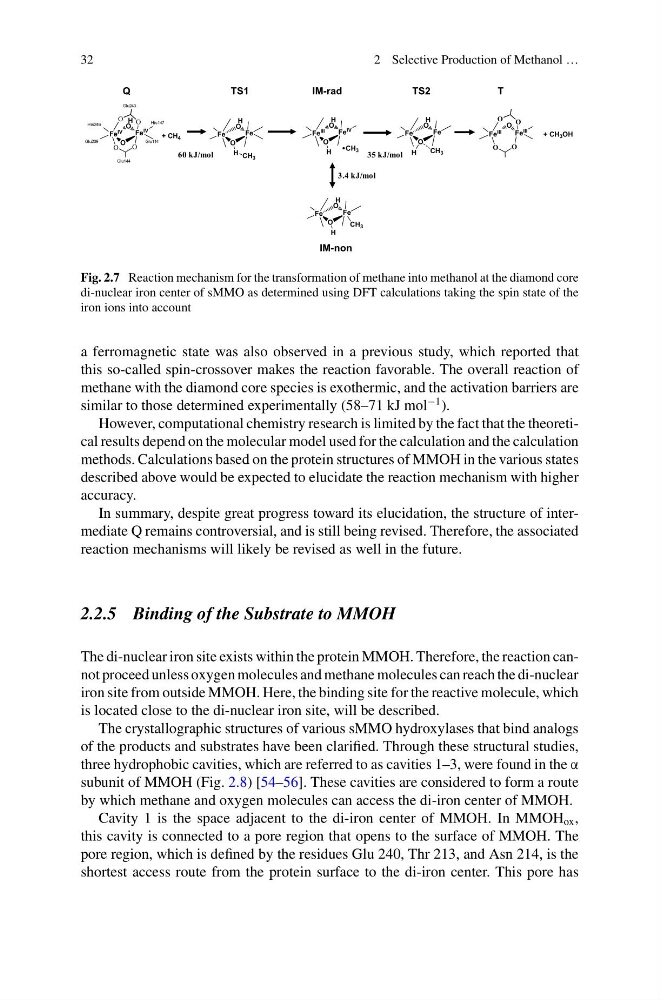
Fig. 2.7 Reaction mechanism for the transformation of methane into methanol at the diamond core
di-nuclear iron center of sMMO as determined using DFT calculations taking the spin state of the
iron ions into account
a ferromagnetic state was also observed in a previous study, which reported that
this so-called spin-crossover makes the reaction favorable. The overall reaction of
methane with the diamond core species is exothermic, and the activation barriers are
similar to those determined experimentally (58–71 kJ mol
−1 ).
However, computational chemistry research is limited by the fact that the theoretical results depend on the molecular model used for the calculation and the calculation
methods. Calculations based on the protein structures of MMOH in the various states
described above would be expected to elucidate the reaction mechanism with higher
accuracy.
In summary, despite great progress toward its elucidation, the structure of intermediate Q remains controversial, and is still being revised. Therefore, the associated
reaction mechanisms will likely be revised as well in the future.
2.2.5 Binding of the Substrate to MMOH
The di-nuclear iron site exists within the protein MMOH. Therefore, the reaction cannot proceed unless oxygen molecules and methane molecules can reach the di-nuclear
iron site from outside MMOH. Here, the binding site for the reactive molecule, which
is located close to the di-nuclear iron site, will be described.
The crystallographic structures of various sMMO hydroxylases that bind analogs
of the products and substrates have been clarified. Through these structural studies,
three hydrophobic cavities, which are referred to as cavities 1–3, were found in the α
subunit of MMOH (Fig. 2.8) [54–56]. These cavities are considered to form a route
by which methane and oxygen molecules can access the di-iron center of MMOH.
Cavity 1 is the space adjacent to the di-iron center of MMOH. In MMOH ox ,
this cavity is connected to a pore region that opens to the surface of MMOH. The
pore region, which is defined by the residues Glu 240, Thr 213, and Asn 214, is the
shortest access route from the protein surface to the di-iron center. This pore has
2 Selective Production of Methanol …
Fe
Fe
O
O
H
CH 3
H
Fe
Fe
O
O
H
CH 3
H
Fe III
Fe IV
O
O
H
CH 3
H
Fe
Fe
O
O
H
CH 3
H
Fe III
Fe III
O
O
O
O
O
+ CH 3 OH
Fe IV
Fe IV
O
O
O
O
O
O H
+ CH 4
His147
His246
Glu114
Glu209
Glu243
Glu144
Q
TS1
IM-rad
TS2
T
IM-non
60 kJ/mol
3.4 kJ/mol
35 kJ/mol
Fig. 2.7 Reaction mechanism for the transformation of methane into methanol at the diamond core
di-nuclear iron center of sMMO as determined using DFT calculations taking the spin state of the
iron ions into account
a ferromagnetic state was also observed in a previous study, which reported that
this so-called spin-crossover makes the reaction favorable. The overall reaction of
methane with the diamond core species is exothermic, and the activation barriers are
similar to those determined experimentally (58–71 kJ mol
−1 ).
However, computational chemistry research is limited by the fact that the theoretical results depend on the molecular model used for the calculation and the calculation
methods. Calculations based on the protein structures of MMOH in the various states
described above would be expected to elucidate the reaction mechanism with higher
accuracy.
In summary, despite great progress toward its elucidation, the structure of intermediate Q remains controversial, and is still being revised. Therefore, the associated
reaction mechanisms will likely be revised as well in the future.
2.2.5 Binding of the Substrate to MMOH
The di-nuclear iron site exists within the protein MMOH. Therefore, the reaction cannot proceed unless oxygen molecules and methane molecules can reach the di-nuclear
iron site from outside MMOH. Here, the binding site for the reactive molecule, which
is located close to the di-nuclear iron site, will be described.
The crystallographic structures of various sMMO hydroxylases that bind analogs
of the products and substrates have been clarified. Through these structural studies,
three hydrophobic cavities, which are referred to as cavities 1–3, were found in the α
subunit of MMOH (Fig. 2.8) [54–56]. These cavities are considered to form a route
by which methane and oxygen molecules can access the di-iron center of MMOH.
Cavity 1 is the space adjacent to the di-iron center of MMOH. In MMOH ox ,
this cavity is connected to a pore region that opens to the surface of MMOH. The
pore region, which is defined by the residues Glu 240, Thr 213, and Asn 214, is the
shortest access route from the protein surface to the di-iron center. This pore has