

2.2 sMMO
33
Cavity 1
Cavity 2
Cavity 3
Leu110
Phe188
Glu240
Asn214
Thr213
Fe
Fe
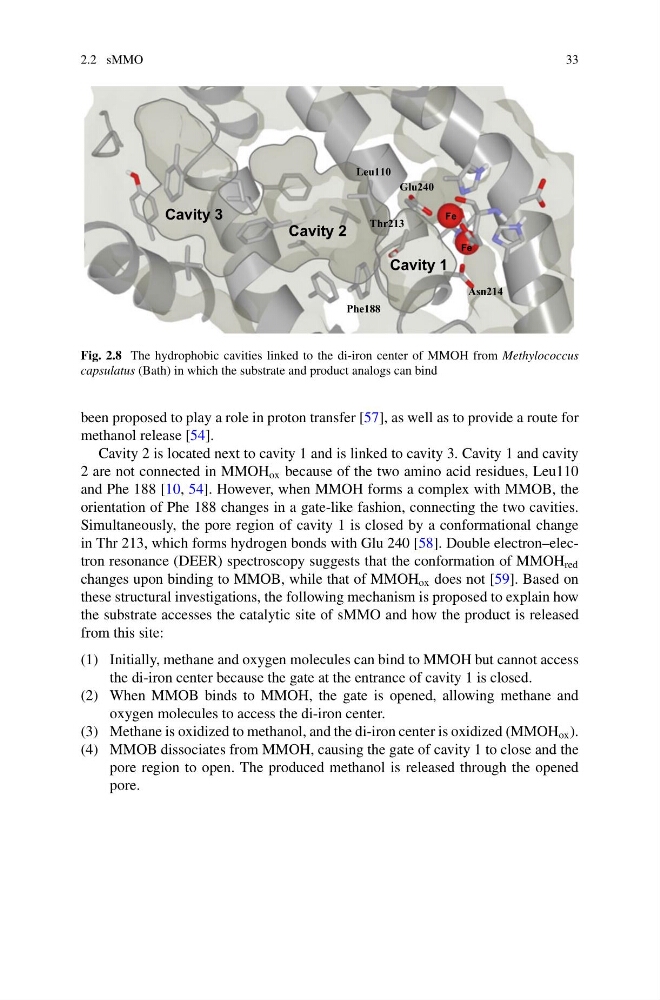
Fig. 2.8 The hydrophobic cavities linked to the di-iron center of MMOH from Methylococcus
capsulatus (Bath) in which the substrate and product analogs can bind
been proposed to play a role in proton transfer [57], as well as to provide a route for
methanol release [54].
Cavity 2 is located next to cavity 1 and is linked to cavity 3. Cavity 1 and cavity
2 are not connected in MMOH ox because of the two amino acid residues, Leu110
and Phe 188 [10, 54]. However, when MMOH forms a complex with MMOB, the
orientation of Phe 188 changes in a gate-like fashion, connecting the two cavities.
Simultaneously, the pore region of cavity 1 is closed by a conformational change
in Thr 213, which forms hydrogen bonds with Glu 240 [58]. Double electron–electron resonance (DEER) spectroscopy suggests that the conformation of MMOH red
changes upon binding to MMOB, while that of MMOH ox does not [59]. Based on
these structural investigations, the following mechanism is proposed to explain how
the substrate accesses the catalytic site of sMMO and how the product is released
from this site:
(1) Initially, methane and oxygen molecules can bind to MMOH but cannot access
the di-iron center because the gate at the entrance of cavity 1 is closed.
(2) When MMOB binds to MMOH, the gate is opened, allowing methane and
oxygen molecules to access the di-iron center.
(3) Methane is oxidized to methanol, and the di-iron center is oxidized (MMOH ox ).
(4) MMOB dissociates from MMOH, causing the gate of cavity 1 to close and the
pore region to open. The produced methanol is released through the opened
pore.
33
Cavity 1
Cavity 2
Cavity 3
Leu110
Phe188
Glu240
Asn214
Thr213
Fe
Fe
Fig. 2.8 The hydrophobic cavities linked to the di-iron center of MMOH from Methylococcus
capsulatus (Bath) in which the substrate and product analogs can bind
been proposed to play a role in proton transfer [57], as well as to provide a route for
methanol release [54].
Cavity 2 is located next to cavity 1 and is linked to cavity 3. Cavity 1 and cavity
2 are not connected in MMOH ox because of the two amino acid residues, Leu110
and Phe 188 [10, 54]. However, when MMOH forms a complex with MMOB, the
orientation of Phe 188 changes in a gate-like fashion, connecting the two cavities.
Simultaneously, the pore region of cavity 1 is closed by a conformational change
in Thr 213, which forms hydrogen bonds with Glu 240 [58]. Double electron–electron resonance (DEER) spectroscopy suggests that the conformation of MMOH red
changes upon binding to MMOB, while that of MMOH ox does not [59]. Based on
these structural investigations, the following mechanism is proposed to explain how
the substrate accesses the catalytic site of sMMO and how the product is released
from this site:
(1) Initially, methane and oxygen molecules can bind to MMOH but cannot access
the di-iron center because the gate at the entrance of cavity 1 is closed.
(2) When MMOB binds to MMOH, the gate is opened, allowing methane and
oxygen molecules to access the di-iron center.
(3) Methane is oxidized to methanol, and the di-iron center is oxidized (MMOH ox ).
(4) MMOB dissociates from MMOH, causing the gate of cavity 1 to close and the
pore region to open. The produced methanol is released through the opened
pore.