

2.2 sMMO
31
Fe
IV
Fe
IV
O
O
O
O
O
O
Q + CH 4
Fe
Fe
O
O
O
O
CH 3
H
Fe
Fe
O
O
O
O
CH 3
H
Fe
III
Fe
III
O
O
O
O
O
T + CH 3 OH
Fe
Fe
O
O
O
O
CH 3
H
Fe
III
Fe
IV
O
O
O
O
CH 3
H
Fe
III
Fe
IV
O
O
O
O
CH 3
H
Fe
Fe
O
O
O
O
CH 3
H
(a)
(b)
(c)
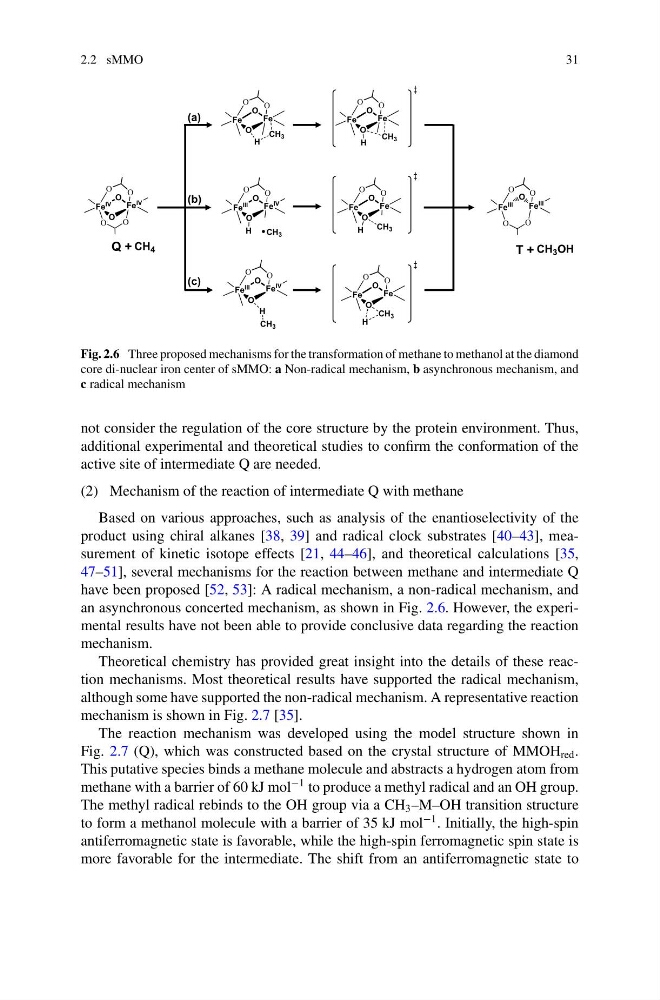
Fig. 2.6 Three proposed mechanisms for the transformation of methane to methanol at the diamond
core di-nuclear iron center of sMMO: a Non-radical mechanism, b asynchronous mechanism, and
c radical mechanism
not consider the regulation of the core structure by the protein environment. Thus,
additional experimental and theoretical studies to confirm the conformation of the
active site of intermediate Q are needed.
(2) Mechanism of the reaction of intermediate Q with methane
Based on various approaches, such as analysis of the enantioselectivity of the
product using chiral alkanes [38, 39] and radical clock substrates [40–43], measurement of kinetic isotope effects [21, 44–46], and theoretical calculations [35,
47–51], several mechanisms for the reaction between methane and intermediate Q
have been proposed [52, 53]: A radical mechanism, a non-radical mechanism, and
an asynchronous concerted mechanism, as shown in Fig. 2.6. However, the experimental results have not been able to provide conclusive data regarding the reaction
mechanism.
Theoretical chemistry has provided great insight into the details of these reaction mechanisms. Most theoretical results have supported the radical mechanism,
although some have supported the non-radical mechanism. A representative reaction
mechanism is shown in Fig. 2.7 [35].
The reaction mechanism was developed using the model structure shown in
Fig. 2.7 (Q), which was constructed based on the crystal structure of MMOH red .
This putative species binds a methane molecule and abstracts a hydrogen atom from
methane with a barrier of 60 kJ mol
−1 to produce a methyl radical and an OH group.
The methyl radical rebinds to the OH group via a CH 3 –M–OH transition structure
to form a methanol molecule with a barrier of 35 kJ mol
−1 . Initially, the high-spin
antiferromagnetic state is favorable, while the high-spin ferromagnetic spin state is
more favorable for the intermediate. The shift from an antiferromagnetic state to
31
Fe
IV
Fe
IV
O
O
O
O
O
O
Q + CH 4
Fe
Fe
O
O
O
O
CH 3
H
Fe
Fe
O
O
O
O
CH 3
H
Fe
III
Fe
III
O
O
O
O
O
T + CH 3 OH
Fe
Fe
O
O
O
O
CH 3
H
Fe
III
Fe
IV
O
O
O
O
CH 3
H
Fe
III
Fe
IV
O
O
O
O
CH 3
H
Fe
Fe
O
O
O
O
CH 3
H
(a)
(b)
(c)
Fig. 2.6 Three proposed mechanisms for the transformation of methane to methanol at the diamond
core di-nuclear iron center of sMMO: a Non-radical mechanism, b asynchronous mechanism, and
c radical mechanism
not consider the regulation of the core structure by the protein environment. Thus,
additional experimental and theoretical studies to confirm the conformation of the
active site of intermediate Q are needed.
(2) Mechanism of the reaction of intermediate Q with methane
Based on various approaches, such as analysis of the enantioselectivity of the
product using chiral alkanes [38, 39] and radical clock substrates [40–43], measurement of kinetic isotope effects [21, 44–46], and theoretical calculations [35,
47–51], several mechanisms for the reaction between methane and intermediate Q
have been proposed [52, 53]: A radical mechanism, a non-radical mechanism, and
an asynchronous concerted mechanism, as shown in Fig. 2.6. However, the experimental results have not been able to provide conclusive data regarding the reaction
mechanism.
Theoretical chemistry has provided great insight into the details of these reaction mechanisms. Most theoretical results have supported the radical mechanism,
although some have supported the non-radical mechanism. A representative reaction
mechanism is shown in Fig. 2.7 [35].
The reaction mechanism was developed using the model structure shown in
Fig. 2.7 (Q), which was constructed based on the crystal structure of MMOH red .
This putative species binds a methane molecule and abstracts a hydrogen atom from
methane with a barrier of 60 kJ mol
−1 to produce a methyl radical and an OH group.
The methyl radical rebinds to the OH group via a CH 3 –M–OH transition structure
to form a methanol molecule with a barrier of 35 kJ mol
−1 . Initially, the high-spin
antiferromagnetic state is favorable, while the high-spin ferromagnetic spin state is
more favorable for the intermediate. The shift from an antiferromagnetic state to