

30
2 Selective Production of Methanol …
(a) Mössbauer spectroscopic study [25]: Mössbauer analysis revealed that the two
iron atoms were high-spin Fe
IV ions and antiferromagnetically coupled in nearly
identical environments.
(b) Extended X-ray absorption fine structure (EXAFS) analysis [26, 27]: A sample
of intermediate Q was prepared by rapid freeze quenching. The results showed
that the two Fe–O bonds were asymmetric (1.77 and 2.05 Å). Both Fe–O bonds
were longer than typical terminal Fe
IV
= O bonds (about 1.65 Å). The distance
between the two iron ions was short (2.46 Å) The coordination number of the
two iron ions was likely five or less.
(c) Time-resolved resonance Raman spectroscopy at 4 °C [28]: The results revealed
that the two equivalent oxygen atoms in the diamond core of intermediate Q
originated from molecular oxygen, providing support for the homolytic cleavage
of the O–O bond of molecular oxygen. Additionally, the vibration modes of
Fe = O and Fe-OH were not observed, although theoretical calculations of
these frequencies have not been conducted yet.
However, the structure of the diamond core remains controversial, as the spectroscopic results are not totally consistent with some computational chemistry and
coordination chemistry results. First, the short distance between the two iron atoms
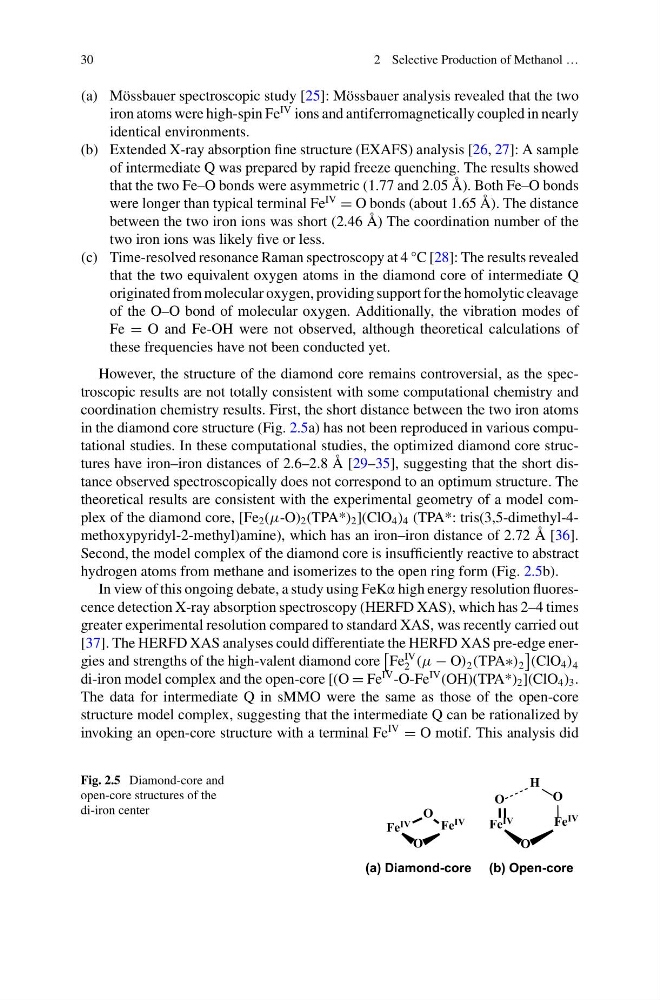
in the diamond core structure (Fig. 2.5a) has not been reproduced in various computational studies. In these computational studies, the optimized diamond core structures have iron–iron distances of 2.6–2.8 Å [29–35], suggesting that the short distance observed spectroscopically does not correspond to an optimum structure. The
theoretical results are consistent with the experimental geometry of a model complex of the diamond core, [Fe 2 (μ-O) 2 (TPA*) 2 ](ClO 4 ) 4 (TPA*: tris(3,5-dimethyl-4methoxypyridyl-2-methyl)amine), which has an iron–iron distance of 2.72 Å [36].
Second, the model complex of the diamond core is insufficiently reactive to abstract
hydrogen atoms from methane and isomerizes to the open ring form (Fig. 2.5b).
In view of this ongoing debate, a study using FeKα high energy resolution fluorescence detection X-ray absorption spectroscopy (HERFD XAS), which has 2–4 times
greater experimental resolution compared to standard XAS, was recently carried out
[37]. The HERFD XAS analyses could differentiate the HERFD XAS pre-edge energies and strengths of the high-valent diamond core
Fe
IV
2 (μ − O) 2 (TPA∗) 2
(ClO 4 ) 4
di-iron model complex and the open-core [(O = Fe
IV -O-Fe
IV (OH)(TPA*) 2 ](ClO 4 ) 3 .
The data for intermediate Q in sMMO were the same as those of the open-core
structure model complex, suggesting that the intermediate Q can be rationalized by
invoking an open-core structure with a terminal Fe
IV
= O motif. This analysis did
Fig. 2.5 Diamond-core and
open-core structures of the
di-iron center
Fe IV
Fe IV
O
O
Fe IV
Fe IV
O
O
O
H
(a) Diamond-core (b) Open-core
2 Selective Production of Methanol …
(a) Mössbauer spectroscopic study [25]: Mössbauer analysis revealed that the two
iron atoms were high-spin Fe
IV ions and antiferromagnetically coupled in nearly
identical environments.
(b) Extended X-ray absorption fine structure (EXAFS) analysis [26, 27]: A sample
of intermediate Q was prepared by rapid freeze quenching. The results showed
that the two Fe–O bonds were asymmetric (1.77 and 2.05 Å). Both Fe–O bonds
were longer than typical terminal Fe
IV
= O bonds (about 1.65 Å). The distance
between the two iron ions was short (2.46 Å) The coordination number of the
two iron ions was likely five or less.
(c) Time-resolved resonance Raman spectroscopy at 4 °C [28]: The results revealed
that the two equivalent oxygen atoms in the diamond core of intermediate Q
originated from molecular oxygen, providing support for the homolytic cleavage
of the O–O bond of molecular oxygen. Additionally, the vibration modes of
Fe = O and Fe-OH were not observed, although theoretical calculations of
these frequencies have not been conducted yet.
However, the structure of the diamond core remains controversial, as the spectroscopic results are not totally consistent with some computational chemistry and
coordination chemistry results. First, the short distance between the two iron atoms
in the diamond core structure (Fig. 2.5a) has not been reproduced in various computational studies. In these computational studies, the optimized diamond core structures have iron–iron distances of 2.6–2.8 Å [29–35], suggesting that the short distance observed spectroscopically does not correspond to an optimum structure. The
theoretical results are consistent with the experimental geometry of a model complex of the diamond core, [Fe 2 (μ-O) 2 (TPA*) 2 ](ClO 4 ) 4 (TPA*: tris(3,5-dimethyl-4methoxypyridyl-2-methyl)amine), which has an iron–iron distance of 2.72 Å [36].
Second, the model complex of the diamond core is insufficiently reactive to abstract
hydrogen atoms from methane and isomerizes to the open ring form (Fig. 2.5b).
In view of this ongoing debate, a study using FeKα high energy resolution fluorescence detection X-ray absorption spectroscopy (HERFD XAS), which has 2–4 times
greater experimental resolution compared to standard XAS, was recently carried out
[37]. The HERFD XAS analyses could differentiate the HERFD XAS pre-edge energies and strengths of the high-valent diamond core
Fe
IV
2 (μ − O) 2 (TPA∗) 2
(ClO 4 ) 4
di-iron model complex and the open-core [(O = Fe
IV -O-Fe
IV (OH)(TPA*) 2 ](ClO 4 ) 3 .
The data for intermediate Q in sMMO were the same as those of the open-core
structure model complex, suggesting that the intermediate Q can be rationalized by
invoking an open-core structure with a terminal Fe
IV
= O motif. This analysis did
Fig. 2.5 Diamond-core and
open-core structures of the
di-iron center
Fe IV
Fe IV
O
O
Fe IV
Fe IV
O
O
O
H
(a) Diamond-core (b) Open-core