

2.2 sMMO
29
Step 5: Reaction with methane
Intermediate Q reacts with methane, resulting in C–H bond cleavage and in turn, the
formation of methanol. The structure and properties of this intermediate have been
extensively investigated, and are described in detail in Sect. 2.2.4.
After the oxidation of methane, intermediate Q is converted to intermediate T,
which is a complex of MMOH and the product. In this intermediate, the di-iron
center is proposed to have a mono-μ-oxo bridge. MMOH returns to its resting state
(MMOH ox ) via the release of methanol from the intermediate.
All of the transformations in the catalytic cycle above depend on the molecular
dynamics of the MMOH protein. The formation of MMOH red from MMOH ox via the
electrons supplied by NADH involves interaction between the MMOH and MMOR
proteins. The activation of molecular oxygen occurs through the transformation from
MMOH red to intermediate Q; interaction between the MMOH and MMOB proteins
is also involved in this transformation. Methane activation and methanol production
occur via reaction with intermediate Q. The release of methanol from MMOH occurs
through the transformation of intermediate T to MMOH ox . Clearly, the mechanism
of the oxidation of methane to methanol by sMMO cannot be understood without
understanding the protein structure of sMMO and its dynamics.
2.2.4 Intermediate Q: Methane Activation and Methanol
Production
As shown in the catalytic cycle, intermediate Q is an important reaction intermediate
that is responsible for the cleavage of the C–H bond of methane. Thus, its geometrical
and electronic structures have been studied in detail.
(1) Structure of intermediate Q
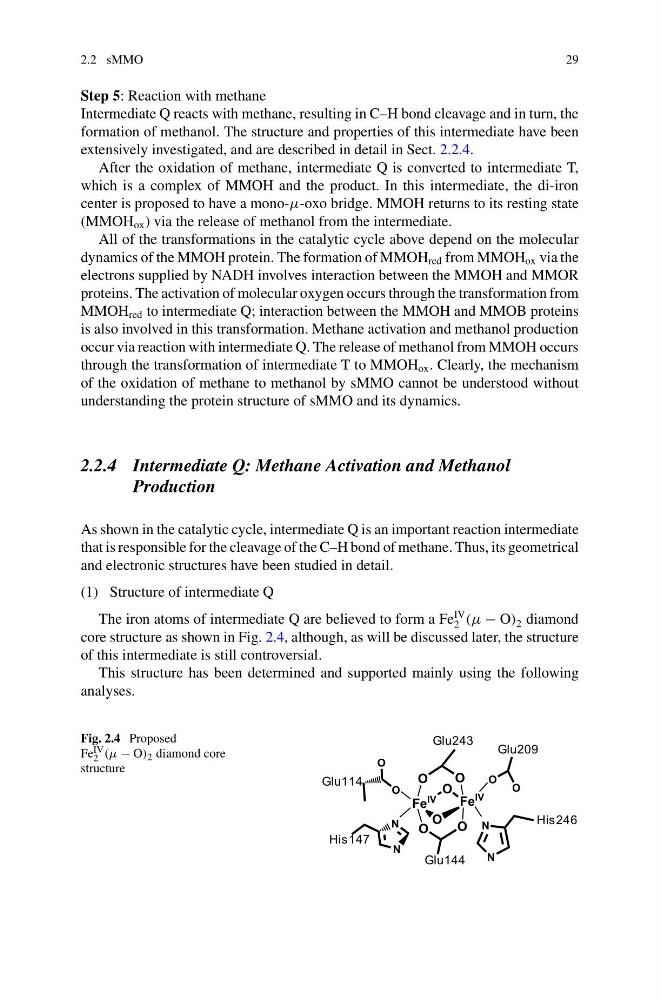
The iron atoms of intermediate Q are believed to form a Fe
IV
2 (μ − O) 2 diamond
core structure as shown in Fig. 2.4, although, as will be discussed later, the structure
of this intermediate is still controversial.
This structure has been determined and supported mainly using the following
analyses.
Fig. 2.4 Proposed
Fe IV
2 (μ − O) 2 diamond core
structure
Fe
IV
Fe
IV
O
O
O
O
O
O
O
O
N
N
O
O
N
N
Glu209
Glu243
His246
His147
Glu144
Glu114
29
Step 5: Reaction with methane
Intermediate Q reacts with methane, resulting in C–H bond cleavage and in turn, the
formation of methanol. The structure and properties of this intermediate have been
extensively investigated, and are described in detail in Sect. 2.2.4.
After the oxidation of methane, intermediate Q is converted to intermediate T,
which is a complex of MMOH and the product. In this intermediate, the di-iron
center is proposed to have a mono-μ-oxo bridge. MMOH returns to its resting state
(MMOH ox ) via the release of methanol from the intermediate.
All of the transformations in the catalytic cycle above depend on the molecular
dynamics of the MMOH protein. The formation of MMOH red from MMOH ox via the
electrons supplied by NADH involves interaction between the MMOH and MMOR
proteins. The activation of molecular oxygen occurs through the transformation from
MMOH red to intermediate Q; interaction between the MMOH and MMOB proteins
is also involved in this transformation. Methane activation and methanol production
occur via reaction with intermediate Q. The release of methanol from MMOH occurs
through the transformation of intermediate T to MMOH ox . Clearly, the mechanism
of the oxidation of methane to methanol by sMMO cannot be understood without
understanding the protein structure of sMMO and its dynamics.
2.2.4 Intermediate Q: Methane Activation and Methanol
Production
As shown in the catalytic cycle, intermediate Q is an important reaction intermediate
that is responsible for the cleavage of the C–H bond of methane. Thus, its geometrical
and electronic structures have been studied in detail.
(1) Structure of intermediate Q
The iron atoms of intermediate Q are believed to form a Fe
IV
2 (μ − O) 2 diamond
core structure as shown in Fig. 2.4, although, as will be discussed later, the structure
of this intermediate is still controversial.
This structure has been determined and supported mainly using the following
analyses.
Fig. 2.4 Proposed
Fe IV
2 (μ − O) 2 diamond core
structure
Fe
IV
Fe
IV
O
O
O
O
O
O
O
O
N
N
O
O
N
N
Glu209
Glu243
His246
His147
Glu144
Glu114