

14
1 Overview of Direct Methane Conversion to Chemicals …
M–CH 3 formation has been aggressively researched, and many reviews have been
published on this topic [27, 44, 79–83]. Labinger et al. conveniently classified M–
CH 3 formation reactions into five types according to their overall stoichiometry [79]:
Class 1: Oxidative addition, Class 2: σ-bond metathesis, Class 3: 1,2-addition, Class
4: Metalloradical activation, and Class 5: Electrophilic activation.
Class 1: Oxidative addition
Oxidative addition reactions are typical for electron-rich, low-valence complexes of
the late transition metals, which are found toward the right side of the periodic table,
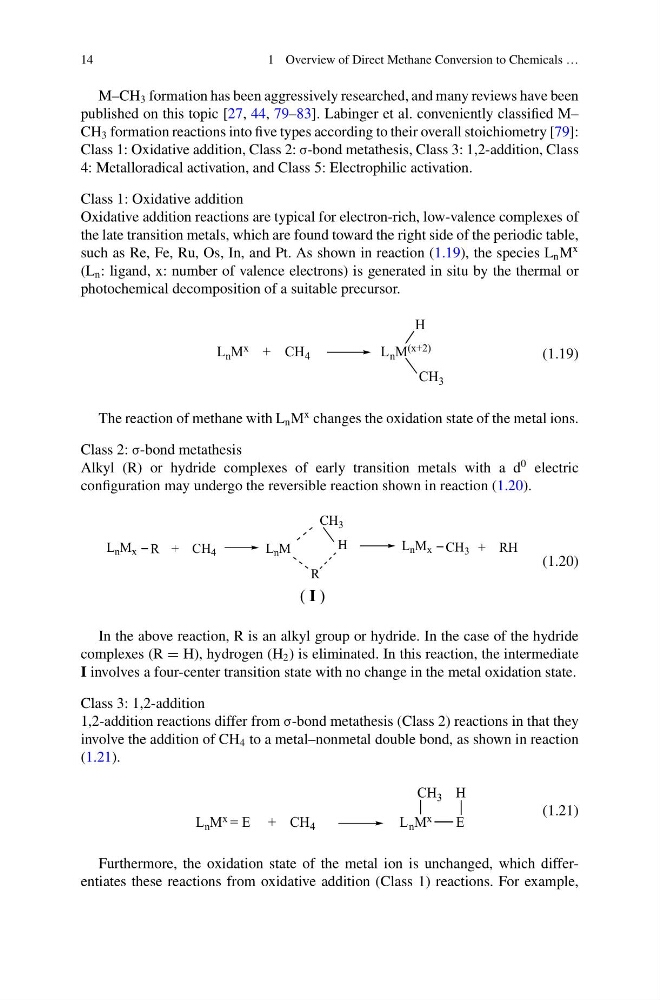
such as Re, Fe, Ru, Os, In, and Pt. As shown in reaction (1.19), the species L n M
x
(L n : ligand, x: number of valence electrons) is generated in situ by the thermal or
photochemical decomposition of a suitable precursor.
L n M x + CH 4
L n M (x+2)
H
CH 3
(1.19)
The reaction of methane with L n M
x changes the oxidation state of the metal ions.
Class 2: σ-bond metathesis
Alkyl (R) or hydride complexes of early transition metals with a d
0 electric
configuration may undergo the reversible reaction shown in reaction (1.20).
L n M
CH 3
H
R
( I )
L n M x R + CH 4
L n M x CH 3 + RH
(1.20)
In the above reaction, R is an alkyl group or hydride. In the case of the hydride
complexes (R = H), hydrogen (H 2 ) is eliminated. In this reaction, the intermediate
I involves a four-center transition state with no change in the metal oxidation state.
Class 3: 1,2-addition
1,2-addition reactions differ from σ-bond metathesis (Class 2) reactions in that they
involve the addition of CH 4 to a metal–nonmetal double bond, as shown in reaction
(1.21).
L n M x = E + CH 4
L n M x
E
H
CH 3
(1.21)
Furthermore, the oxidation state of the metal ion is unchanged, which differentiates these reactions from oxidative addition (Class 1) reactions. For example,
1 Overview of Direct Methane Conversion to Chemicals …
M–CH 3 formation has been aggressively researched, and many reviews have been
published on this topic [27, 44, 79–83]. Labinger et al. conveniently classified M–
CH 3 formation reactions into five types according to their overall stoichiometry [79]:
Class 1: Oxidative addition, Class 2: σ-bond metathesis, Class 3: 1,2-addition, Class
4: Metalloradical activation, and Class 5: Electrophilic activation.
Class 1: Oxidative addition
Oxidative addition reactions are typical for electron-rich, low-valence complexes of
the late transition metals, which are found toward the right side of the periodic table,
such as Re, Fe, Ru, Os, In, and Pt. As shown in reaction (1.19), the species L n M
x
(L n : ligand, x: number of valence electrons) is generated in situ by the thermal or
photochemical decomposition of a suitable precursor.
L n M x + CH 4
L n M (x+2)
H
CH 3
(1.19)
The reaction of methane with L n M
x changes the oxidation state of the metal ions.
Class 2: σ-bond metathesis
Alkyl (R) or hydride complexes of early transition metals with a d
0 electric
configuration may undergo the reversible reaction shown in reaction (1.20).
L n M
CH 3
H
R
( I )
L n M x R + CH 4
L n M x CH 3 + RH
(1.20)
In the above reaction, R is an alkyl group or hydride. In the case of the hydride
complexes (R = H), hydrogen (H 2 ) is eliminated. In this reaction, the intermediate
I involves a four-center transition state with no change in the metal oxidation state.
Class 3: 1,2-addition
1,2-addition reactions differ from σ-bond metathesis (Class 2) reactions in that they
involve the addition of CH 4 to a metal–nonmetal double bond, as shown in reaction
(1.21).
L n M x = E + CH 4
L n M x
E
H
CH 3
(1.21)
Furthermore, the oxidation state of the metal ion is unchanged, which differentiates these reactions from oxidative addition (Class 1) reactions. For example,