

1.6 Generation of Key Reaction Intermediates
15
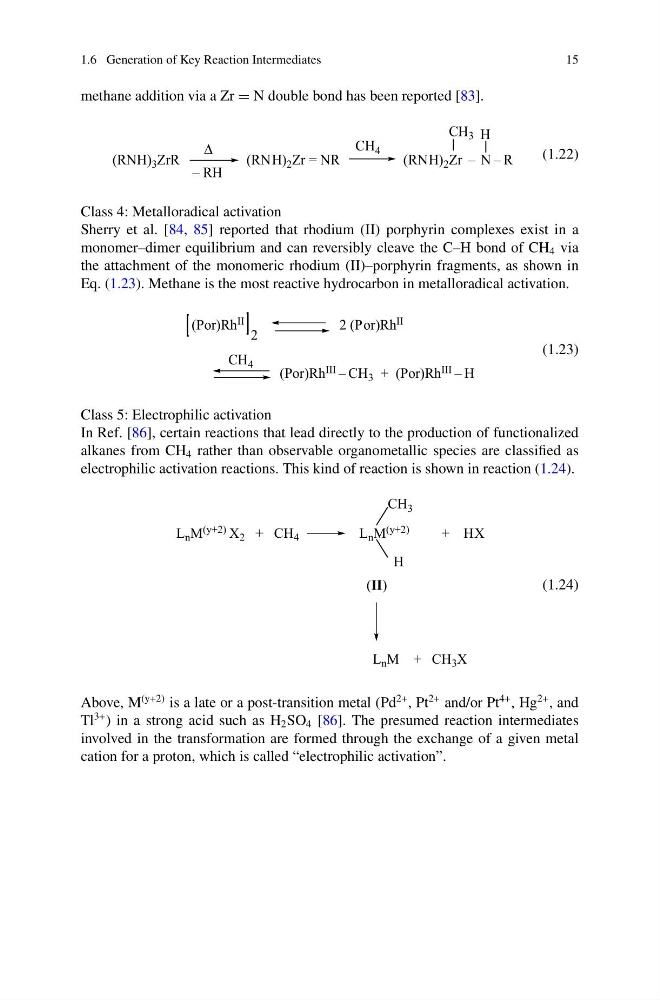
methane addition via a Zr = N double bond has been reported [83].
(RNH) 3 ZrR
(RNH) 2 Zr = NR
(RNH) 2 Zr – N – R
– RH
CH 4
H
Δ
CH 3
(1.22)
Class 4: Metalloradical activation
Sherry et al. [84, 85] reported that rhodium (II) porphyrin complexes exist in a
monomer–dimer equilibrium and can reversibly cleave the C–H bond of CH 4 via
the attachment of the monomeric rhodium (II)–porphyrin fragments, as shown in
Eq. (1.23). Methane is the most reactive hydrocarbon in metalloradical activation.
(Por)Rh II
2 (Por)Rh II
2
CH 4
(Por)Rh III – CH 3 + (Por)Rh III – H
(1.23)
Class 5: Electrophilic activation
In Ref. [86], certain reactions that lead directly to the production of functionalized
alkanes from CH 4 rather than observable organometallic species are classified as
electrophilic activation reactions. This kind of reaction is shown in reaction (1.24).
L n M (y+2) X 2 + CH 4
L n M (y+2)
+ HX
CH 3
H
(II)
L n M + CH 3 X
(1.24)
Above, M
(y+2) is a late or a post-transition metal (Pd
2+ , Pt
2+ and/or Pt
4+ , Hg
2+ , and
Tl
3+ ) in a strong acid such as H 2 SO 4 [86]. The presumed reaction intermediates
involved in the transformation are formed through the exchange of a given metal
cation for a proton, which is called “electrophilic activation”.
15
methane addition via a Zr = N double bond has been reported [83].
(RNH) 3 ZrR
(RNH) 2 Zr = NR
(RNH) 2 Zr – N – R
– RH
CH 4
H
Δ
CH 3
(1.22)
Class 4: Metalloradical activation
Sherry et al. [84, 85] reported that rhodium (II) porphyrin complexes exist in a
monomer–dimer equilibrium and can reversibly cleave the C–H bond of CH 4 via
the attachment of the monomeric rhodium (II)–porphyrin fragments, as shown in
Eq. (1.23). Methane is the most reactive hydrocarbon in metalloradical activation.
(Por)Rh II
2 (Por)Rh II
2
CH 4
(Por)Rh III – CH 3 + (Por)Rh III – H
(1.23)
Class 5: Electrophilic activation
In Ref. [86], certain reactions that lead directly to the production of functionalized
alkanes from CH 4 rather than observable organometallic species are classified as
electrophilic activation reactions. This kind of reaction is shown in reaction (1.24).
L n M (y+2) X 2 + CH 4
L n M (y+2)
+ HX
CH 3
H
(II)
L n M + CH 3 X
(1.24)
Above, M
(y+2) is a late or a post-transition metal (Pd
2+ , Pt
2+ and/or Pt
4+ , Hg
2+ , and
Tl
3+ ) in a strong acid such as H 2 SO 4 [86]. The presumed reaction intermediates
involved in the transformation are formed through the exchange of a given metal
cation for a proton, which is called “electrophilic activation”.