

1.6 Generation of Key Reaction Intermediates
13
1.6.3 Formation of Methyl Carbenium Ions ( + CH 3 )
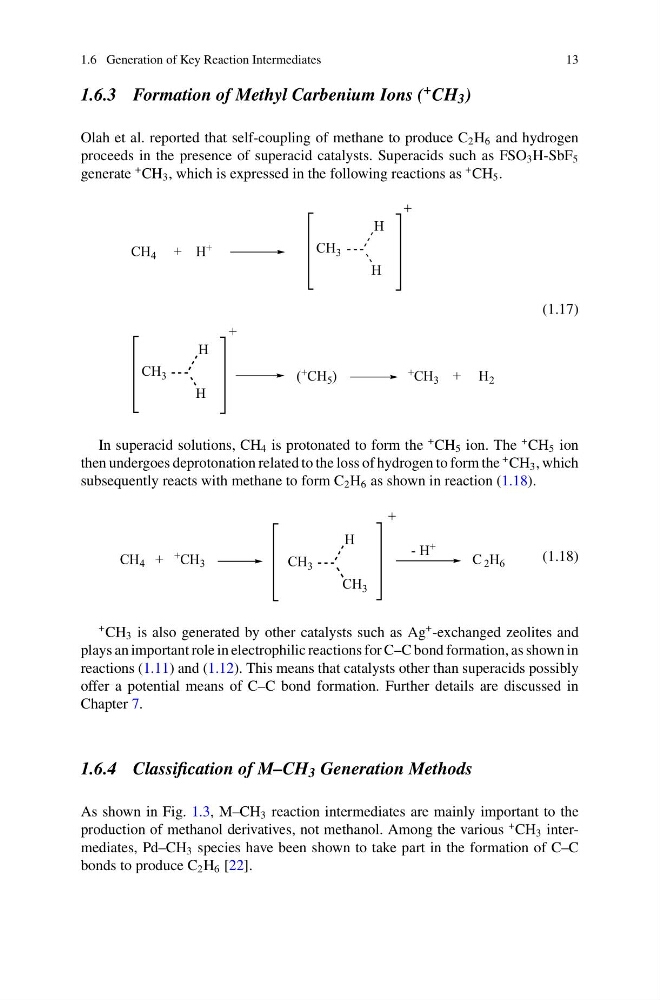
Olah et al. reported that self-coupling of methane to produce C 2 H 6 and hydrogen
proceeds in the presence of superacid catalysts. Superacids such as FSO 3 H-SbF 5
generate
+ CH 3 , which is expressed in the following reactions as
+ CH 5 .
CH 4 + H +
CH 3
H
H
+
( + CH 5 )
+ CH 3 + H 2
CH 3
H
H
+
(1.17)
In superacid solutions, CH 4 is protonated to form the
+ CH 5 ion. The
+ CH 5 ion
then undergoes deprotonation related to the loss of hydrogen to form the
+ CH 3 , which
subsequently reacts with methane to form C 2 H 6 as shown in reaction (1.18).
CH 3
CH 3
H
+
CH 4 + + CH 3
C 2 H 6
- H +
(1.18)
+ CH 3 is also generated by other catalysts such as Ag
+ -exchanged zeolites and
plays an important role in electrophilic reactions for C–C bond formation, as shown in
reactions (1.11) and (1.12). This means that catalysts other than superacids possibly
offer a potential means of C–C bond formation. Further details are discussed in
Chapter 7.
1.6.4 Classification of M–CH 3 Generation Methods
As shown in Fig. 1.3, M–CH 3 reaction intermediates are mainly important to the
production of methanol derivatives, not methanol. Among the various
+ CH 3 intermediates, Pd–CH 3 species have been shown to take part in the formation of C–C
bonds to produce C 2 H 6 [22].
13
1.6.3 Formation of Methyl Carbenium Ions ( + CH 3 )
Olah et al. reported that self-coupling of methane to produce C 2 H 6 and hydrogen
proceeds in the presence of superacid catalysts. Superacids such as FSO 3 H-SbF 5
generate
+ CH 3 , which is expressed in the following reactions as
+ CH 5 .
CH 4 + H +
CH 3
H
H
+
( + CH 5 )
+ CH 3 + H 2
CH 3
H
H
+
(1.17)
In superacid solutions, CH 4 is protonated to form the
+ CH 5 ion. The
+ CH 5 ion
then undergoes deprotonation related to the loss of hydrogen to form the
+ CH 3 , which
subsequently reacts with methane to form C 2 H 6 as shown in reaction (1.18).
CH 3
CH 3
H
+
CH 4 + + CH 3
C 2 H 6
- H +
(1.18)
+ CH 3 is also generated by other catalysts such as Ag
+ -exchanged zeolites and
plays an important role in electrophilic reactions for C–C bond formation, as shown in
reactions (1.11) and (1.12). This means that catalysts other than superacids possibly
offer a potential means of C–C bond formation. Further details are discussed in
Chapter 7.
1.6.4 Classification of M–CH 3 Generation Methods
As shown in Fig. 1.3, M–CH 3 reaction intermediates are mainly important to the
production of methanol derivatives, not methanol. Among the various
+ CH 3 intermediates, Pd–CH 3 species have been shown to take part in the formation of C–C
bonds to produce C 2 H 6 [22].