

7.7 Unique Properties of Silver Cations …
213
C 4 H 8 +
O
O
O
Si
O
Al
O
O
O
CH 3 CHCH 2 CH 3
O
O
O
Si
O
Al
O
O
O
H
(7.71)
+ Ag n -H
+ H 2
O
O
O
Si
O
Al
O
O
O
H
O
O
O
Si
O
Al
O
O
O
-
Ag n
+
(7.72)
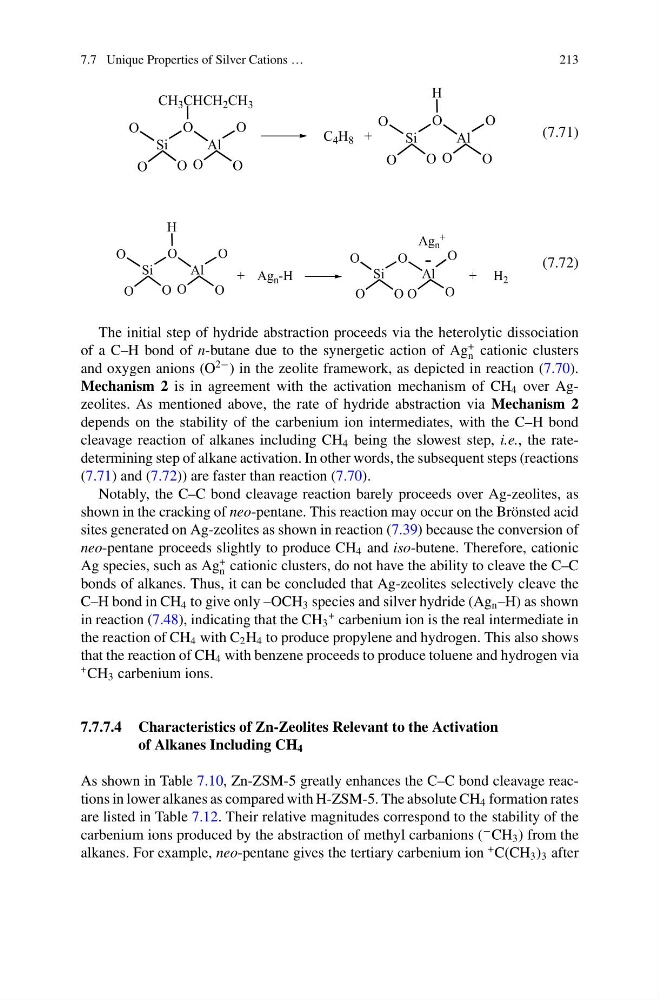
The initial step of hydride abstraction proceeds via the heterolytic dissociation
of a C–H bond of n-butane due to the synergetic action of Ag
+
n cationic clusters
and oxygen anions (O
2− ) in the zeolite framework, as depicted in reaction (7.70).
Mechanism 2 is in agreement with the activation mechanism of CH 4 over Agzeolites. As mentioned above, the rate of hydride abstraction via Mechanism 2
depends on the stability of the carbenium ion intermediates, with the C–H bond
cleavage reaction of alkanes including CH 4 being the slowest step, i.e., the ratedetermining step of alkane activation. In other words, the subsequent steps (reactions
(7.71) and (7.72)) are faster than reaction (7.70).
Notably, the C–C bond cleavage reaction barely proceeds over Ag-zeolites, as
shown in the cracking of neo-pentane. This reaction may occur on the Brönsted acid
sites generated on Ag-zeolites as shown in reaction (7.39) because the conversion of
neo-pentane proceeds slightly to produce CH 4 and iso-butene. Therefore, cationic
Ag species, such as Ag
+
n cationic clusters, do not have the ability to cleave the C–C
bonds of alkanes. Thus, it can be concluded that Ag-zeolites selectively cleave the
C–H bond in CH 4 to give only –OCH 3 species and silver hydride (Ag n –H) as shown
in reaction (7.48), indicating that the CH 3
+ carbenium ion is the real intermediate in
the reaction of CH 4 with C 2 H 4 to produce propylene and hydrogen. This also shows
that the reaction of CH 4 with benzene proceeds to produce toluene and hydrogen via
+ CH 3 carbenium ions.
7.7.7.4 Characteristics of Zn-Zeolites Relevant to the Activation
of Alkanes Including CH 4
As shown in Table 7.10, Zn-ZSM-5 greatly enhances the C–C bond cleavage reactions in lower alkanes as compared with H-ZSM-5. The absolute CH 4 formation rates
are listed in Table 7.12. Their relative magnitudes correspond to the stability of the
carbenium ions produced by the abstraction of methyl carbanions (
− CH 3 ) from the
alkanes. For example, neo-pentane gives the tertiary carbenium ion
+ C(CH 3 ) 3 after
213
C 4 H 8 +
O
O
O
Si
O
Al
O
O
O
CH 3 CHCH 2 CH 3
O
O
O
Si
O
Al
O
O
O
H
(7.71)
+ Ag n -H
+ H 2
O
O
O
Si
O
Al
O
O
O
H
O
O
O
Si
O
Al
O
O
O
-
Ag n
+
(7.72)
The initial step of hydride abstraction proceeds via the heterolytic dissociation
of a C–H bond of n-butane due to the synergetic action of Ag
+
n cationic clusters
and oxygen anions (O
2− ) in the zeolite framework, as depicted in reaction (7.70).
Mechanism 2 is in agreement with the activation mechanism of CH 4 over Agzeolites. As mentioned above, the rate of hydride abstraction via Mechanism 2
depends on the stability of the carbenium ion intermediates, with the C–H bond
cleavage reaction of alkanes including CH 4 being the slowest step, i.e., the ratedetermining step of alkane activation. In other words, the subsequent steps (reactions
(7.71) and (7.72)) are faster than reaction (7.70).
Notably, the C–C bond cleavage reaction barely proceeds over Ag-zeolites, as
shown in the cracking of neo-pentane. This reaction may occur on the Brönsted acid
sites generated on Ag-zeolites as shown in reaction (7.39) because the conversion of
neo-pentane proceeds slightly to produce CH 4 and iso-butene. Therefore, cationic
Ag species, such as Ag
+
n cationic clusters, do not have the ability to cleave the C–C
bonds of alkanes. Thus, it can be concluded that Ag-zeolites selectively cleave the
C–H bond in CH 4 to give only –OCH 3 species and silver hydride (Ag n –H) as shown
in reaction (7.48), indicating that the CH 3
+ carbenium ion is the real intermediate in
the reaction of CH 4 with C 2 H 4 to produce propylene and hydrogen. This also shows
that the reaction of CH 4 with benzene proceeds to produce toluene and hydrogen via
+ CH 3 carbenium ions.
7.7.7.4 Characteristics of Zn-Zeolites Relevant to the Activation
of Alkanes Including CH 4
As shown in Table 7.10, Zn-ZSM-5 greatly enhances the C–C bond cleavage reactions in lower alkanes as compared with H-ZSM-5. The absolute CH 4 formation rates
are listed in Table 7.12. Their relative magnitudes correspond to the stability of the
carbenium ions produced by the abstraction of methyl carbanions (
− CH 3 ) from the
alkanes. For example, neo-pentane gives the tertiary carbenium ion
+ C(CH 3 ) 3 after