

214
7 C–C Bond Formation via Carbocations in the Methane …
− CH 3 abstraction by Zn
2+ cations, while iso-butane and iso-pentane give the secondary carbenium ions
+ C(CH 3 ) 2 H and
+ C(CH 3 )(C 2 H 5 )H, respectively. However, in
the first step, the abstraction of
− CH 3 from n-butane and n-pentane should give primary carbenium ions. In Table 7.12, the CH 4 formation rates for reactions involving
tertiary and secondary carbenium ions are faster than that involve primary carbenium
ions, indicating that the cracking of lower alkanes proceeds via the carbenium ion
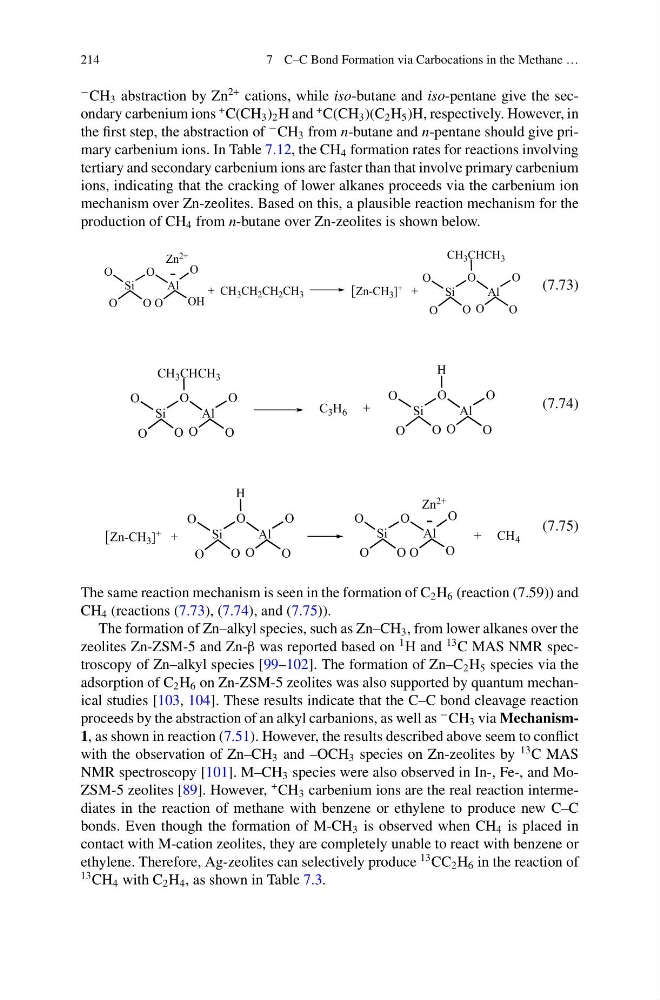
mechanism over Zn-zeolites. Based on this, a plausible reaction mechanism for the
production of CH 4 from n-butane over Zn-zeolites is shown below.
Zn 2+
+ CH 3 CH 2 CH 2 CH 3
[Zn-CH 3 ] + +
O
OH
O
Si
O
Al
O
O
O
-
O
O
O
Si
O
Al
O
O
O
CH 3 CHCH 3
(7.73)
C 3 H 6 +
O
O
O
Si
O
Al
O
O
O
CH 3 CHCH 3
O
O
O
Si
O
Al
O
O
O
H
(7.74)
+ CH 4
[Zn-CH 3 ] + +
O
O
O
Si
O
Al
O
O
O
H
Zn 2+
O
O
O
Si
O
Al
O
O
O
-
(7.75)
The same reaction mechanism is seen in the formation of C 2 H 6 (reaction (7.59)) and
CH 4 (reactions (7.73), (7.74), and (7.75)).
The formation of Zn–alkyl species, such as Zn–CH 3 , from lower alkanes over the
zeolites Zn-ZSM-5 and Zn-β was reported based on
1 H and
13 C MAS NMR spectroscopy of Zn–alkyl species [99–102]. The formation of Zn–C 2 H 5 species via the
adsorption of C 2 H 6 on Zn-ZSM-5 zeolites was also supported by quantum mechanical studies [103, 104]. These results indicate that the C–C bond cleavage reaction
proceeds by the abstraction of an alkyl carbanions, as well as
− CH 3 via Mechanism1, as shown in reaction (7.51). However, the results described above seem to conflict
with the observation of Zn–CH 3 and –OCH 3 species on Zn-zeolites by
13 C MAS
NMR spectroscopy [101]. M–CH 3 species were also observed in In-, Fe-, and MoZSM-5 zeolites [89]. However,
+ CH 3 carbenium ions are the real reaction intermediates in the reaction of methane with benzene or ethylene to produce new C–C
bonds. Even though the formation of M-CH 3 is observed when CH 4 is placed in
contact with M-cation zeolites, they are completely unable to react with benzene or
ethylene. Therefore, Ag-zeolites can selectively produce
13 CC 2 H 6 in the reaction of
13 CH 4 with C 2 H 4 , as shown in Table 7.3.
7 C–C Bond Formation via Carbocations in the Methane …
− CH 3 abstraction by Zn
2+ cations, while iso-butane and iso-pentane give the secondary carbenium ions
+ C(CH 3 ) 2 H and
+ C(CH 3 )(C 2 H 5 )H, respectively. However, in
the first step, the abstraction of
− CH 3 from n-butane and n-pentane should give primary carbenium ions. In Table 7.12, the CH 4 formation rates for reactions involving
tertiary and secondary carbenium ions are faster than that involve primary carbenium
ions, indicating that the cracking of lower alkanes proceeds via the carbenium ion
mechanism over Zn-zeolites. Based on this, a plausible reaction mechanism for the
production of CH 4 from n-butane over Zn-zeolites is shown below.
Zn 2+
+ CH 3 CH 2 CH 2 CH 3
[Zn-CH 3 ] + +
O
OH
O
Si
O
Al
O
O
O
-
O
O
O
Si
O
Al
O
O
O
CH 3 CHCH 3
(7.73)
C 3 H 6 +
O
O
O
Si
O
Al
O
O
O
CH 3 CHCH 3
O
O
O
Si
O
Al
O
O
O
H
(7.74)
+ CH 4
[Zn-CH 3 ] + +
O
O
O
Si
O
Al
O
O
O
H
Zn 2+
O
O
O
Si
O
Al
O
O
O
-
(7.75)
The same reaction mechanism is seen in the formation of C 2 H 6 (reaction (7.59)) and
CH 4 (reactions (7.73), (7.74), and (7.75)).
The formation of Zn–alkyl species, such as Zn–CH 3 , from lower alkanes over the
zeolites Zn-ZSM-5 and Zn-β was reported based on
1 H and
13 C MAS NMR spectroscopy of Zn–alkyl species [99–102]. The formation of Zn–C 2 H 5 species via the
adsorption of C 2 H 6 on Zn-ZSM-5 zeolites was also supported by quantum mechanical studies [103, 104]. These results indicate that the C–C bond cleavage reaction
proceeds by the abstraction of an alkyl carbanions, as well as
− CH 3 via Mechanism1, as shown in reaction (7.51). However, the results described above seem to conflict
with the observation of Zn–CH 3 and –OCH 3 species on Zn-zeolites by
13 C MAS
NMR spectroscopy [101]. M–CH 3 species were also observed in In-, Fe-, and MoZSM-5 zeolites [89]. However,
+ CH 3 carbenium ions are the real reaction intermediates in the reaction of methane with benzene or ethylene to produce new C–C
bonds. Even though the formation of M-CH 3 is observed when CH 4 is placed in
contact with M-cation zeolites, they are completely unable to react with benzene or
ethylene. Therefore, Ag-zeolites can selectively produce
13 CC 2 H 6 in the reaction of
13 CH 4 with C 2 H 4 , as shown in Table 7.3.