

212
7 C–C Bond Formation via Carbocations in the Methane …
these effects were clearly observed in the cracking of iso-butene, n-pentane, and
iso-pentane. The rates of these reactions over Zn-ZSM-5 were much faster than
those over H-ZSM-5.
Results (1) and (2) clearly show that the activation mechanism of lower alkanes
over M-cation zeolites is different from that over H-zeolites. The reaction proceeds
via carbenium ion reaction intermediates over M-cation zeolites, while the reactions of lower alkanes over H-ZSM-5 proceed via penta-coordinated carbonium ion
intermediates.
7.7.7.3 Different Catalytic Properties of Ag-Zeolites and Zn-Zeolites
in the Activation of Methane: Characteristics of Ag-Zeolites
Relevant to C–C Bond Cleavage
The order of the C–H bond cleavage reaction rates over Ag-ZSM-5 and Zn-ZSM-5
are listed in Table 7.11 [97, 98]. The hydrogen formation rates over Ag-ZSM-5
in lower alkane cracking follow the same order as those of Zn-ZSM-5. However,
these formation rates are much faster than those observed over H-ZSM-5, showing
that the reaction mechanism of C–H bond cleavage over Ag- and Zn-ZSM-5
zeolites is different from that over H-ZSM-5. Hydride abstraction occurs over
Ag- and Zn-Zeolites via Mechanism 2, as mentioned in Sect. 7.7.6. The order
reflects the stability of the secondary and/or tertiary carbenium ions formed by
the abstraction of hydride ions by the metal cations, such as Zn
2+ . Therefore,
iso-butane and iso-pentane showed the highest reactivities, because these alkanes
produce tertiary carbenium ions. n-Pentane and n-butane have reactivities an order
of magnitude smaller than those of iso-butane or iso-pentane because they give
secondary carbenium ions via hydride abstraction. Ag-ZSM-5 shows little activity
for the conversion of neo-pentane, because hydride abstraction produces a primary
carbenium ion. However, Ag-zeolites abstract hydride ions (H
− ) from all the lower
alkanes (n-butane, iso-butane, n-pentane, and iso-pentane), except for neo-pentane
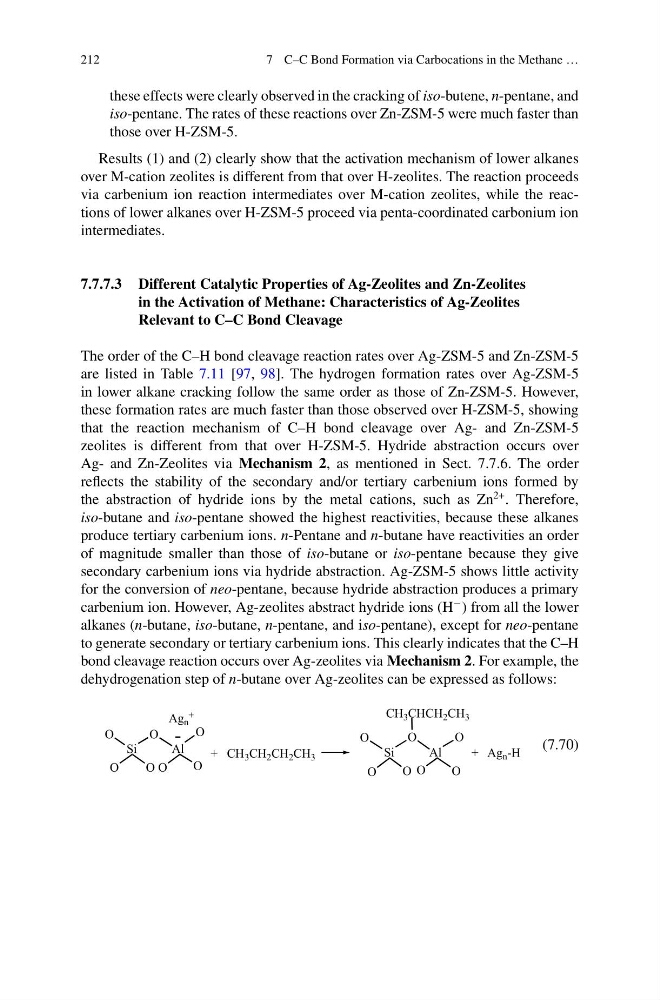
to generate secondary or tertiary carbenium ions. This clearly indicates that the C–H
bond cleavage reaction occurs over Ag-zeolites via Mechanism 2. For example, the
dehydrogenation step of n-butane over Ag-zeolites can be expressed as follows:
O
O
O
Si
O
Al
O
O
O
-
Ag n
+
+ CH 3 CH 2 CH 2 CH 3
O
O
O
Si
O
Al
O
O
O
CH 3 CHCH 2 CH 3
+ Ag n -H
(7.70)
7 C–C Bond Formation via Carbocations in the Methane …
these effects were clearly observed in the cracking of iso-butene, n-pentane, and
iso-pentane. The rates of these reactions over Zn-ZSM-5 were much faster than
those over H-ZSM-5.
Results (1) and (2) clearly show that the activation mechanism of lower alkanes
over M-cation zeolites is different from that over H-zeolites. The reaction proceeds
via carbenium ion reaction intermediates over M-cation zeolites, while the reactions of lower alkanes over H-ZSM-5 proceed via penta-coordinated carbonium ion
intermediates.
7.7.7.3 Different Catalytic Properties of Ag-Zeolites and Zn-Zeolites
in the Activation of Methane: Characteristics of Ag-Zeolites
Relevant to C–C Bond Cleavage
The order of the C–H bond cleavage reaction rates over Ag-ZSM-5 and Zn-ZSM-5
are listed in Table 7.11 [97, 98]. The hydrogen formation rates over Ag-ZSM-5
in lower alkane cracking follow the same order as those of Zn-ZSM-5. However,
these formation rates are much faster than those observed over H-ZSM-5, showing
that the reaction mechanism of C–H bond cleavage over Ag- and Zn-ZSM-5
zeolites is different from that over H-ZSM-5. Hydride abstraction occurs over
Ag- and Zn-Zeolites via Mechanism 2, as mentioned in Sect. 7.7.6. The order
reflects the stability of the secondary and/or tertiary carbenium ions formed by
the abstraction of hydride ions by the metal cations, such as Zn
2+ . Therefore,
iso-butane and iso-pentane showed the highest reactivities, because these alkanes
produce tertiary carbenium ions. n-Pentane and n-butane have reactivities an order
of magnitude smaller than those of iso-butane or iso-pentane because they give
secondary carbenium ions via hydride abstraction. Ag-ZSM-5 shows little activity
for the conversion of neo-pentane, because hydride abstraction produces a primary
carbenium ion. However, Ag-zeolites abstract hydride ions (H
− ) from all the lower
alkanes (n-butane, iso-butane, n-pentane, and iso-pentane), except for neo-pentane
to generate secondary or tertiary carbenium ions. This clearly indicates that the C–H
bond cleavage reaction occurs over Ag-zeolites via Mechanism 2. For example, the
dehydrogenation step of n-butane over Ag-zeolites can be expressed as follows:
O
O
O
Si
O
Al
O
O
O
-
Ag n
+
+ CH 3 CH 2 CH 2 CH 3
O
O
O
Si
O
Al
O
O
O
CH 3 CHCH 2 CH 3
+ Ag n -H
(7.70)