

194
7 C–C Bond Formation via Carbocations in the Methane …
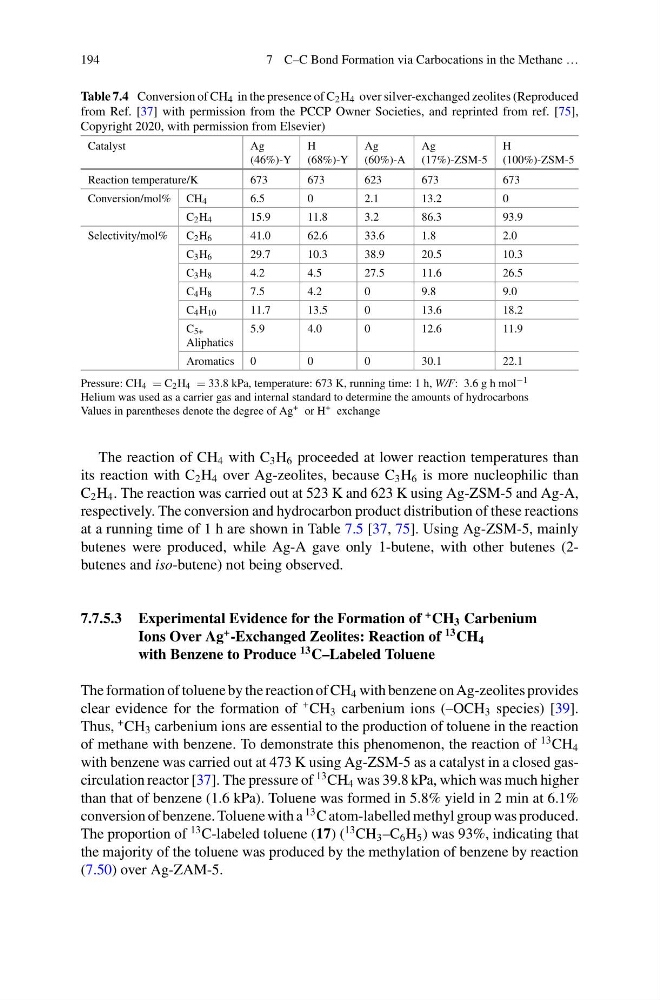
Table 7.4 Conversion of CH 4 in the presence of C 2 H 4 over silver-exchanged zeolites (Reproduced
from Ref. [37] with permission from the PCCP Owner Societies, and reprinted from ref. [75],
Copyright 2020, with permission from Elsevier)
Catalyst
Ag
(46%)-Y
H
(68%)-Y
Ag
(60%)-A
Ag
(17%)-ZSM-5
H
(100%)-ZSM-5
Reaction temperature/K
673
673
623
673
673
Conversion/mol% CH 4
6.5
0
2.1
13.2
0
C 2 H 4
15.9
11.8
3.2
86.3
93.9
Selectivity/mol%
C 2 H 6
41.0
62.6
33.6
1.8
2.0
C 3 H 6
29.7
10.3
38.9
20.5
10.3
C 3 H 8
4.2
4.5
27.5
11.6
26.5
C 4 H 8
7.5
4.2
0
9.8
9.0
C 4 H 10
11.7
13.5
0
13.6
18.2
C 5+
Aliphatics
5.9
4.0
0
12.6
11.9
Aromatics 0
0
0
30.1
22.1
Pressure: CH 4 = C 2 H 4 = 33.8 kPa, temperature: 673 K, running time: 1 h, W/F: 3.6 g h mol −1
Helium was used as a carrier gas and internal standard to determine the amounts of hydrocarbons
Values in parentheses denote the degree of Ag + or H + exchange
The reaction of CH 4 with C 3 H 6 proceeded at lower reaction temperatures than
its reaction with C 2 H 4 over Ag-zeolites, because C 3 H 6 is more nucleophilic than
C 2 H 4 . The reaction was carried out at 523 K and 623 K using Ag-ZSM-5 and Ag-A,
respectively. The conversion and hydrocarbon product distribution of these reactions
at a running time of 1 h are shown in Table 7.5 [37, 75]. Using Ag-ZSM-5, mainly
butenes were produced, while Ag-A gave only 1-butene, with other butenes (2butenes and iso-butene) not being observed.
7.7.5.3 Experimental Evidence for the Formation of
+ CH 3 Carbenium
Ions Over Ag
+ -Exchanged Zeolites: Reaction of
13 CH 4
with Benzene to Produce
13 C–Labeled Toluene
The formation of toluene by the reaction of CH 4 with benzene on Ag-zeolites provides
clear evidence for the formation of
+ CH 3 carbenium ions (–OCH 3 species) [39].
Thus,
+ CH 3 carbenium ions are essential to the production of toluene in the reaction
of methane with benzene. To demonstrate this phenomenon, the reaction of
13 CH 4
with benzene was carried out at 473 K using Ag-ZSM-5 as a catalyst in a closed gascirculation reactor [37]. The pressure of
13 CH 4 was 39.8 kPa, which was much higher
than that of benzene (1.6 kPa). Toluene was formed in 5.8% yield in 2 min at 6.1%
conversion of benzene. Toluene with a
13 C atom-labelled methyl group was produced.
The proportion of
13 C-labeled toluene (17) (
13 CH 3 –C 6 H 5 ) was 93%, indicating that
the majority of the toluene was produced by the methylation of benzene by reaction
(7.50) over Ag-ZAM-5.
7 C–C Bond Formation via Carbocations in the Methane …
Table 7.4 Conversion of CH 4 in the presence of C 2 H 4 over silver-exchanged zeolites (Reproduced
from Ref. [37] with permission from the PCCP Owner Societies, and reprinted from ref. [75],
Copyright 2020, with permission from Elsevier)
Catalyst
Ag
(46%)-Y
H
(68%)-Y
Ag
(60%)-A
Ag
(17%)-ZSM-5
H
(100%)-ZSM-5
Reaction temperature/K
673
673
623
673
673
Conversion/mol% CH 4
6.5
0
2.1
13.2
0
C 2 H 4
15.9
11.8
3.2
86.3
93.9
Selectivity/mol%
C 2 H 6
41.0
62.6
33.6
1.8
2.0
C 3 H 6
29.7
10.3
38.9
20.5
10.3
C 3 H 8
4.2
4.5
27.5
11.6
26.5
C 4 H 8
7.5
4.2
0
9.8
9.0
C 4 H 10
11.7
13.5
0
13.6
18.2
C 5+
Aliphatics
5.9
4.0
0
12.6
11.9
Aromatics 0
0
0
30.1
22.1
Pressure: CH 4 = C 2 H 4 = 33.8 kPa, temperature: 673 K, running time: 1 h, W/F: 3.6 g h mol −1
Helium was used as a carrier gas and internal standard to determine the amounts of hydrocarbons
Values in parentheses denote the degree of Ag + or H + exchange
The reaction of CH 4 with C 3 H 6 proceeded at lower reaction temperatures than
its reaction with C 2 H 4 over Ag-zeolites, because C 3 H 6 is more nucleophilic than
C 2 H 4 . The reaction was carried out at 523 K and 623 K using Ag-ZSM-5 and Ag-A,
respectively. The conversion and hydrocarbon product distribution of these reactions
at a running time of 1 h are shown in Table 7.5 [37, 75]. Using Ag-ZSM-5, mainly
butenes were produced, while Ag-A gave only 1-butene, with other butenes (2butenes and iso-butene) not being observed.
7.7.5.3 Experimental Evidence for the Formation of
+ CH 3 Carbenium
Ions Over Ag
+ -Exchanged Zeolites: Reaction of
13 CH 4
with Benzene to Produce
13 C–Labeled Toluene
The formation of toluene by the reaction of CH 4 with benzene on Ag-zeolites provides
clear evidence for the formation of
+ CH 3 carbenium ions (–OCH 3 species) [39].
Thus,
+ CH 3 carbenium ions are essential to the production of toluene in the reaction
of methane with benzene. To demonstrate this phenomenon, the reaction of
13 CH 4
with benzene was carried out at 473 K using Ag-ZSM-5 as a catalyst in a closed gascirculation reactor [37]. The pressure of
13 CH 4 was 39.8 kPa, which was much higher
than that of benzene (1.6 kPa). Toluene was formed in 5.8% yield in 2 min at 6.1%
conversion of benzene. Toluene with a
13 C atom-labelled methyl group was produced.
The proportion of
13 C-labeled toluene (17) (
13 CH 3 –C 6 H 5 ) was 93%, indicating that
the majority of the toluene was produced by the methylation of benzene by reaction
(7.50) over Ag-ZAM-5.