

7.7 Unique Properties of Silver Cations …
195
Table 7.5 Conversion of CH 4 in the presence of C 3 H 6 using Ag-ZSM-5 and Ag-A zeolites
(Reproduced from Ref. [37] with permission from the PCCP Owner Societies, and reprinted from
ref. [75], Copyright 2020, with permission from Elsevier)
Ag + -exchanged zeolite
Ag (17%)-ZSM-5 Ag (100%)-A
Reaction temperature/K
523
623
Conversion/%
CH 4
4.5
2.1
C 3 H 6
42.6
3.2
Hydrocarbon
distribution/mol%
C 2 H 4
0
0
C 2 H 6
0
33.6
C 3 H 8
0
38.9
C 4 H 8
38.6
11.2 (1-Butene)
C 4 H 10
3.4
0
C 5 H 10
8.3
0
C 5 H 12
3.6
0
C 6
26.5
0
C 7
11.1
0
Aromatic hydrocarbons 8.5
0
CH 4 = C 3 H 6 = 33.8 kPa, running time: 1 h, W/F = 3.6 g h mol −1
+ 13 CH 4
13 CH 3
+
H 2
(17)
(7.50)
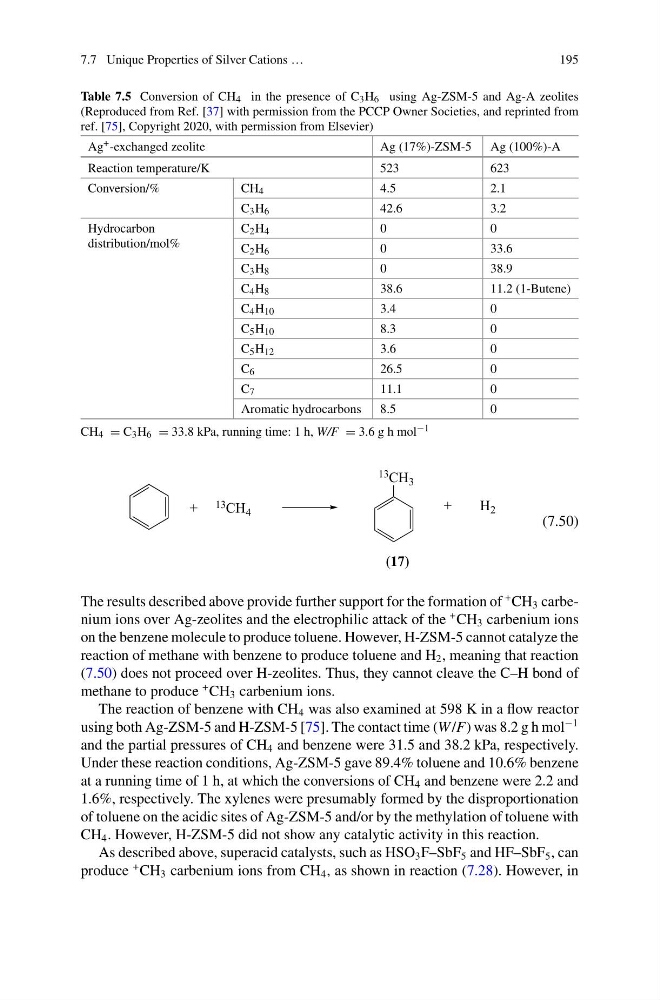
The results described above provide further support for the formation of
+ CH 3 carbenium ions over Ag-zeolites and the electrophilic attack of the
+ CH 3 carbenium ions
on the benzene molecule to produce toluene. However, H-ZSM-5 cannot catalyze the
reaction of methane with benzene to produce toluene and H 2 , meaning that reaction
(7.50) does not proceed over H-zeolites. Thus, they cannot cleave the C–H bond of
methane to produce
+ CH 3 carbenium ions.
The reaction of benzene with CH 4 was also examined at 598 K in a flow reactor
using both Ag-ZSM-5 and H-ZSM-5 [75]. The contact time (W /F) was 8.2 g h mol
−1
and the partial pressures of CH 4 and benzene were 31.5 and 38.2 kPa, respectively.
Under these reaction conditions, Ag-ZSM-5 gave 89.4% toluene and 10.6% benzene
at a running time of 1 h, at which the conversions of CH 4 and benzene were 2.2 and
1.6%, respectively. The xylenes were presumably formed by the disproportionation
of toluene on the acidic sites of Ag-ZSM-5 and/or by the methylation of toluene with
CH 4 . However, H-ZSM-5 did not show any catalytic activity in this reaction.
As described above, superacid catalysts, such as HSO 3 F–SbF 5 and HF–SbF 5 , can
produce
+ CH 3 carbenium ions from CH 4 , as shown in reaction (7.28). However, in
195
Table 7.5 Conversion of CH 4 in the presence of C 3 H 6 using Ag-ZSM-5 and Ag-A zeolites
(Reproduced from Ref. [37] with permission from the PCCP Owner Societies, and reprinted from
ref. [75], Copyright 2020, with permission from Elsevier)
Ag + -exchanged zeolite
Ag (17%)-ZSM-5 Ag (100%)-A
Reaction temperature/K
523
623
Conversion/%
CH 4
4.5
2.1
C 3 H 6
42.6
3.2
Hydrocarbon
distribution/mol%
C 2 H 4
0
0
C 2 H 6
0
33.6
C 3 H 8
0
38.9
C 4 H 8
38.6
11.2 (1-Butene)
C 4 H 10
3.4
0
C 5 H 10
8.3
0
C 5 H 12
3.6
0
C 6
26.5
0
C 7
11.1
0
Aromatic hydrocarbons 8.5
0
CH 4 = C 3 H 6 = 33.8 kPa, running time: 1 h, W/F = 3.6 g h mol −1
+ 13 CH 4
13 CH 3
+
H 2
(17)
(7.50)
The results described above provide further support for the formation of
+ CH 3 carbenium ions over Ag-zeolites and the electrophilic attack of the
+ CH 3 carbenium ions
on the benzene molecule to produce toluene. However, H-ZSM-5 cannot catalyze the
reaction of methane with benzene to produce toluene and H 2 , meaning that reaction
(7.50) does not proceed over H-zeolites. Thus, they cannot cleave the C–H bond of
methane to produce
+ CH 3 carbenium ions.
The reaction of benzene with CH 4 was also examined at 598 K in a flow reactor
using both Ag-ZSM-5 and H-ZSM-5 [75]. The contact time (W /F) was 8.2 g h mol
−1
and the partial pressures of CH 4 and benzene were 31.5 and 38.2 kPa, respectively.
Under these reaction conditions, Ag-ZSM-5 gave 89.4% toluene and 10.6% benzene
at a running time of 1 h, at which the conversions of CH 4 and benzene were 2.2 and
1.6%, respectively. The xylenes were presumably formed by the disproportionation
of toluene on the acidic sites of Ag-ZSM-5 and/or by the methylation of toluene with
CH 4 . However, H-ZSM-5 did not show any catalytic activity in this reaction.
As described above, superacid catalysts, such as HSO 3 F–SbF 5 and HF–SbF 5 , can
produce
+ CH 3 carbenium ions from CH 4 , as shown in reaction (7.28). However, in