

7.7 Unique Properties of Silver Cations …
193
However, in the case of superacid catalysts, reaction (7.30) proceeds via the formation of
+ C 2 H 5 carbenium ions; C 3 H 6 is not produced in this reaction and C 3 H 8 is
a product, as described in Sect. 7.5.2.
7.7.5.2 Reaction of CH 4 with Ethylene or Propylene Over the Zeolite
Ag-ZSM-5 in a Flow Reactor
The reaction of methane with ethylene over the zeolite Ag-ZSM-5 was also carried
out in a flow reactor [37, 75]. An equimolar mixture of CH 4 (33.8 kPa) and C 2 H 4
(33.8 kPa) was passed over the catalyst at 598 K with a W /F of 3.6 g h mol
−1 , where
W (g) is the weight of the catalyst and F (mol h
−1 ) is the total flow rate. The time
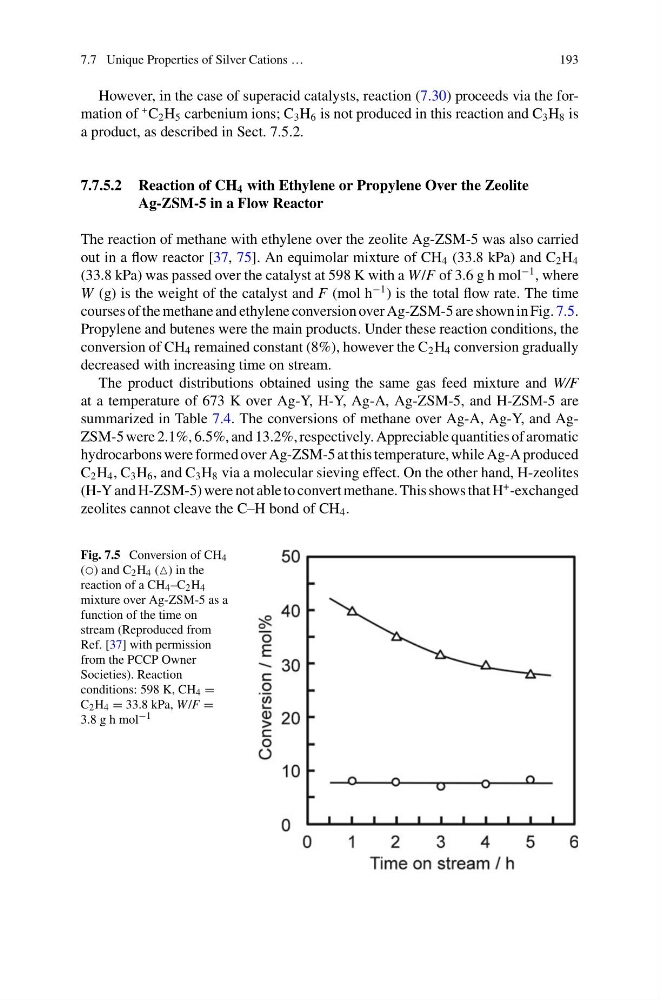
courses of the methane and ethylene conversion over Ag-ZSM-5 are shown in Fig. 7.5.
Propylene and butenes were the main products. Under these reaction conditions, the
conversion of CH 4 remained constant (8%), however the C 2 H 4 conversion gradually
decreased with increasing time on stream.
The product distributions obtained using the same gas feed mixture and W/F
at a temperature of 673 K over Ag-Y, H-Y, Ag-A, Ag-ZSM-5, and H-ZSM-5 are
summarized in Table 7.4. The conversions of methane over Ag-A, Ag-Y, and AgZSM-5 were 2.1%, 6.5%, and 13.2%, respectively. Appreciable quantities of aromatic
hydrocarbons were formed over Ag-ZSM-5 at this temperature, while Ag-A produced
C 2 H 4 , C 3 H 6 , and C 3 H 8 via a molecular sieving effect. On the other hand, H-zeolites
(H-Y and H-ZSM-5) were not able to convert methane. This shows that H
+ -exchanged
zeolites cannot cleave the C–H bond of CH 4 .
Fig. 7.5 Conversion of CH 4
(◯) and C 2 H 4 () in the
reaction of a CH 4 –C 2 H 4
mixture over Ag-ZSM-5 as a
function of the time on
stream (Reproduced from
Ref. [37] with permission
from the PCCP Owner
Societies). Reaction
conditions: 598 K, CH 4 =
C 2 H 4 = 33.8 kPa, W /F =
3.8 g h mol −1
193
However, in the case of superacid catalysts, reaction (7.30) proceeds via the formation of
+ C 2 H 5 carbenium ions; C 3 H 6 is not produced in this reaction and C 3 H 8 is
a product, as described in Sect. 7.5.2.
7.7.5.2 Reaction of CH 4 with Ethylene or Propylene Over the Zeolite
Ag-ZSM-5 in a Flow Reactor
The reaction of methane with ethylene over the zeolite Ag-ZSM-5 was also carried
out in a flow reactor [37, 75]. An equimolar mixture of CH 4 (33.8 kPa) and C 2 H 4
(33.8 kPa) was passed over the catalyst at 598 K with a W /F of 3.6 g h mol
−1 , where
W (g) is the weight of the catalyst and F (mol h
−1 ) is the total flow rate. The time
courses of the methane and ethylene conversion over Ag-ZSM-5 are shown in Fig. 7.5.
Propylene and butenes were the main products. Under these reaction conditions, the
conversion of CH 4 remained constant (8%), however the C 2 H 4 conversion gradually
decreased with increasing time on stream.
The product distributions obtained using the same gas feed mixture and W/F
at a temperature of 673 K over Ag-Y, H-Y, Ag-A, Ag-ZSM-5, and H-ZSM-5 are
summarized in Table 7.4. The conversions of methane over Ag-A, Ag-Y, and AgZSM-5 were 2.1%, 6.5%, and 13.2%, respectively. Appreciable quantities of aromatic
hydrocarbons were formed over Ag-ZSM-5 at this temperature, while Ag-A produced
C 2 H 4 , C 3 H 6 , and C 3 H 8 via a molecular sieving effect. On the other hand, H-zeolites
(H-Y and H-ZSM-5) were not able to convert methane. This shows that H
+ -exchanged
zeolites cannot cleave the C–H bond of CH 4 .
Fig. 7.5 Conversion of CH 4
(◯) and C 2 H 4 () in the
reaction of a CH 4 –C 2 H 4
mixture over Ag-ZSM-5 as a
function of the time on
stream (Reproduced from
Ref. [37] with permission
from the PCCP Owner
Societies). Reaction
conditions: 598 K, CH 4 =
C 2 H 4 = 33.8 kPa, W /F =
3.8 g h mol −1