

192
7 C–C Bond Formation via Carbocations in the Methane …
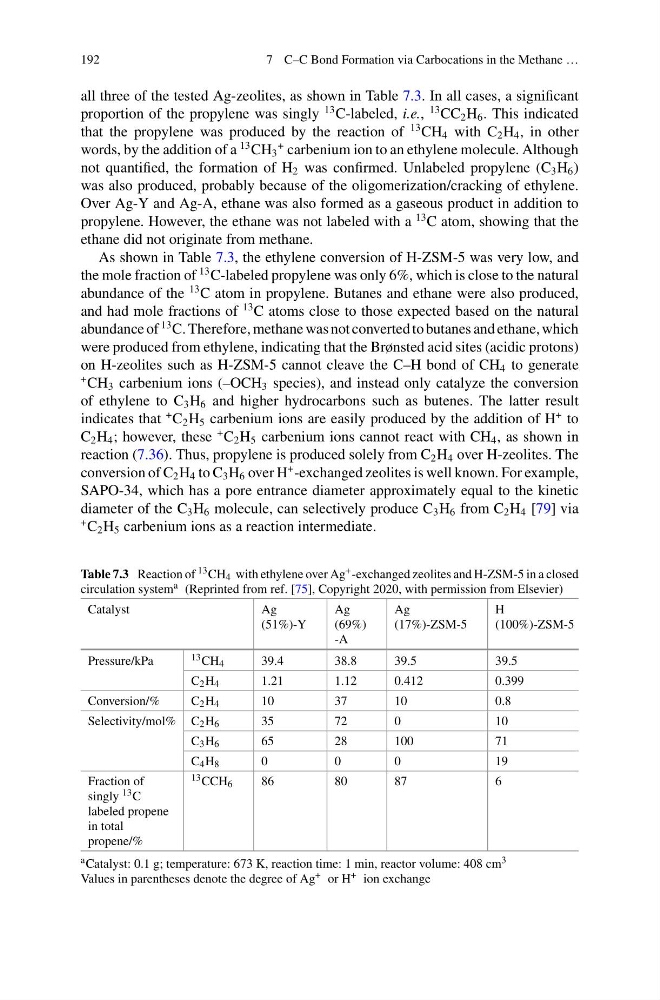
all three of the tested Ag-zeolites, as shown in Table 7.3. In all cases, a significant
proportion of the propylene was singly
13 C-labeled, i.e.,
13 CC 2 H 6 . This indicated
that the propylene was produced by the reaction of
13 CH 4 with C 2 H 4 , in other
words, by the addition of a
13 CH 3
+ carbenium ion to an ethylene molecule. Although
not quantified, the formation of H 2 was confirmed. Unlabeled propylene (C 3 H 6 )
was also produced, probably because of the oligomerization/cracking of ethylene.
Over Ag-Y and Ag-A, ethane was also formed as a gaseous product in addition to
propylene. However, the ethane was not labeled with a
13 C atom, showing that the
ethane did not originate from methane.
As shown in Table 7.3, the ethylene conversion of H-ZSM-5 was very low, and
the mole fraction of
13 C-labeled propylene was only 6%, which is close to the natural
abundance of the
13 C atom in propylene. Butanes and ethane were also produced,
and had mole fractions of
13 C atoms close to those expected based on the natural
abundance of
13 C. Therefore, methane was not converted to butanes and ethane, which
were produced from ethylene, indicating that the Brønsted acid sites (acidic protons)
on H-zeolites such as H-ZSM-5 cannot cleave the C–H bond of CH 4 to generate
+ CH 3 carbenium ions (–OCH 3 species), and instead only catalyze the conversion
of ethylene to C 3 H 6 and higher hydrocarbons such as butenes. The latter result
indicates that
+ C 2 H 5 carbenium ions are easily produced by the addition of H
+ to
C 2 H 4 ; however, these
+ C 2 H 5 carbenium ions cannot react with CH 4 , as shown in
reaction (7.36). Thus, propylene is produced solely from C 2 H 4 over H-zeolites. The
conversion of C 2 H 4 to C 3 H 6 over H
+ -exchanged zeolites is well known. For example,
SAPO-34, which has a pore entrance diameter approximately equal to the kinetic
diameter of the C 3 H 6 molecule, can selectively produce C 3 H 6 from C 2 H 4 [79] via
+ C 2 H 5 carbenium ions as a reaction intermediate.
Table 7.3 Reaction of 13 CH 4 with ethylene over Ag + -exchanged zeolites and H-ZSM-5 in a closed
circulation system a (Reprinted from ref. [75], Copyright 2020, with permission from Elsevier)
Catalyst
Ag
(51%)-Y
Ag
(69%)
-A
Ag
(17%)-ZSM-5
H
(100%)-ZSM-5
Pressure/kPa
13 CH 4
39.4
38.8
39.5
39.5
C 2 H 4
1.21
1.12
0.412
0.399
Conversion/%
C 2 H 4
10
37
10
0.8
Selectivity/mol% C 2 H 6
35
72
0
10
C 3 H 6
65
28
100
71
C 4 H 8
0
0
0
19
Fraction of
singly 13 C
labeled propene
in total
propene/%
13 CCH 6
86
80
87
6
a Catalyst: 0.1 g; temperature: 673 K, reaction time: 1 min, reactor volume: 408 cm 3
Values in parentheses denote the degree of Ag + or H + ion exchange
7 C–C Bond Formation via Carbocations in the Methane …
all three of the tested Ag-zeolites, as shown in Table 7.3. In all cases, a significant
proportion of the propylene was singly
13 C-labeled, i.e.,
13 CC 2 H 6 . This indicated
that the propylene was produced by the reaction of
13 CH 4 with C 2 H 4 , in other
words, by the addition of a
13 CH 3
+ carbenium ion to an ethylene molecule. Although
not quantified, the formation of H 2 was confirmed. Unlabeled propylene (C 3 H 6 )
was also produced, probably because of the oligomerization/cracking of ethylene.
Over Ag-Y and Ag-A, ethane was also formed as a gaseous product in addition to
propylene. However, the ethane was not labeled with a
13 C atom, showing that the
ethane did not originate from methane.
As shown in Table 7.3, the ethylene conversion of H-ZSM-5 was very low, and
the mole fraction of
13 C-labeled propylene was only 6%, which is close to the natural
abundance of the
13 C atom in propylene. Butanes and ethane were also produced,
and had mole fractions of
13 C atoms close to those expected based on the natural
abundance of
13 C. Therefore, methane was not converted to butanes and ethane, which
were produced from ethylene, indicating that the Brønsted acid sites (acidic protons)
on H-zeolites such as H-ZSM-5 cannot cleave the C–H bond of CH 4 to generate
+ CH 3 carbenium ions (–OCH 3 species), and instead only catalyze the conversion
of ethylene to C 3 H 6 and higher hydrocarbons such as butenes. The latter result
indicates that
+ C 2 H 5 carbenium ions are easily produced by the addition of H
+ to
C 2 H 4 ; however, these
+ C 2 H 5 carbenium ions cannot react with CH 4 , as shown in
reaction (7.36). Thus, propylene is produced solely from C 2 H 4 over H-zeolites. The
conversion of C 2 H 4 to C 3 H 6 over H
+ -exchanged zeolites is well known. For example,
SAPO-34, which has a pore entrance diameter approximately equal to the kinetic
diameter of the C 3 H 6 molecule, can selectively produce C 3 H 6 from C 2 H 4 [79] via
+ C 2 H 5 carbenium ions as a reaction intermediate.
Table 7.3 Reaction of 13 CH 4 with ethylene over Ag + -exchanged zeolites and H-ZSM-5 in a closed
circulation system a (Reprinted from ref. [75], Copyright 2020, with permission from Elsevier)
Catalyst
Ag
(51%)-Y
Ag
(69%)
-A
Ag
(17%)-ZSM-5
H
(100%)-ZSM-5
Pressure/kPa
13 CH 4
39.4
38.8
39.5
39.5
C 2 H 4
1.21
1.12
0.412
0.399
Conversion/%
C 2 H 4
10
37
10
0.8
Selectivity/mol% C 2 H 6
35
72
0
10
C 3 H 6
65
28
100
71
C 4 H 8
0
0
0
19
Fraction of
singly 13 C
labeled propene
in total
propene/%
13 CCH 6
86
80
87
6
a Catalyst: 0.1 g; temperature: 673 K, reaction time: 1 min, reactor volume: 408 cm 3
Values in parentheses denote the degree of Ag + or H + ion exchange