

184
7 C–C Bond Formation via Carbocations in the Methane …
Thus, the metallic silver (Ag
0 ), which is formed by the reduction of Ag
+ cations with
hydrogen, is re-oxidized with oxygen to form both Ag
+ cations and H 2 O as shown
in reaction (7.40). The disappearance of the Ag
+ cations due to reduction with H 2
and the reappearance of the Ag
+ cations upon oxidation have been confirmed in
the infrared spectra of CO adsorbed on Ag-zeolites, such as Ag-Y [45, 46]. The
formation of acidic protons (H
+ ) has also been confirmed by the appearance of O–H
groups in infrared spectroscopy [43]. When Ag-Y was placed in contact with D 2 ,
two deuteroxyl bands (O–D bands) were observed. These O-D bands were similar
to the high and low frequency bands of D-Y (D
+ -exchanged Y-type zeolite) [47].
However, the chemistry of the reduction–oxidation process is more complex than
the simplified version shown in reactions (7.39) and (7.40), and a great deal of effort
has been devoted to elucidating the silver species involved [43, 47–60]. In fact,
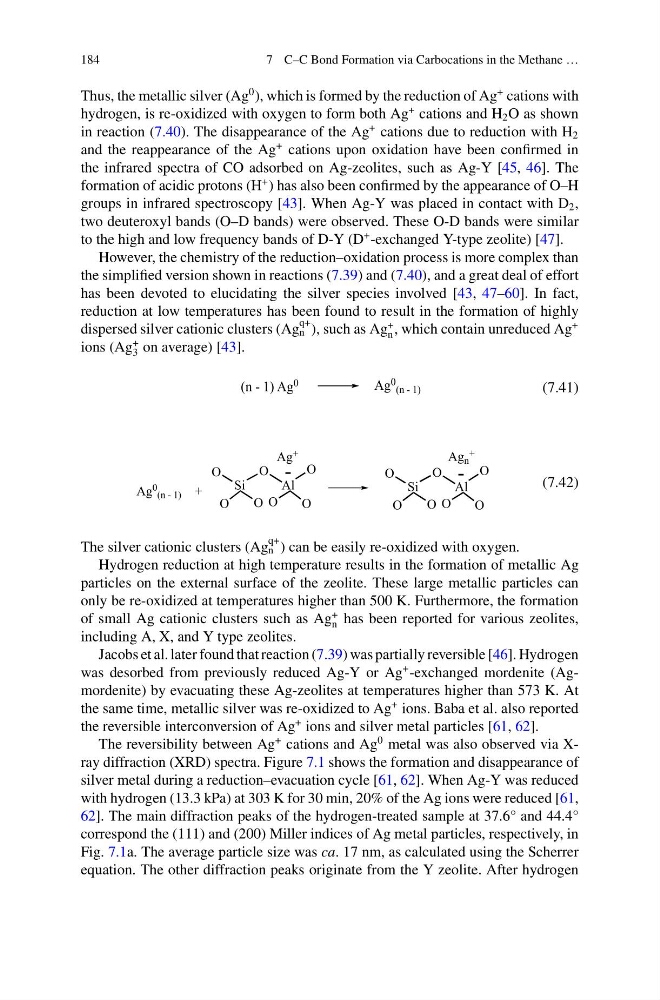
reduction at low temperatures has been found to result in the formation of highly
dispersed silver cationic clusters (Ag
q+
n ), such as Ag
+
n , which contain unreduced Ag
+
ions (Ag
+
3 on average) [43].
(n - 1) Ag 0
Ag 0 (n - 1)
(7.41)
Ag +
Ag 0 (n - 1) +
Ag n
+
O
O
O
Si
O
Al
O
O
O
-
O
O
O
Si
O
Al
O
O
O
-
(7.42)
The silver cationic clusters (Ag
q+
n ) can be easily re-oxidized with oxygen.
Hydrogen reduction at high temperature results in the formation of metallic Ag
particles on the external surface of the zeolite. These large metallic particles can
only be re-oxidized at temperatures higher than 500 K. Furthermore, the formation
of small Ag cationic clusters such as Ag
+
n has been reported for various zeolites,
including A, X, and Y type zeolites.
Jacobs et al. later found that reaction (7.39) was partially reversible [46]. Hydrogen
was desorbed from previously reduced Ag-Y or Ag
+ -exchanged mordenite (Agmordenite) by evacuating these Ag-zeolites at temperatures higher than 573 K. At
the same time, metallic silver was re-oxidized to Ag
+ ions. Baba et al. also reported
the reversible interconversion of Ag
+ ions and silver metal particles [61, 62].
The reversibility between Ag
+ cations and Ag
0 metal was also observed via Xray diffraction (XRD) spectra. Figure 7.1 shows the formation and disappearance of
silver metal during a reduction–evacuation cycle [61, 62]. When Ag-Y was reduced
with hydrogen (13.3 kPa) at 303 K for 30 min, 20% of the Ag ions were reduced [61,
62]. The main diffraction peaks of the hydrogen-treated sample at 37.6° and 44.4°
correspond the (111) and (200) Miller indices of Ag metal particles, respectively, in
Fig. 7.1a. The average particle size was ca. 17 nm, as calculated using the Scherrer
equation. The other diffraction peaks originate from the Y zeolite. After hydrogen
7 C–C Bond Formation via Carbocations in the Methane …
Thus, the metallic silver (Ag
0 ), which is formed by the reduction of Ag
+ cations with
hydrogen, is re-oxidized with oxygen to form both Ag
+ cations and H 2 O as shown
in reaction (7.40). The disappearance of the Ag
+ cations due to reduction with H 2
and the reappearance of the Ag
+ cations upon oxidation have been confirmed in
the infrared spectra of CO adsorbed on Ag-zeolites, such as Ag-Y [45, 46]. The
formation of acidic protons (H
+ ) has also been confirmed by the appearance of O–H
groups in infrared spectroscopy [43]. When Ag-Y was placed in contact with D 2 ,
two deuteroxyl bands (O–D bands) were observed. These O-D bands were similar
to the high and low frequency bands of D-Y (D
+ -exchanged Y-type zeolite) [47].
However, the chemistry of the reduction–oxidation process is more complex than
the simplified version shown in reactions (7.39) and (7.40), and a great deal of effort
has been devoted to elucidating the silver species involved [43, 47–60]. In fact,
reduction at low temperatures has been found to result in the formation of highly
dispersed silver cationic clusters (Ag
q+
n ), such as Ag
+
n , which contain unreduced Ag
+
ions (Ag
+
3 on average) [43].
(n - 1) Ag 0
Ag 0 (n - 1)
(7.41)
Ag +
Ag 0 (n - 1) +
Ag n
+
O
O
O
Si
O
Al
O
O
O
-
O
O
O
Si
O
Al
O
O
O
-
(7.42)
The silver cationic clusters (Ag
q+
n ) can be easily re-oxidized with oxygen.
Hydrogen reduction at high temperature results in the formation of metallic Ag
particles on the external surface of the zeolite. These large metallic particles can
only be re-oxidized at temperatures higher than 500 K. Furthermore, the formation
of small Ag cationic clusters such as Ag
+
n has been reported for various zeolites,
including A, X, and Y type zeolites.
Jacobs et al. later found that reaction (7.39) was partially reversible [46]. Hydrogen
was desorbed from previously reduced Ag-Y or Ag
+ -exchanged mordenite (Agmordenite) by evacuating these Ag-zeolites at temperatures higher than 573 K. At
the same time, metallic silver was re-oxidized to Ag
+ ions. Baba et al. also reported
the reversible interconversion of Ag
+ ions and silver metal particles [61, 62].
The reversibility between Ag
+ cations and Ag
0 metal was also observed via Xray diffraction (XRD) spectra. Figure 7.1 shows the formation and disappearance of
silver metal during a reduction–evacuation cycle [61, 62]. When Ag-Y was reduced
with hydrogen (13.3 kPa) at 303 K for 30 min, 20% of the Ag ions were reduced [61,
62]. The main diffraction peaks of the hydrogen-treated sample at 37.6° and 44.4°
correspond the (111) and (200) Miller indices of Ag metal particles, respectively, in
Fig. 7.1a. The average particle size was ca. 17 nm, as calculated using the Scherrer
equation. The other diffraction peaks originate from the Y zeolite. After hydrogen