

7.7 Unique Properties of Silver Cations …
183
7.7 Unique Properties of Silver Cations in the Zeolite-Based
Catalysis of the Reaction of Methane with Ethylene
The characteristics of Ag-zeolites that lead to the activation of methane to generate
+ CH 3 carbenium ions, which in turn enables the reaction of methane with alkenes
such as ethylene or aromatic hydrocarbons such as benzene, are discussed in the
following sections.
7.7.1 General Properties of Ag + -Exchanged Zeolites:
Reversible Reduction of Ag + Cations and Generation
of Brønsted Acid Sites
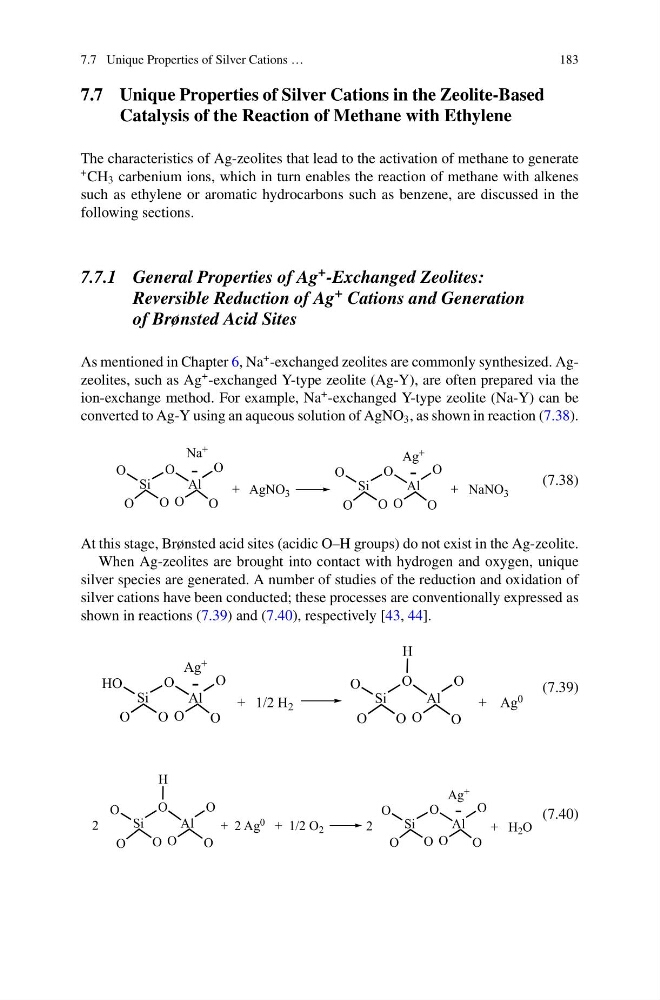
As mentioned in Chapter 6, Na
+ -exchanged zeolites are commonly synthesized. Agzeolites, such as Ag
+ -exchanged Y-type zeolite (Ag-Y), are often prepared via the
ion-exchange method. For example, Na
+ -exchanged Y-type zeolite (Na-Y) can be
converted to Ag-Y using an aqueous solution of AgNO 3 , as shown in reaction (7.38).
O
O
O
Si
O
Al
O
O
O
-
Na +
+ AgNO 3
Ag +
+ NaNO 3
O
O
O
Si
O
Al
O
O
O
-
(7.38)
At this stage, Brønsted acid sites (acidic O–H groups) do not exist in the Ag-zeolite.
When Ag-zeolites are brought into contact with hydrogen and oxygen, unique
silver species are generated. A number of studies of the reduction and oxidation of
silver cations have been conducted; these processes are conventionally expressed as
shown in reactions (7.39) and (7.40), respectively [43, 44].
+ 1/2 H 2
+ Ag 0
Ag +
O
O
HO
Si
O
Al
O
O
O
-
O
O
O
Si
O
Al
O
O
O
H
(7.39)
2
+ 2 Ag 0 + 1/2 O 2
2
+ H 2 O
O
O
O
Si
O
Al
O
O
O
H
Ag +
O
O
O
Si
O
Al
O
O
O
-
(7.40)
183
7.7 Unique Properties of Silver Cations in the Zeolite-Based
Catalysis of the Reaction of Methane with Ethylene
The characteristics of Ag-zeolites that lead to the activation of methane to generate
+ CH 3 carbenium ions, which in turn enables the reaction of methane with alkenes
such as ethylene or aromatic hydrocarbons such as benzene, are discussed in the
following sections.
7.7.1 General Properties of Ag + -Exchanged Zeolites:
Reversible Reduction of Ag + Cations and Generation
of Brønsted Acid Sites
As mentioned in Chapter 6, Na
+ -exchanged zeolites are commonly synthesized. Agzeolites, such as Ag
+ -exchanged Y-type zeolite (Ag-Y), are often prepared via the
ion-exchange method. For example, Na
+ -exchanged Y-type zeolite (Na-Y) can be
converted to Ag-Y using an aqueous solution of AgNO 3 , as shown in reaction (7.38).
O
O
O
Si
O
Al
O
O
O
-
Na +
+ AgNO 3
Ag +
+ NaNO 3
O
O
O
Si
O
Al
O
O
O
-
(7.38)
At this stage, Brønsted acid sites (acidic O–H groups) do not exist in the Ag-zeolite.
When Ag-zeolites are brought into contact with hydrogen and oxygen, unique
silver species are generated. A number of studies of the reduction and oxidation of
silver cations have been conducted; these processes are conventionally expressed as
shown in reactions (7.39) and (7.40), respectively [43, 44].
+ 1/2 H 2
+ Ag 0
Ag +
O
O
HO
Si
O
Al
O
O
O
-
O
O
O
Si
O
Al
O
O
O
H
(7.39)
2
+ 2 Ag 0 + 1/2 O 2
2
+ H 2 O
O
O
O
Si
O
Al
O
O
O
H
Ag +
O
O
O
Si
O
Al
O
O
O
-
(7.40)