

182
7 C–C Bond Formation via Carbocations in the Methane …
CH 3 CH CH 2 +
O
O
O
Si
O
Al
O
O
O
CH 3
O
O
O Si
O
Al
O
O
O
H
CH 2 CH 2
+
(7.34)
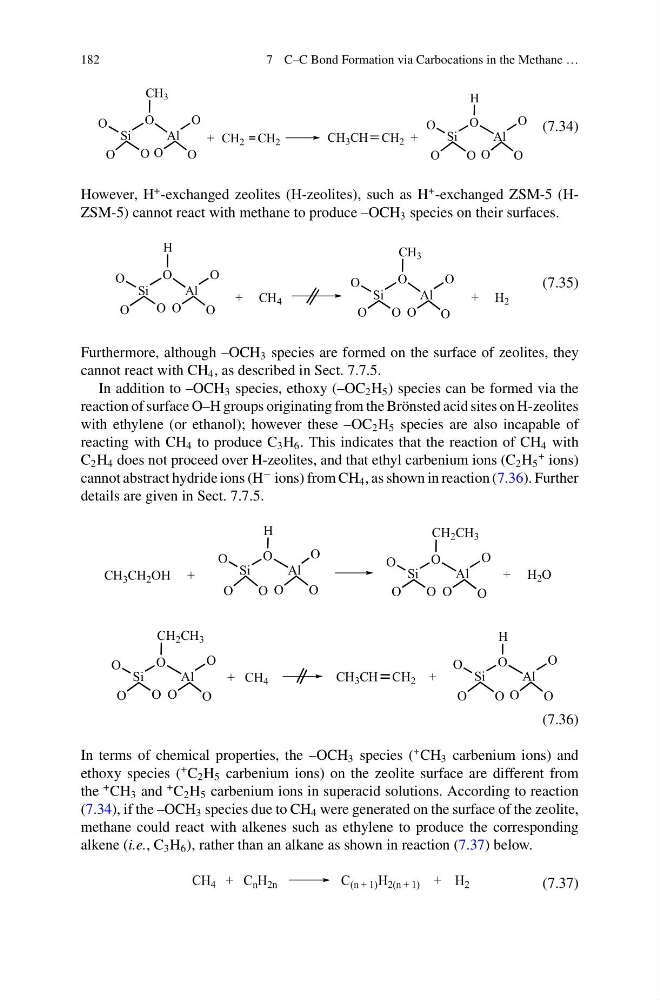
However, H
+ -exchanged zeolites (H-zeolites), such as H
+ -exchanged ZSM-5 (HZSM-5) cannot react with methane to produce –OCH 3 species on their surfaces.
O
O
O
Si
O
Al
O
O
O
H
+ CH 4
O
O
O
Si
O
Al
O
O
O
CH 3
+ H 2
(7.35)
Furthermore, although –OCH 3 species are formed on the surface of zeolites, they
cannot react with CH 4 , as described in Sect. 7.7.5.
In addition to –OCH 3 species, ethoxy (–OC 2 H 5 ) species can be formed via the
reaction of surface O–H groups originating from the Brönsted acid sites on H-zeolites
with ethylene (or ethanol); however these –OC 2 H 5 species are also incapable of
reacting with CH 4 to produce C 3 H 6 . This indicates that the reaction of CH 4 with
C 2 H 4 does not proceed over H-zeolites, and that ethyl carbenium ions (C 2 H 5
+ ions)
cannot abstract hydride ions (H
− ions) from CH 4 , as shown in reaction (7.36). Further
details are given in Sect. 7.7.5.
O
O
O Si
O
Al
O
O
O
H
CH 3 CH 2 OH +
+ H 2 O
O
O
O Si
O
Al
O
O
O
CH 2 CH 3
CH 3 CH CH 2 +
O
O
O Si
O
Al
O
O
O
H
+ CH 4
O
O
O Si
O
Al
O
O
O
CH 2 CH 3
(7.36)
In terms of chemical properties, the –OCH 3 species (
+ CH 3 carbenium ions) and
ethoxy species (
+ C 2 H 5 carbenium ions) on the zeolite surface are different from
the
+ CH 3 and
+ C 2 H 5 carbenium ions in superacid solutions. According to reaction
(7.34), if the –OCH 3 species due to CH 4 were generated on the surface of the zeolite,
methane could react with alkenes such as ethylene to produce the corresponding
alkene (i.e., C 3 H 6 ), rather than an alkane as shown in reaction (7.37) below.
CH 4 + C n H 2n
C (n + 1) H 2(n + 1) + H 2
(7.37)
7 C–C Bond Formation via Carbocations in the Methane …
CH 3 CH CH 2 +
O
O
O
Si
O
Al
O
O
O
CH 3
O
O
O Si
O
Al
O
O
O
H
CH 2 CH 2
+
(7.34)
However, H
+ -exchanged zeolites (H-zeolites), such as H
+ -exchanged ZSM-5 (HZSM-5) cannot react with methane to produce –OCH 3 species on their surfaces.
O
O
O
Si
O
Al
O
O
O
H
+ CH 4
O
O
O
Si
O
Al
O
O
O
CH 3
+ H 2
(7.35)
Furthermore, although –OCH 3 species are formed on the surface of zeolites, they
cannot react with CH 4 , as described in Sect. 7.7.5.
In addition to –OCH 3 species, ethoxy (–OC 2 H 5 ) species can be formed via the
reaction of surface O–H groups originating from the Brönsted acid sites on H-zeolites
with ethylene (or ethanol); however these –OC 2 H 5 species are also incapable of
reacting with CH 4 to produce C 3 H 6 . This indicates that the reaction of CH 4 with
C 2 H 4 does not proceed over H-zeolites, and that ethyl carbenium ions (C 2 H 5
+ ions)
cannot abstract hydride ions (H
− ions) from CH 4 , as shown in reaction (7.36). Further
details are given in Sect. 7.7.5.
O
O
O Si
O
Al
O
O
O
H
CH 3 CH 2 OH +
+ H 2 O
O
O
O Si
O
Al
O
O
O
CH 2 CH 3
CH 3 CH CH 2 +
O
O
O Si
O
Al
O
O
O
H
+ CH 4
O
O
O Si
O
Al
O
O
O
CH 2 CH 3
(7.36)
In terms of chemical properties, the –OCH 3 species (
+ CH 3 carbenium ions) and
ethoxy species (
+ C 2 H 5 carbenium ions) on the zeolite surface are different from
the
+ CH 3 and
+ C 2 H 5 carbenium ions in superacid solutions. According to reaction
(7.34), if the –OCH 3 species due to CH 4 were generated on the surface of the zeolite,
methane could react with alkenes such as ethylene to produce the corresponding
alkene (i.e., C 3 H 6 ), rather than an alkane as shown in reaction (7.37) below.
CH 4 + C n H 2n
C (n + 1) H 2(n + 1) + H 2
(7.37)