

7.6 Ag + -Exchanged Zeolite Catalysts for C–C Bond …
181
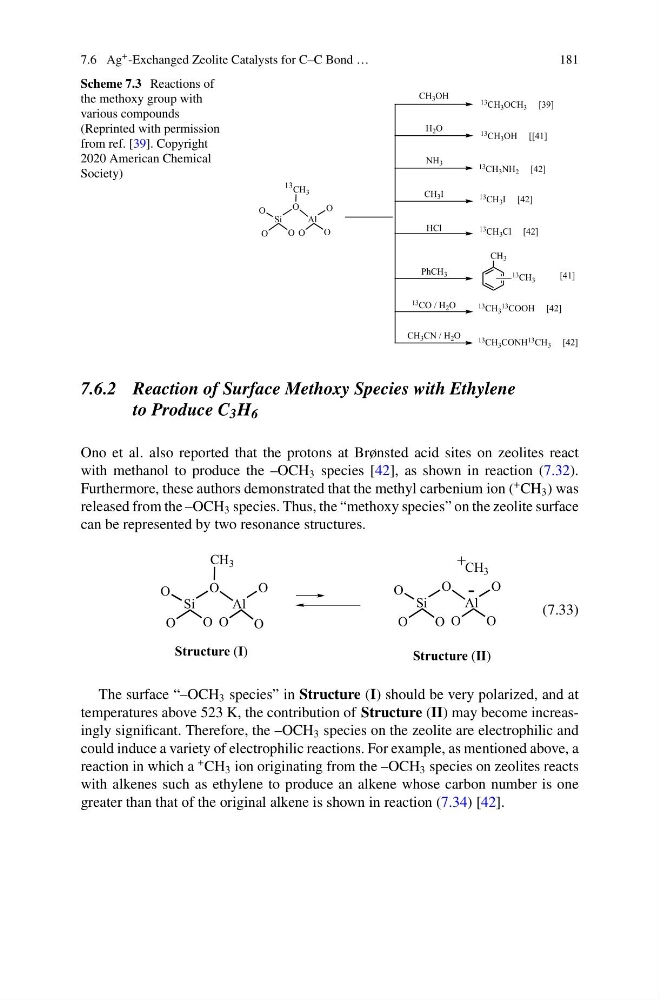
Scheme 7.3 Reactions of
the methoxy group with
various compounds
(Reprinted with permission
from ref. [39]. Copyright
2020 American Chemical
Society)
O
O
O
Si
O
Al
O
O
O
CH 3
13
CH 3 CN / H 2 O
13 CO / H 2 O
CH 3 OH
H 2 O
NH 3
CH 3 I
HCl
PhCH 3
13 CH 3 OCH 3 [39]
13 CH 3 OH [[41]
13 CH 3 NH 2 [42]
13 CH 3 I [42]
13 CH 3 Cl [42]
CH 3
13 CH 3
13 CH 3
13 COOH [42]
13 CH 3 CONH 13 CH 3 [42]
[41]
7.6.2 Reaction of Surface Methoxy Species with Ethylene
to Produce C 3 H 6
Ono et al. also reported that the protons at Brønsted acid sites on zeolites react
with methanol to produce the –OCH 3 species [42], as shown in reaction (7.32).
Furthermore, these authors demonstrated that the methyl carbenium ion (
+ CH 3 ) was
released from the –OCH 3 species. Thus, the “methoxy species” on the zeolite surface
can be represented by two resonance structures.
O
O
O
Si
O
Al
O
O
O
CH 3
-
+
Structure (I)
Structure (II)
O
O
O
Si
O
Al
O
O
O
CH 3
(7.33)
The surface “–OCH 3 species” in Structure (I) should be very polarized, and at
temperatures above 523 K, the contribution of Structure (II) may become increasingly significant. Therefore, the –OCH 3 species on the zeolite are electrophilic and
could induce a variety of electrophilic reactions. For example, as mentioned above, a
reaction in which a
+ CH 3 ion originating from the –OCH 3 species on zeolites reacts
with alkenes such as ethylene to produce an alkene whose carbon number is one
greater than that of the original alkene is shown in reaction (7.34) [42].
181
Scheme 7.3 Reactions of
the methoxy group with
various compounds
(Reprinted with permission
from ref. [39]. Copyright
2020 American Chemical
Society)
O
O
O
Si
O
Al
O
O
O
CH 3
13
CH 3 CN / H 2 O
13 CO / H 2 O
CH 3 OH
H 2 O
NH 3
CH 3 I
HCl
PhCH 3
13 CH 3 OCH 3 [39]
13 CH 3 OH [[41]
13 CH 3 NH 2 [42]
13 CH 3 I [42]
13 CH 3 Cl [42]
CH 3
13 CH 3
13 CH 3
13 COOH [42]
13 CH 3 CONH 13 CH 3 [42]
[41]
7.6.2 Reaction of Surface Methoxy Species with Ethylene
to Produce C 3 H 6
Ono et al. also reported that the protons at Brønsted acid sites on zeolites react
with methanol to produce the –OCH 3 species [42], as shown in reaction (7.32).
Furthermore, these authors demonstrated that the methyl carbenium ion (
+ CH 3 ) was
released from the –OCH 3 species. Thus, the “methoxy species” on the zeolite surface
can be represented by two resonance structures.
O
O
O
Si
O
Al
O
O
O
CH 3
-
+
Structure (I)
Structure (II)
O
O
O
Si
O
Al
O
O
O
CH 3
(7.33)
The surface “–OCH 3 species” in Structure (I) should be very polarized, and at
temperatures above 523 K, the contribution of Structure (II) may become increasingly significant. Therefore, the –OCH 3 species on the zeolite are electrophilic and
could induce a variety of electrophilic reactions. For example, as mentioned above, a
reaction in which a
+ CH 3 ion originating from the –OCH 3 species on zeolites reacts
with alkenes such as ethylene to produce an alkene whose carbon number is one
greater than that of the original alkene is shown in reaction (7.34) [42].