

180
7 C–C Bond Formation via Carbocations in the Methane …
(1) The general properties of zeolites; namely, the reactivity of surface methoxy
species (–OCH 3 ) on zeolites.
(2) The unique catalytic properties of solid-acid catalysis by Ag-zeolites:
Hydrogen-induced acid catalysis.
(3) The reversible heterolytic dissociation of hydrogen molecules on Ag-zeolites
and the formation of hydrogen species.
(4) The heterolytic dissociation of C–H bonds of methane over Ag-zeolites and the
reaction of CH 4 with C 2 H 4 to produce C 3 H 6 and H 2 .
(5) Activation of alkanes including CH 4 over metal cation-exchanged zeolites: The
differences between the catalytic properties of Ag-zeolites and Zn
2+ -exchanged
zeolites (Zn-zeolites).
7.6.1 Catalysis of Electrophilic Reactions by H + -Exchanged
Zeolites: Role of the Methoxy Species on the Zeolite
Surface
Methane could potentially be reacted with other hydrocarbons such as ethylene
using catalysts other than superacids to generate
+ CH 3 from CH 4 . The acidic O–
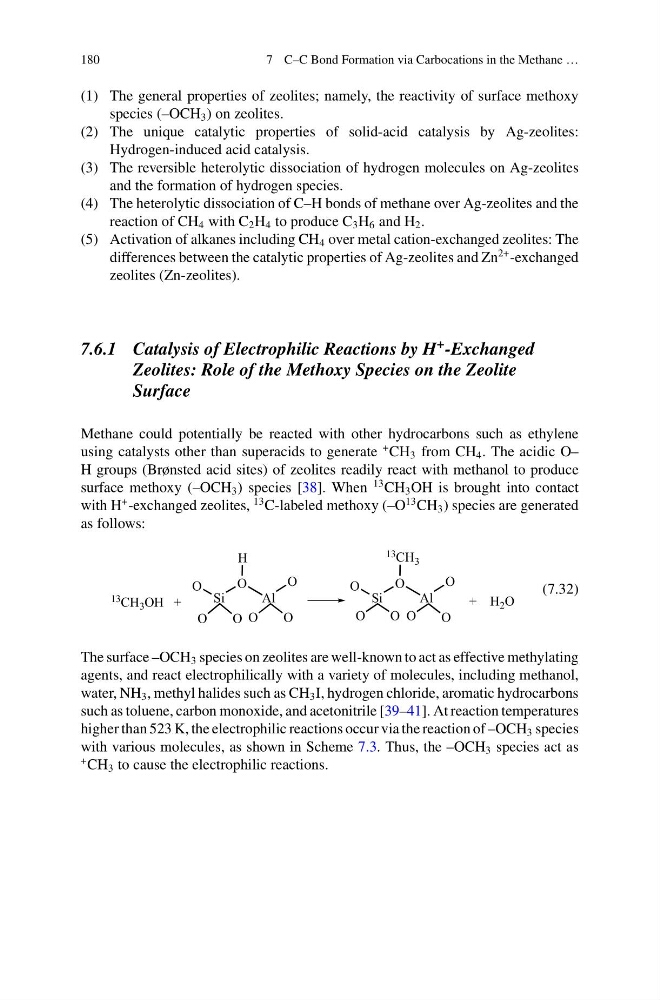
H groups (Brønsted acid sites) of zeolites readily react with methanol to produce
surface methoxy (–OCH 3 ) species [38]. When
13 CH 3 OH is brought into contact
with H
+ -exchanged zeolites,
13 C-labeled methoxy (–O
13 CH 3 ) species are generated
as follows:
O
O
O Si
O
Al
O
O
O
H
13 CH 3 OH +
+ H 2 O
O
O
O Si
O
Al
O
O
O
13 CH 3
(7.32)
The surface –OCH 3 species on zeolites are well-known to act as effective methylating
agents, and react electrophilically with a variety of molecules, including methanol,
water, NH 3 , methyl halides such as CH 3 I, hydrogen chloride, aromatic hydrocarbons
such as toluene, carbon monoxide, and acetonitrile [39–41]. At reaction temperatures
higher than 523 K, the electrophilic reactions occur via the reaction of –OCH 3 species
with various molecules, as shown in Scheme 7.3. Thus, the –OCH 3 species act as
+ CH 3 to cause the electrophilic reactions.
7 C–C Bond Formation via Carbocations in the Methane …
(1) The general properties of zeolites; namely, the reactivity of surface methoxy
species (–OCH 3 ) on zeolites.
(2) The unique catalytic properties of solid-acid catalysis by Ag-zeolites:
Hydrogen-induced acid catalysis.
(3) The reversible heterolytic dissociation of hydrogen molecules on Ag-zeolites
and the formation of hydrogen species.
(4) The heterolytic dissociation of C–H bonds of methane over Ag-zeolites and the
reaction of CH 4 with C 2 H 4 to produce C 3 H 6 and H 2 .
(5) Activation of alkanes including CH 4 over metal cation-exchanged zeolites: The
differences between the catalytic properties of Ag-zeolites and Zn
2+ -exchanged
zeolites (Zn-zeolites).
7.6.1 Catalysis of Electrophilic Reactions by H + -Exchanged
Zeolites: Role of the Methoxy Species on the Zeolite
Surface
Methane could potentially be reacted with other hydrocarbons such as ethylene
using catalysts other than superacids to generate
+ CH 3 from CH 4 . The acidic O–
H groups (Brønsted acid sites) of zeolites readily react with methanol to produce
surface methoxy (–OCH 3 ) species [38]. When
13 CH 3 OH is brought into contact
with H
+ -exchanged zeolites,
13 C-labeled methoxy (–O
13 CH 3 ) species are generated
as follows:
O
O
O Si
O
Al
O
O
O
H
13 CH 3 OH +
+ H 2 O
O
O
O Si
O
Al
O
O
O
13 CH 3
(7.32)
The surface –OCH 3 species on zeolites are well-known to act as effective methylating
agents, and react electrophilically with a variety of molecules, including methanol,
water, NH 3 , methyl halides such as CH 3 I, hydrogen chloride, aromatic hydrocarbons
such as toluene, carbon monoxide, and acetonitrile [39–41]. At reaction temperatures
higher than 523 K, the electrophilic reactions occur via the reaction of –OCH 3 species
with various molecules, as shown in Scheme 7.3. Thus, the –OCH 3 species act as
+ CH 3 to cause the electrophilic reactions.