

7.5 Role of Penta-Coordinated Carbonium Ion Intermediates …
179
+ H +
H 2
C
C
H 3 CH 2
+
CH 2
CH 3 CH 3
+
13 CH 4 +
+
13 C
H
C 2 H 5
13 CH 3 CH 2 CH 3 + H +
(16)
H
H
H
(7.30)
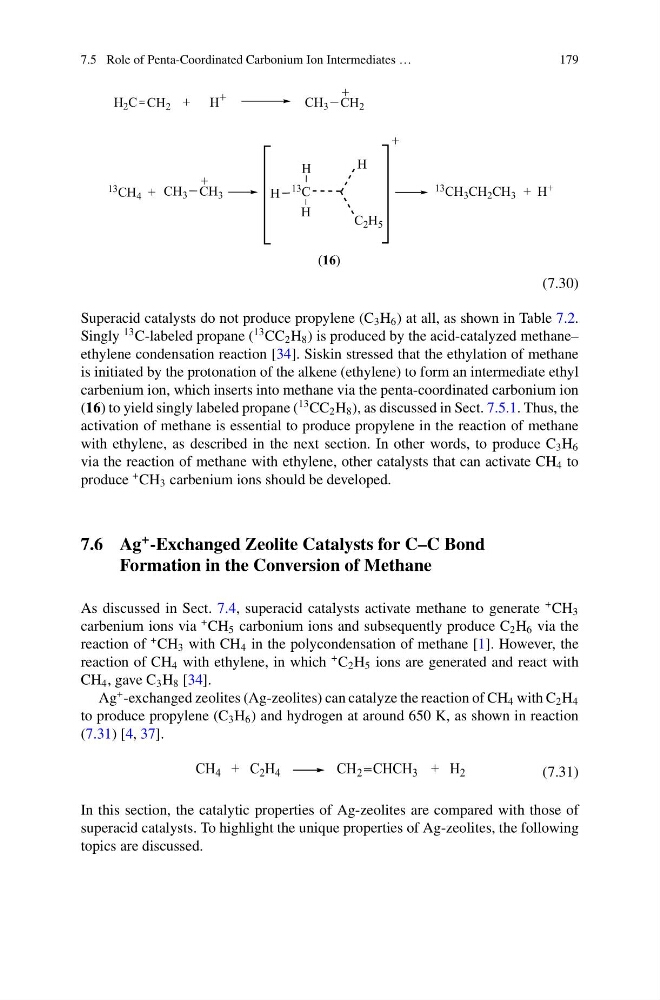
Superacid catalysts do not produce propylene (C 3 H 6 ) at all, as shown in Table 7.2.
Singly
13 C-labeled propane (
13 CC 2 H 8 ) is produced by the acid-catalyzed methane–
ethylene condensation reaction [34]. Siskin stressed that the ethylation of methane
is initiated by the protonation of the alkene (ethylene) to form an intermediate ethyl
carbenium ion, which inserts into methane via the penta-coordinated carbonium ion
(16) to yield singly labeled propane (
13 CC 2 H 8 ), as discussed in Sect. 7.5.1. Thus, the
activation of methane is essential to produce propylene in the reaction of methane
with ethylene, as described in the next section. In other words, to produce C 3 H 6
via the reaction of methane with ethylene, other catalysts that can activate CH 4 to
produce
+ CH 3 carbenium ions should be developed.
7.6 Ag + -Exchanged Zeolite Catalysts for C–C Bond
Formation in the Conversion of Methane
As discussed in Sect. 7.4, superacid catalysts activate methane to generate
+ CH 3
carbenium ions via
+ CH 5 carbonium ions and subsequently produce C 2 H 6 via the
reaction of
+ CH 3 with CH 4 in the polycondensation of methane [1]. However, the
reaction of CH 4 with ethylene, in which
+ C 2 H 5 ions are generated and react with
CH 4 , gave C 3 H 8 [34].
Ag
+ -exchanged zeolites (Ag-zeolites) can catalyze the reaction of CH 4 with C 2 H 4
to produce propylene (C 3 H 6 ) and hydrogen at around 650 K, as shown in reaction
(7.31) [4, 37].
CH 4 + C 2 H 4
CH 2 CHCH 3 + H 2
(7.31)
In this section, the catalytic properties of Ag-zeolites are compared with those of
superacid catalysts. To highlight the unique properties of Ag-zeolites, the following
topics are discussed.
179
+ H +
H 2
C
C
H 3 CH 2
+
CH 2
CH 3 CH 3
+
13 CH 4 +
+
13 C
H
C 2 H 5
13 CH 3 CH 2 CH 3 + H +
(16)
H
H
H
(7.30)
Superacid catalysts do not produce propylene (C 3 H 6 ) at all, as shown in Table 7.2.
Singly
13 C-labeled propane (
13 CC 2 H 8 ) is produced by the acid-catalyzed methane–
ethylene condensation reaction [34]. Siskin stressed that the ethylation of methane
is initiated by the protonation of the alkene (ethylene) to form an intermediate ethyl
carbenium ion, which inserts into methane via the penta-coordinated carbonium ion
(16) to yield singly labeled propane (
13 CC 2 H 8 ), as discussed in Sect. 7.5.1. Thus, the
activation of methane is essential to produce propylene in the reaction of methane
with ethylene, as described in the next section. In other words, to produce C 3 H 6
via the reaction of methane with ethylene, other catalysts that can activate CH 4 to
produce
+ CH 3 carbenium ions should be developed.
7.6 Ag + -Exchanged Zeolite Catalysts for C–C Bond
Formation in the Conversion of Methane
As discussed in Sect. 7.4, superacid catalysts activate methane to generate
+ CH 3
carbenium ions via
+ CH 5 carbonium ions and subsequently produce C 2 H 6 via the
reaction of
+ CH 3 with CH 4 in the polycondensation of methane [1]. However, the
reaction of CH 4 with ethylene, in which
+ C 2 H 5 ions are generated and react with
CH 4 , gave C 3 H 8 [34].
Ag
+ -exchanged zeolites (Ag-zeolites) can catalyze the reaction of CH 4 with C 2 H 4
to produce propylene (C 3 H 6 ) and hydrogen at around 650 K, as shown in reaction
(7.31) [4, 37].
CH 4 + C 2 H 4
CH 2 CHCH 3 + H 2
(7.31)
In this section, the catalytic properties of Ag-zeolites are compared with those of
superacid catalysts. To highlight the unique properties of Ag-zeolites, the following
topics are discussed.