

7.7 Unique Properties of Silver Cations …
185
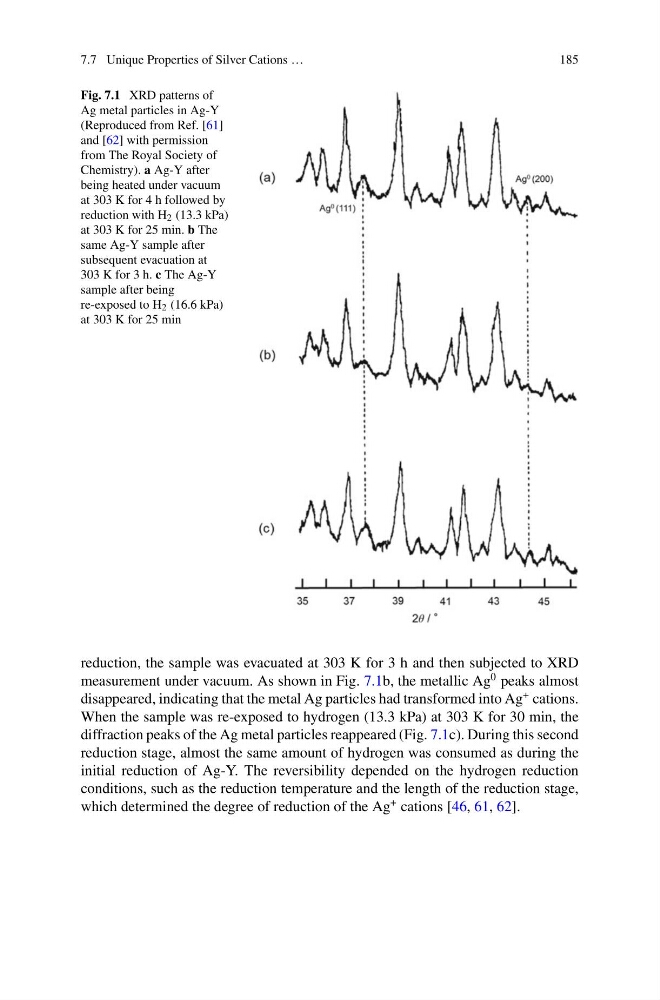
Fig. 7.1 XRD patterns of
Ag metal particles in Ag-Y
(Reproduced from Ref. [61]
and [62] with permission
from The Royal Society of
Chemistry). a Ag-Y after
being heated under vacuum
at 303 K for 4 h followed by
reduction with H 2 (13.3 kPa)
at 303 K for 25 min. b The
same Ag-Y sample after
subsequent evacuation at
303 K for 3 h. c The Ag-Y
sample after being
re-exposed to H 2 (16.6 kPa)
at 303 K for 25 min
reduction, the sample was evacuated at 303 K for 3 h and then subjected to XRD
measurement under vacuum. As shown in Fig. 7.1b, the metallic Ag
0 peaks almost
disappeared, indicating that the metal Ag particles had transformed into Ag
+ cations.
When the sample was re-exposed to hydrogen (13.3 kPa) at 303 K for 30 min, the
diffraction peaks of the Ag metal particles reappeared (Fig. 7.1c). During this second
reduction stage, almost the same amount of hydrogen was consumed as during the
initial reduction of Ag-Y. The reversibility depended on the hydrogen reduction
conditions, such as the reduction temperature and the length of the reduction stage,
which determined the degree of reduction of the Ag
+ cations [46, 61, 62].
185
Fig. 7.1 XRD patterns of
Ag metal particles in Ag-Y
(Reproduced from Ref. [61]
and [62] with permission
from The Royal Society of
Chemistry). a Ag-Y after
being heated under vacuum
at 303 K for 4 h followed by
reduction with H 2 (13.3 kPa)
at 303 K for 25 min. b The
same Ag-Y sample after
subsequent evacuation at
303 K for 3 h. c The Ag-Y
sample after being
re-exposed to H 2 (16.6 kPa)
at 303 K for 25 min
reduction, the sample was evacuated at 303 K for 3 h and then subjected to XRD
measurement under vacuum. As shown in Fig. 7.1b, the metallic Ag
0 peaks almost
disappeared, indicating that the metal Ag particles had transformed into Ag
+ cations.
When the sample was re-exposed to hydrogen (13.3 kPa) at 303 K for 30 min, the
diffraction peaks of the Ag metal particles reappeared (Fig. 7.1c). During this second
reduction stage, almost the same amount of hydrogen was consumed as during the
initial reduction of Ag-Y. The reversibility depended on the hydrogen reduction
conditions, such as the reduction temperature and the length of the reduction stage,
which determined the degree of reduction of the Ag
+ cations [46, 61, 62].