

7.5 Role of Penta-Coordinated Carbonium Ion Intermediates …
177
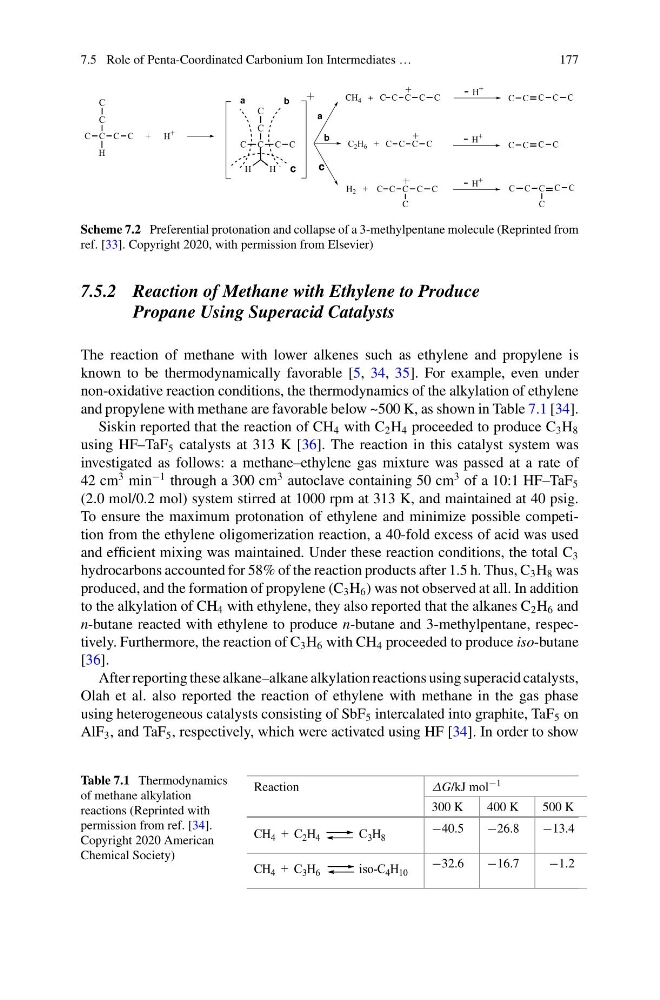
Scheme 7.2 Preferential protonation and collapse of a 3-methylpentane molecule (Reprinted from
ref. [33]. Copyright 2020, with permission from Elsevier)
7.5.2 Reaction of Methane with Ethylene to Produce
Propane Using Superacid Catalysts
The reaction of methane with lower alkenes such as ethylene and propylene is
known to be thermodynamically favorable [5, 34, 35]. For example, even under
non-oxidative reaction conditions, the thermodynamics of the alkylation of ethylene
and propylene with methane are favorable below ~500 K, as shown in Table 7.1 [34].
Siskin reported that the reaction of CH 4 with C 2 H 4 proceeded to produce C 3 H 8
using HF–TaF 5 catalysts at 313 K [36]. The reaction in this catalyst system was
investigated as follows: a methane–ethylene gas mixture was passed at a rate of
42 cm
3 min
−1 through a 300 cm
3 autoclave containing 50 cm
3 of a 10:1 HF–TaF 5
(2.0 mol/0.2 mol) system stirred at 1000 rpm at 313 K, and maintained at 40 psig.
To ensure the maximum protonation of ethylene and minimize possible competition from the ethylene oligomerization reaction, a 40-fold excess of acid was used
and efficient mixing was maintained. Under these reaction conditions, the total C 3
hydrocarbons accounted for 58% of the reaction products after 1.5 h. Thus, C 3 H 8 was
produced, and the formation of propylene (C 3 H 6 ) was not observed at all. In addition
to the alkylation of CH 4 with ethylene, they also reported that the alkanes C 2 H 6 and
n-butane reacted with ethylene to produce n-butane and 3-methylpentane, respectively. Furthermore, the reaction of C 3 H 6 with CH 4 proceeded to produce iso-butane
[36].
After reporting these alkane–alkane alkylation reactions using superacid catalysts,
Olah et al. also reported the reaction of ethylene with methane in the gas phase
using heterogeneous catalysts consisting of SbF 5 intercalated into graphite, TaF 5 on
AlF 3 , and TaF 5 , respectively, which were activated using HF [34]. In order to show
Table 7.1 Thermodynamics
of methane alkylation
reactions (Reprinted with
permission from ref. [34].
Copyright 2020 American
Chemical Society)
Reaction
ΔG/kJ mol −1
300 K
400 K
500 K
CH 4 + C 2 H 4
C 3 H 8
−40.5
−26.8
−13.4
CH 4 + C 3 H 6
iso-C 4 H 10
−32.6
−16.7
−1.2
177
Scheme 7.2 Preferential protonation and collapse of a 3-methylpentane molecule (Reprinted from
ref. [33]. Copyright 2020, with permission from Elsevier)
7.5.2 Reaction of Methane with Ethylene to Produce
Propane Using Superacid Catalysts
The reaction of methane with lower alkenes such as ethylene and propylene is
known to be thermodynamically favorable [5, 34, 35]. For example, even under
non-oxidative reaction conditions, the thermodynamics of the alkylation of ethylene
and propylene with methane are favorable below ~500 K, as shown in Table 7.1 [34].
Siskin reported that the reaction of CH 4 with C 2 H 4 proceeded to produce C 3 H 8
using HF–TaF 5 catalysts at 313 K [36]. The reaction in this catalyst system was
investigated as follows: a methane–ethylene gas mixture was passed at a rate of
42 cm
3 min
−1 through a 300 cm
3 autoclave containing 50 cm
3 of a 10:1 HF–TaF 5
(2.0 mol/0.2 mol) system stirred at 1000 rpm at 313 K, and maintained at 40 psig.
To ensure the maximum protonation of ethylene and minimize possible competition from the ethylene oligomerization reaction, a 40-fold excess of acid was used
and efficient mixing was maintained. Under these reaction conditions, the total C 3
hydrocarbons accounted for 58% of the reaction products after 1.5 h. Thus, C 3 H 8 was
produced, and the formation of propylene (C 3 H 6 ) was not observed at all. In addition
to the alkylation of CH 4 with ethylene, they also reported that the alkanes C 2 H 6 and
n-butane reacted with ethylene to produce n-butane and 3-methylpentane, respectively. Furthermore, the reaction of C 3 H 6 with CH 4 proceeded to produce iso-butane
[36].
After reporting these alkane–alkane alkylation reactions using superacid catalysts,
Olah et al. also reported the reaction of ethylene with methane in the gas phase
using heterogeneous catalysts consisting of SbF 5 intercalated into graphite, TaF 5 on
AlF 3 , and TaF 5 , respectively, which were activated using HF [34]. In order to show
Table 7.1 Thermodynamics
of methane alkylation
reactions (Reprinted with
permission from ref. [34].
Copyright 2020 American
Chemical Society)
Reaction
ΔG/kJ mol −1
300 K
400 K
500 K
CH 4 + C 2 H 4
C 3 H 8
−40.5
−26.8
−13.4
CH 4 + C 3 H 6
iso-C 4 H 10
−32.6
−16.7
−1.2