

176
7 C–C Bond Formation via Carbocations in the Methane …
According to reactions (7.23)–(7.27), the primary alkylation products of
the reactions of iso-butene and propylene with iso-butane should be 2,2,4trimethylpentane (and/or 2,2,4-trimethylpentenes) and 2,2-dimethylpentane (and/or
2,2-dimethylpentenes). However, as mentioned above, these alkanes and alkenes
were not observed in superacid catalyst systems [31]. This result indicates that the
reaction of alkanes with alkyl carbenium to form an alkene via proton elimination is
unfavorable. However, the carbenium ions can attack both C–H and C–C bonds to
produce direct alkylation and proton elimination in superacid catalyst systems.
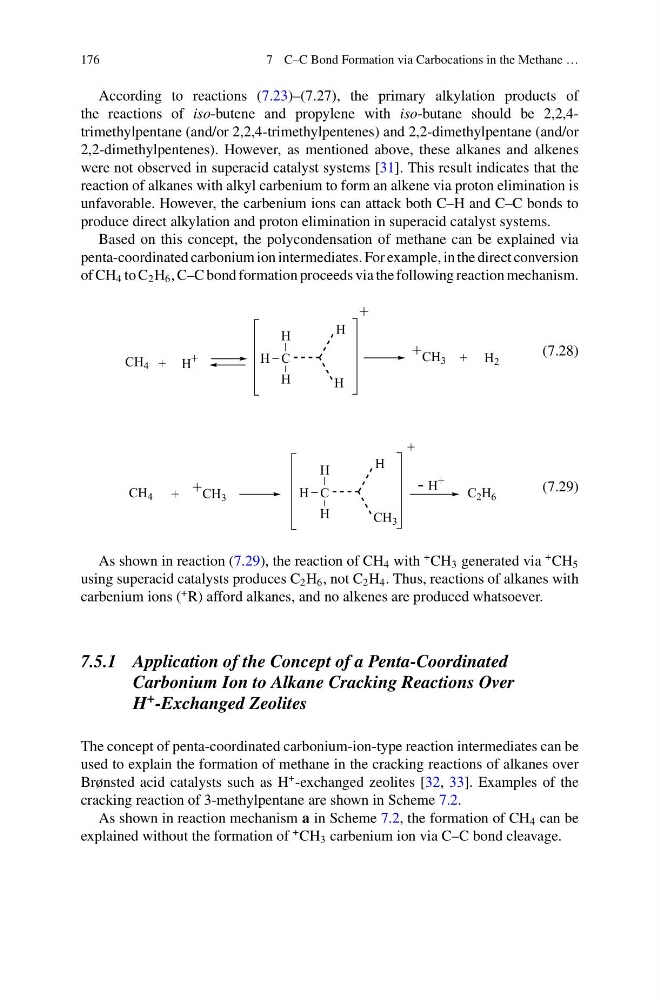
Based on this concept, the polycondensation of methane can be explained via
penta-coordinated carbonium ion intermediates. For example, in the direct conversion
of CH 4 to C 2 H 6 , C–C bond formation proceeds via the following reaction mechanism.
+ H 2
+ H +
CH 4
C
H
H
H
H
H
+
CH 3
+
(7.28)
CH 4
CH 3
+
+
C
H
H
H
H
CH 3
+
- H +
C 2 H 6
(7.29)
As shown in reaction (7.29), the reaction of CH 4 with
+ CH 3 generated via
+ CH 5
using superacid catalysts produces C 2 H 6 , not C 2 H 4 . Thus, reactions of alkanes with
carbenium ions (
+ R) afford alkanes, and no alkenes are produced whatsoever.
7.5.1 Application of the Concept of a Penta-Coordinated
Carbonium Ion to Alkane Cracking Reactions Over
H + -Exchanged Zeolites
The concept of penta-coordinated carbonium-ion-type reaction intermediates can be
used to explain the formation of methane in the cracking reactions of alkanes over
Brønsted acid catalysts such as H
+ -exchanged zeolites [32, 33]. Examples of the
cracking reaction of 3-methylpentane are shown in Scheme 7.2.
As shown in reaction mechanism a in Scheme 7.2, the formation of CH 4 can be
explained without the formation of
+ CH 3 carbenium ion via C–C bond cleavage.
7 C–C Bond Formation via Carbocations in the Methane …
According to reactions (7.23)–(7.27), the primary alkylation products of
the reactions of iso-butene and propylene with iso-butane should be 2,2,4trimethylpentane (and/or 2,2,4-trimethylpentenes) and 2,2-dimethylpentane (and/or
2,2-dimethylpentenes). However, as mentioned above, these alkanes and alkenes
were not observed in superacid catalyst systems [31]. This result indicates that the
reaction of alkanes with alkyl carbenium to form an alkene via proton elimination is
unfavorable. However, the carbenium ions can attack both C–H and C–C bonds to
produce direct alkylation and proton elimination in superacid catalyst systems.
Based on this concept, the polycondensation of methane can be explained via
penta-coordinated carbonium ion intermediates. For example, in the direct conversion
of CH 4 to C 2 H 6 , C–C bond formation proceeds via the following reaction mechanism.
+ H 2
+ H +
CH 4
C
H
H
H
H
H
+
CH 3
+
(7.28)
CH 4
CH 3
+
+
C
H
H
H
H
CH 3
+
- H +
C 2 H 6
(7.29)
As shown in reaction (7.29), the reaction of CH 4 with
+ CH 3 generated via
+ CH 5
using superacid catalysts produces C 2 H 6 , not C 2 H 4 . Thus, reactions of alkanes with
carbenium ions (
+ R) afford alkanes, and no alkenes are produced whatsoever.
7.5.1 Application of the Concept of a Penta-Coordinated
Carbonium Ion to Alkane Cracking Reactions Over
H + -Exchanged Zeolites
The concept of penta-coordinated carbonium-ion-type reaction intermediates can be
used to explain the formation of methane in the cracking reactions of alkanes over
Brønsted acid catalysts such as H
+ -exchanged zeolites [32, 33]. Examples of the
cracking reaction of 3-methylpentane are shown in Scheme 7.2.
As shown in reaction mechanism a in Scheme 7.2, the formation of CH 4 can be
explained without the formation of
+ CH 3 carbenium ion via C–C bond cleavage.