

170
7 C–C Bond Formation via Carbocations in the Methane …
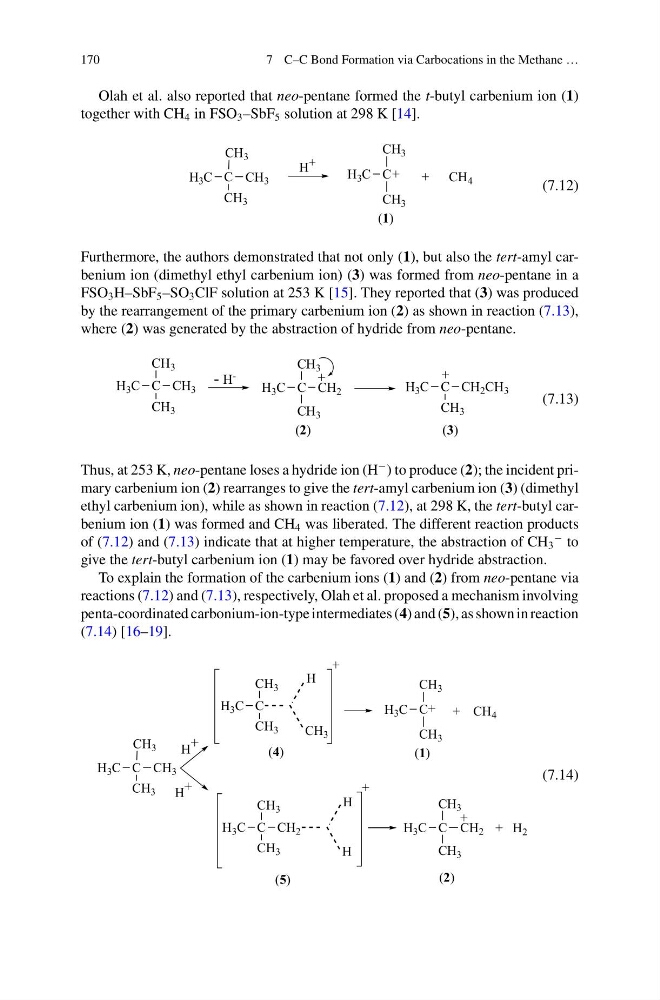
Olah et al. also reported that neo-pentane formed the t-butyl carbenium ion (1)
together with CH 4 in FSO 3 –SbF 5 solution at 298 K [14].
+ CH 4
C
CH 3
CH 3
H 3 C
+
(1)
C
CH 3
CH 3
CH 3
H 3 C
H +
(7.12)
Furthermore, the authors demonstrated that not only (1), but also the tert-amyl carbenium ion (dimethyl ethyl carbenium ion) (3) was formed from neo-pentane in a
FSO 3 H–SbF 5 –SO 3 ClF solution at 253 K [15]. They reported that (3) was produced
by the rearrangement of the primary carbenium ion (2) as shown in reaction (7.13),
where (2) was generated by the abstraction of hydride from neo-pentane.
C
CH 3
CH 3
CH 3
H 3 C
- H -
C
CH 3
CH 3
CH 2
H 3 C
(2)
C
CH 3
CH 2 CH 3
H 3 C
+
(3)
+
(7.13)
Thus, at 253 K, neo-pentane loses a hydride ion (H
− ) to produce (2); the incident primary carbenium ion (2) rearranges to give the tert-amyl carbenium ion (3) (dimethyl
ethyl carbenium ion), while as shown in reaction (7.12), at 298 K, the tert-butyl carbenium ion (1) was formed and CH 4 was liberated. The different reaction products
of (7.12) and (7.13) indicate that at higher temperature, the abstraction of CH 3
− to
give the tert-butyl carbenium ion (1) may be favored over hydride abstraction.
To explain the formation of the carbenium ions (1) and (2) from neo-pentane via
reactions (7.12) and (7.13), respectively, Olah et al. proposed a mechanism involving
penta-coordinated carbonium-ion-type intermediates (4) and (5), as shown in reaction
(7.14) [16–19].
H
H
+
+
+ CH 4
C
CH 3
CH 3
H 3 C
+
(1)
C
CH 3
CH 3
CH 3
H 3 C
H +
H +
C
CH 3
CH 3
H 3 C
H
CH 3
C
CH 3
CH 3
CH 2
H 3 C
(5)
(4)
C
CH 3
CH 3
CH 2
H 3 C
(2)
+
+ H 2
(7.14)
7 C–C Bond Formation via Carbocations in the Methane …
Olah et al. also reported that neo-pentane formed the t-butyl carbenium ion (1)
together with CH 4 in FSO 3 –SbF 5 solution at 298 K [14].
+ CH 4
C
CH 3
CH 3
H 3 C
+
(1)
C
CH 3
CH 3
CH 3
H 3 C
H +
(7.12)
Furthermore, the authors demonstrated that not only (1), but also the tert-amyl carbenium ion (dimethyl ethyl carbenium ion) (3) was formed from neo-pentane in a
FSO 3 H–SbF 5 –SO 3 ClF solution at 253 K [15]. They reported that (3) was produced
by the rearrangement of the primary carbenium ion (2) as shown in reaction (7.13),
where (2) was generated by the abstraction of hydride from neo-pentane.
C
CH 3
CH 3
CH 3
H 3 C
- H -
C
CH 3
CH 3
CH 2
H 3 C
(2)
C
CH 3
CH 2 CH 3
H 3 C
+
(3)
+
(7.13)
Thus, at 253 K, neo-pentane loses a hydride ion (H
− ) to produce (2); the incident primary carbenium ion (2) rearranges to give the tert-amyl carbenium ion (3) (dimethyl
ethyl carbenium ion), while as shown in reaction (7.12), at 298 K, the tert-butyl carbenium ion (1) was formed and CH 4 was liberated. The different reaction products
of (7.12) and (7.13) indicate that at higher temperature, the abstraction of CH 3
− to
give the tert-butyl carbenium ion (1) may be favored over hydride abstraction.
To explain the formation of the carbenium ions (1) and (2) from neo-pentane via
reactions (7.12) and (7.13), respectively, Olah et al. proposed a mechanism involving
penta-coordinated carbonium-ion-type intermediates (4) and (5), as shown in reaction
(7.14) [16–19].
H
H
+
+
+ CH 4
C
CH 3
CH 3
H 3 C
+
(1)
C
CH 3
CH 3
CH 3
H 3 C
H +
H +
C
CH 3
CH 3
H 3 C
H
CH 3
C
CH 3
CH 3
CH 2
H 3 C
(5)
(4)
C
CH 3
CH 3
CH 2
H 3 C
(2)
+
+ H 2
(7.14)