

7.3 Formation of Carbocations in Superacid Solutions
171
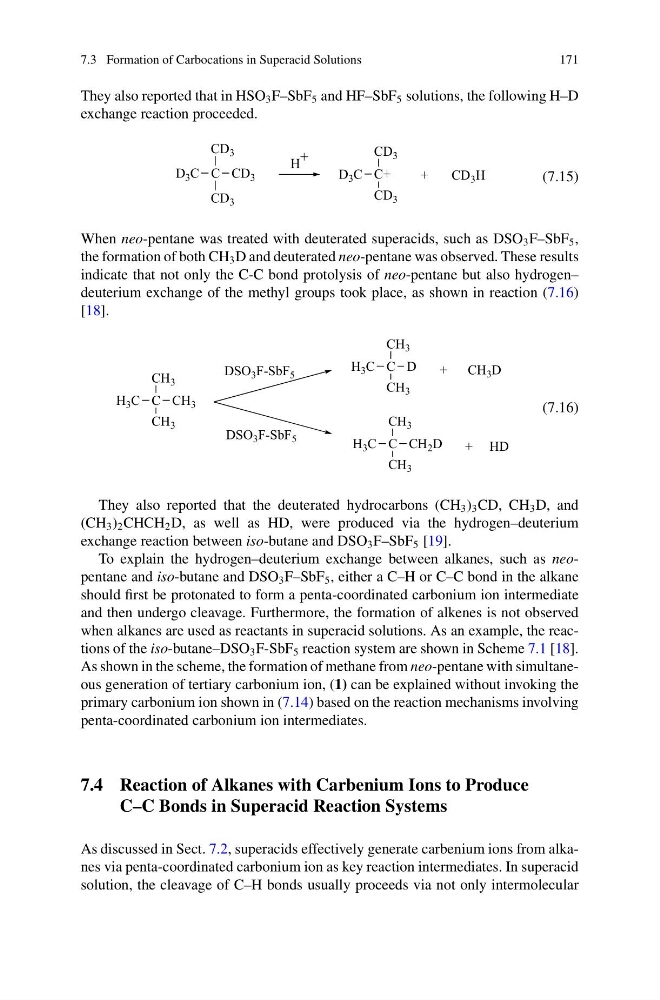
They also reported that in HSO 3 F–SbF 5 and HF–SbF 5 solutions, the following H–D
exchange reaction proceeded.
+
CD 3 H
C
CD 3
CD 3
CD 3
D 3 C
C
CD 3
CD 3
D 3 C
+
H +
(7.15)
When neo-pentane was treated with deuterated superacids, such as DSO 3 F–SbF 5 ,
the formation of both CH 3 D and deuterated neo-pentane was observed. These results
indicate that not only the C-C bond protolysis of neo-pentane but also hydrogen–
deuterium exchange of the methyl groups took place, as shown in reaction (7.16)
[18].
+ CH 3 D
C
CH 3
CH 3
CH 3
H 3 C
+ HD
DSO 3 F-SbF 5
DSO 3 F-SbF 5
C
CH 3
CH 3
D
H 3 C
C
CH 3
CH 3
CH 2 D
H 3 C
(7.16)
They also reported that the deuterated hydrocarbons (CH 3 ) 3 CD, CH 3 D, and
(CH 3 ) 2 CHCH 2 D, as well as HD, were produced via the hydrogen–deuterium
exchange reaction between iso-butane and DSO 3 F–SbF 5 [19].
To explain the hydrogen–deuterium exchange between alkanes, such as neopentane and iso-butane and DSO 3 F–SbF 5 , either a C–H or C–C bond in the alkane
should first be protonated to form a penta-coordinated carbonium ion intermediate
and then undergo cleavage. Furthermore, the formation of alkenes is not observed
when alkanes are used as reactants in superacid solutions. As an example, the reactions of the iso-butane–DSO 3 F-SbF 5 reaction system are shown in Scheme 7.1 [18].
As shown in the scheme, the formation of methane from neo-pentane with simultaneous generation of tertiary carbonium ion, (1) can be explained without invoking the
primary carbonium ion shown in (7.14) based on the reaction mechanisms involving
penta-coordinated carbonium ion intermediates.
7.4 Reaction of Alkanes with Carbenium Ions to Produce
C–C Bonds in Superacid Reaction Systems
As discussed in Sect. 7.2, superacids effectively generate carbenium ions from alkanes via penta-coordinated carbonium ion as key reaction intermediates. In superacid
solution, the cleavage of C–H bonds usually proceeds via not only intermolecular
171
They also reported that in HSO 3 F–SbF 5 and HF–SbF 5 solutions, the following H–D
exchange reaction proceeded.
+
CD 3 H
C
CD 3
CD 3
CD 3
D 3 C
C
CD 3
CD 3
D 3 C
+
H +
(7.15)
When neo-pentane was treated with deuterated superacids, such as DSO 3 F–SbF 5 ,
the formation of both CH 3 D and deuterated neo-pentane was observed. These results
indicate that not only the C-C bond protolysis of neo-pentane but also hydrogen–
deuterium exchange of the methyl groups took place, as shown in reaction (7.16)
[18].
+ CH 3 D
C
CH 3
CH 3
CH 3
H 3 C
+ HD
DSO 3 F-SbF 5
DSO 3 F-SbF 5
C
CH 3
CH 3
D
H 3 C
C
CH 3
CH 3
CH 2 D
H 3 C
(7.16)
They also reported that the deuterated hydrocarbons (CH 3 ) 3 CD, CH 3 D, and
(CH 3 ) 2 CHCH 2 D, as well as HD, were produced via the hydrogen–deuterium
exchange reaction between iso-butane and DSO 3 F–SbF 5 [19].
To explain the hydrogen–deuterium exchange between alkanes, such as neopentane and iso-butane and DSO 3 F–SbF 5 , either a C–H or C–C bond in the alkane
should first be protonated to form a penta-coordinated carbonium ion intermediate
and then undergo cleavage. Furthermore, the formation of alkenes is not observed
when alkanes are used as reactants in superacid solutions. As an example, the reactions of the iso-butane–DSO 3 F-SbF 5 reaction system are shown in Scheme 7.1 [18].
As shown in the scheme, the formation of methane from neo-pentane with simultaneous generation of tertiary carbonium ion, (1) can be explained without invoking the
primary carbonium ion shown in (7.14) based on the reaction mechanisms involving
penta-coordinated carbonium ion intermediates.
7.4 Reaction of Alkanes with Carbenium Ions to Produce
C–C Bonds in Superacid Reaction Systems
As discussed in Sect. 7.2, superacids effectively generate carbenium ions from alkanes via penta-coordinated carbonium ion as key reaction intermediates. In superacid
solution, the cleavage of C–H bonds usually proceeds via not only intermolecular