

7.2 Superacid Catalysts for the Activation of CH 4 …
169
(4) Abstraction of hydride ions from alkanes
Carbenium ions can also be produced by the abstraction of a hydride ion (H
− )
from an alkane by a Lewis acid (homogeneous catalysts) or a Lewis acid site
(heterogeneous catalysts), L, as follows:
+ L
+
R H
R + L H
(7.8)
Here, L is usually a metal cation and/or metal cationic species, and L–H represents
a metal–hydride species, such as Ag–H.
In the following sections, the formation of carbenium ions using various catalysts
via reactions (7.4)–(7.8) and their reaction mechanisms are discussed.
7.3 Formation of Carbocations in Superacid Solutions
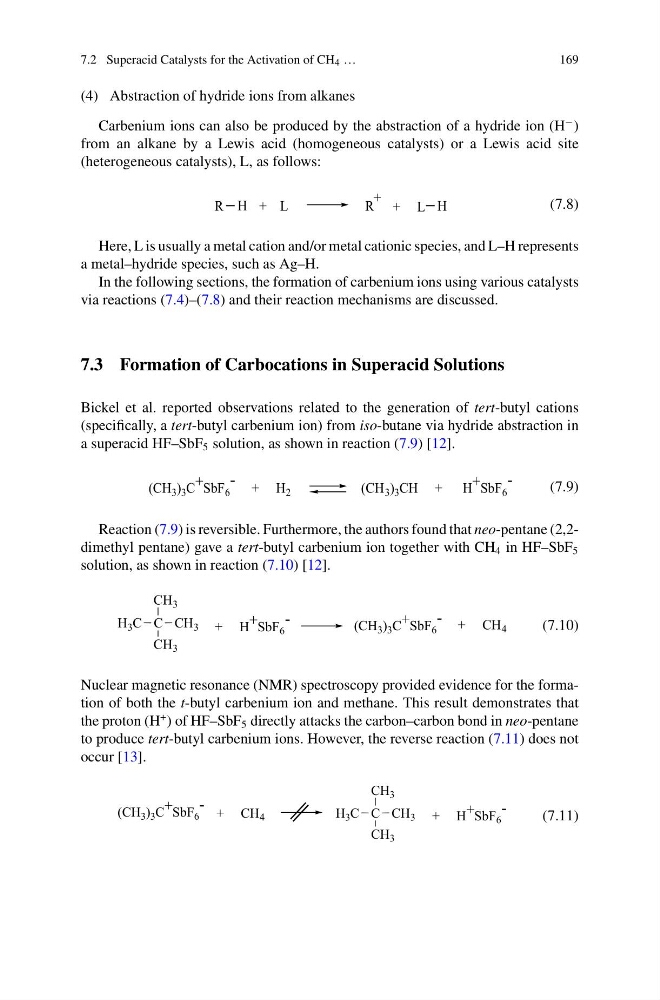
Bickel et al. reported observations related to the generation of tert-butyl cations
(specifically, a tert-butyl carbenium ion) from iso-butane via hydride abstraction in
a superacid HF–SbF 5 solution, as shown in reaction (7.9) [12].
(CH 3 ) 3 C + SbF 6
- + H 2
(CH 3 ) 3 CH + H + SbF 6
-
(7.9)
Reaction (7.9) is reversible. Furthermore, the authors found that neo-pentane (2,2dimethyl pentane) gave a tert-butyl carbenium ion together with CH 4 in HF–SbF 5
solution, as shown in reaction (7.10) [12].
C
CH 3
CH 3
CH 3
H 3 C
+ H + SbF 6
-
(CH 3 ) 3 C + SbF 6
- + CH 4
(7.10)
Nuclear magnetic resonance (NMR) spectroscopy provided evidence for the formation of both the t-butyl carbenium ion and methane. This result demonstrates that
the proton (H
+ ) of HF–SbF 5 directly attacks the carbon–carbon bond in neo-pentane
to produce tert-butyl carbenium ions. However, the reverse reaction (7.11) does not
occur [13].
(CH 3 ) 3 C + SbF 6
- + CH 4
C
CH 3
CH 3
CH 3
H 3 C
+ H + SbF 6
-
(7.11)
169
(4) Abstraction of hydride ions from alkanes
Carbenium ions can also be produced by the abstraction of a hydride ion (H
− )
from an alkane by a Lewis acid (homogeneous catalysts) or a Lewis acid site
(heterogeneous catalysts), L, as follows:
+ L
+
R H
R + L H
(7.8)
Here, L is usually a metal cation and/or metal cationic species, and L–H represents
a metal–hydride species, such as Ag–H.
In the following sections, the formation of carbenium ions using various catalysts
via reactions (7.4)–(7.8) and their reaction mechanisms are discussed.
7.3 Formation of Carbocations in Superacid Solutions
Bickel et al. reported observations related to the generation of tert-butyl cations
(specifically, a tert-butyl carbenium ion) from iso-butane via hydride abstraction in
a superacid HF–SbF 5 solution, as shown in reaction (7.9) [12].
(CH 3 ) 3 C + SbF 6
- + H 2
(CH 3 ) 3 CH + H + SbF 6
-
(7.9)
Reaction (7.9) is reversible. Furthermore, the authors found that neo-pentane (2,2dimethyl pentane) gave a tert-butyl carbenium ion together with CH 4 in HF–SbF 5
solution, as shown in reaction (7.10) [12].
C
CH 3
CH 3
CH 3
H 3 C
+ H + SbF 6
-
(CH 3 ) 3 C + SbF 6
- + CH 4
(7.10)
Nuclear magnetic resonance (NMR) spectroscopy provided evidence for the formation of both the t-butyl carbenium ion and methane. This result demonstrates that
the proton (H
+ ) of HF–SbF 5 directly attacks the carbon–carbon bond in neo-pentane
to produce tert-butyl carbenium ions. However, the reverse reaction (7.11) does not
occur [13].
(CH 3 ) 3 C + SbF 6
- + CH 4
C
CH 3
CH 3
CH 3
H 3 C
+ H + SbF 6
-
(7.11)