

6.7 Active Species and Reaction Mechanism …
153
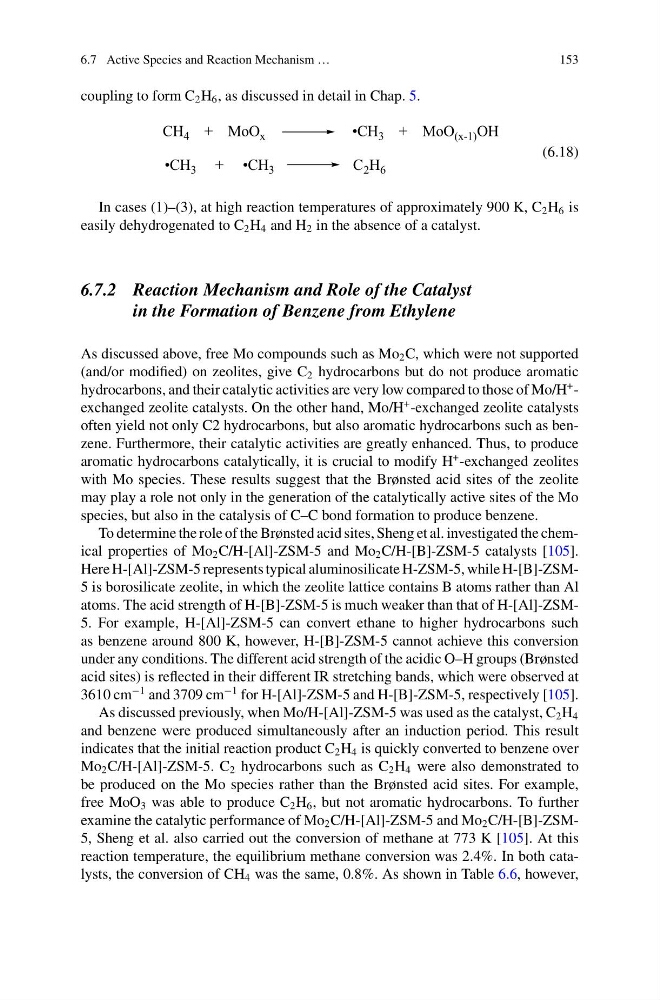
coupling to form C 2 H 6 , as discussed in detail in Chap. 5.
CH 4 + MoO x
•CH 3 + MoO (x-1) OH
•CH 3 + •CH 3
C 2 H 6
(6.18)
In cases (1)–(3), at high reaction temperatures of approximately 900 K, C 2 H 6 is
easily dehydrogenated to C 2 H 4 and H 2 in the absence of a catalyst.
6.7.2 Reaction Mechanism and Role of the Catalyst
in the Formation of Benzene from Ethylene
As discussed above, free Mo compounds such as Mo 2 C, which were not supported
(and/or modified) on zeolites, give C 2 hydrocarbons but do not produce aromatic
hydrocarbons, and their catalytic activities are very low compared to those of Mo/H
+ -
exchanged zeolite catalysts. On the other hand, Mo/H
+ -exchanged zeolite catalysts
often yield not only C2 hydrocarbons, but also aromatic hydrocarbons such as benzene. Furthermore, their catalytic activities are greatly enhanced. Thus, to produce
aromatic hydrocarbons catalytically, it is crucial to modify H
+ -exchanged zeolites
with Mo species. These results suggest that the Brønsted acid sites of the zeolite
may play a role not only in the generation of the catalytically active sites of the Mo
species, but also in the catalysis of C–C bond formation to produce benzene.
To determine the role of the Brønsted acid sites, Sheng et al. investigated the chemical properties of Mo 2 C/H-[Al]-ZSM-5 and Mo 2 C/H-[B]-ZSM-5 catalysts [105].
Here H-[Al]-ZSM-5 represents typical aluminosilicate H-ZSM-5, while H-[B]-ZSM5 is borosilicate zeolite, in which the zeolite lattice contains B atoms rather than Al
atoms. The acid strength of H-[B]-ZSM-5 is much weaker than that of H-[Al]-ZSM5. For example, H-[Al]-ZSM-5 can convert ethane to higher hydrocarbons such
as benzene around 800 K, however, H-[B]-ZSM-5 cannot achieve this conversion
under any conditions. The different acid strength of the acidic O–H groups (Brønsted
acid sites) is reflected in their different IR stretching bands, which were observed at
3610 cm
−1 and 3709 cm
−1 for H-[Al]-ZSM-5 and H-[B]-ZSM-5, respectively [105].
As discussed previously, when Mo/H-[Al]-ZSM-5 was used as the catalyst, C 2 H 4
and benzene were produced simultaneously after an induction period. This result
indicates that the initial reaction product C 2 H 4 is quickly converted to benzene over
Mo 2 C/H-[Al]-ZSM-5. C 2 hydrocarbons such as C 2 H 4 were also demonstrated to
be produced on the Mo species rather than the Brønsted acid sites. For example,
free MoO 3 was able to produce C 2 H 6 , but not aromatic hydrocarbons. To further
examine the catalytic performance of Mo 2 C/H-[Al]-ZSM-5 and Mo 2 C/H-[B]-ZSM5, Sheng et al. also carried out the conversion of methane at 773 K [105]. At this
reaction temperature, the equilibrium methane conversion was 2.4%. In both catalysts, the conversion of CH 4 was the same, 0.8%. As shown in Table 6.6, however,
153
coupling to form C 2 H 6 , as discussed in detail in Chap. 5.
CH 4 + MoO x
•CH 3 + MoO (x-1) OH
•CH 3 + •CH 3
C 2 H 6
(6.18)
In cases (1)–(3), at high reaction temperatures of approximately 900 K, C 2 H 6 is
easily dehydrogenated to C 2 H 4 and H 2 in the absence of a catalyst.
6.7.2 Reaction Mechanism and Role of the Catalyst
in the Formation of Benzene from Ethylene
As discussed above, free Mo compounds such as Mo 2 C, which were not supported
(and/or modified) on zeolites, give C 2 hydrocarbons but do not produce aromatic
hydrocarbons, and their catalytic activities are very low compared to those of Mo/H
+ -
exchanged zeolite catalysts. On the other hand, Mo/H
+ -exchanged zeolite catalysts
often yield not only C2 hydrocarbons, but also aromatic hydrocarbons such as benzene. Furthermore, their catalytic activities are greatly enhanced. Thus, to produce
aromatic hydrocarbons catalytically, it is crucial to modify H
+ -exchanged zeolites
with Mo species. These results suggest that the Brønsted acid sites of the zeolite
may play a role not only in the generation of the catalytically active sites of the Mo
species, but also in the catalysis of C–C bond formation to produce benzene.
To determine the role of the Brønsted acid sites, Sheng et al. investigated the chemical properties of Mo 2 C/H-[Al]-ZSM-5 and Mo 2 C/H-[B]-ZSM-5 catalysts [105].
Here H-[Al]-ZSM-5 represents typical aluminosilicate H-ZSM-5, while H-[B]-ZSM5 is borosilicate zeolite, in which the zeolite lattice contains B atoms rather than Al
atoms. The acid strength of H-[B]-ZSM-5 is much weaker than that of H-[Al]-ZSM5. For example, H-[Al]-ZSM-5 can convert ethane to higher hydrocarbons such
as benzene around 800 K, however, H-[B]-ZSM-5 cannot achieve this conversion
under any conditions. The different acid strength of the acidic O–H groups (Brønsted
acid sites) is reflected in their different IR stretching bands, which were observed at
3610 cm
−1 and 3709 cm
−1 for H-[Al]-ZSM-5 and H-[B]-ZSM-5, respectively [105].
As discussed previously, when Mo/H-[Al]-ZSM-5 was used as the catalyst, C 2 H 4
and benzene were produced simultaneously after an induction period. This result
indicates that the initial reaction product C 2 H 4 is quickly converted to benzene over
Mo 2 C/H-[Al]-ZSM-5. C 2 hydrocarbons such as C 2 H 4 were also demonstrated to
be produced on the Mo species rather than the Brønsted acid sites. For example,
free MoO 3 was able to produce C 2 H 6 , but not aromatic hydrocarbons. To further
examine the catalytic performance of Mo 2 C/H-[Al]-ZSM-5 and Mo 2 C/H-[B]-ZSM5, Sheng et al. also carried out the conversion of methane at 773 K [105]. At this
reaction temperature, the equilibrium methane conversion was 2.4%. In both catalysts, the conversion of CH 4 was the same, 0.8%. As shown in Table 6.6, however,