

152
6 Conversion of Methane to Aromatic Hydrocarbons
MoC x + CH 4
a Mo
a = 1/2 (y + z - x) - 1
CH y
CH z
Mo
CH y
CH z
+ CH 4
MoC x + C 2 H 4 and /or C 2 H 6
Intermediate (I)
(6.16)
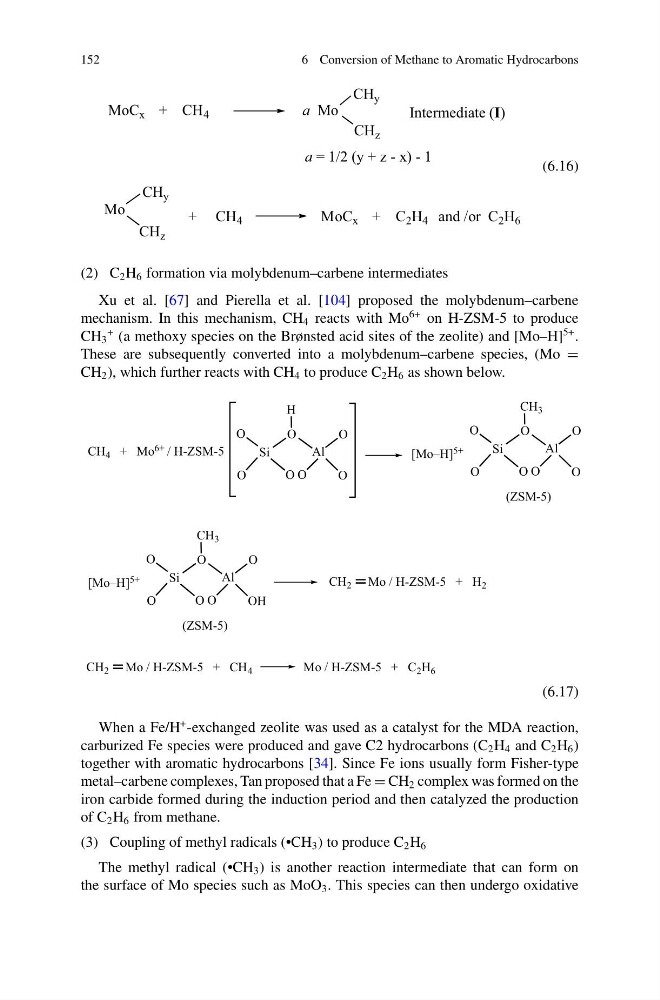
(2) C 2 H 6 formation via molybdenum–carbene intermediates
Xu et al. [67] and Pierella et al. [104] proposed the molybdenum–carbene
mechanism. In this mechanism, CH 4 reacts with Mo
6+ on H-ZSM-5 to produce
CH 3
+ (a methoxy species on the Brønsted acid sites of the zeolite) and [Mo–H]
5+ .
These are subsequently converted into a molybdenum–carbene species, (Mo =
CH 2 ), which further reacts with CH 4 to produce C 2 H 6 as shown below.
H
Si
O
O
O
O
O
Al
O
O
CH 4 + Mo 6+ / H-ZSM-5
[Mo–H] 5+
CH 3
Si
O
O
O
O
O
Al
O
O
(ZSM-5)
CH 2 Mo / H-ZSM-5 + H 2
CH 2 Mo / H-ZSM-5 + CH 4
Mo / H-ZSM-5 + C 2 H 6
[Mo–H] 5+
CH 3
Si
O
O
O
O
O
Al
OH
O
(ZSM-5)
(6.17)
When a Fe/H
+ -exchanged zeolite was used as a catalyst for the MDA reaction,
carburized Fe species were produced and gave C2 hydrocarbons (C 2 H 4 and C 2 H 6 )
together with aromatic hydrocarbons [34]. Since Fe ions usually form Fisher-type
metal–carbene complexes, Tan proposed that a Fe = CH 2 complex was formed on the
iron carbide formed during the induction period and then catalyzed the production
of C 2 H 6 from methane.
(3) Coupling of methyl radicals (•CH 3 ) to produce C 2 H 6
The methyl radical (•CH 3 ) is another reaction intermediate that can form on
the surface of Mo species such as MoO 3 . This species can then undergo oxidative
6 Conversion of Methane to Aromatic Hydrocarbons
MoC x + CH 4
a Mo
a = 1/2 (y + z - x) - 1
CH y
CH z
Mo
CH y
CH z
+ CH 4
MoC x + C 2 H 4 and /or C 2 H 6
Intermediate (I)
(6.16)
(2) C 2 H 6 formation via molybdenum–carbene intermediates
Xu et al. [67] and Pierella et al. [104] proposed the molybdenum–carbene
mechanism. In this mechanism, CH 4 reacts with Mo
6+ on H-ZSM-5 to produce
CH 3
+ (a methoxy species on the Brønsted acid sites of the zeolite) and [Mo–H]
5+ .
These are subsequently converted into a molybdenum–carbene species, (Mo =
CH 2 ), which further reacts with CH 4 to produce C 2 H 6 as shown below.
H
Si
O
O
O
O
O
Al
O
O
CH 4 + Mo 6+ / H-ZSM-5
[Mo–H] 5+
CH 3
Si
O
O
O
O
O
Al
O
O
(ZSM-5)
CH 2 Mo / H-ZSM-5 + H 2
CH 2 Mo / H-ZSM-5 + CH 4
Mo / H-ZSM-5 + C 2 H 6
[Mo–H] 5+
CH 3
Si
O
O
O
O
O
Al
OH
O
(ZSM-5)
(6.17)
When a Fe/H
+ -exchanged zeolite was used as a catalyst for the MDA reaction,
carburized Fe species were produced and gave C2 hydrocarbons (C 2 H 4 and C 2 H 6 )
together with aromatic hydrocarbons [34]. Since Fe ions usually form Fisher-type
metal–carbene complexes, Tan proposed that a Fe = CH 2 complex was formed on the
iron carbide formed during the induction period and then catalyzed the production
of C 2 H 6 from methane.
(3) Coupling of methyl radicals (•CH 3 ) to produce C 2 H 6
The methyl radical (•CH 3 ) is another reaction intermediate that can form on
the surface of Mo species such as MoO 3 . This species can then undergo oxidative