

154
6 Conversion of Methane to Aromatic Hydrocarbons
Table 6.6 Methane
activation selectivity using
Mo 2 C/H-[Al]-ZSM-5 and
Mo 2 C/H-[B]-ZSM-5 at
approximately 1% methane
conversion at 923 K in a flow
reactor
Catalyst
Product Selectivity/%
C 2 H 4
Benzene
Mo 2 C/H-[Al]-ZSM-5
5
91
Mo 2 C/H-[B]-ZSM-5
90
7
Reported in ref. [105]
Catalyst: 50 mg, CH 4 /He: 5/95
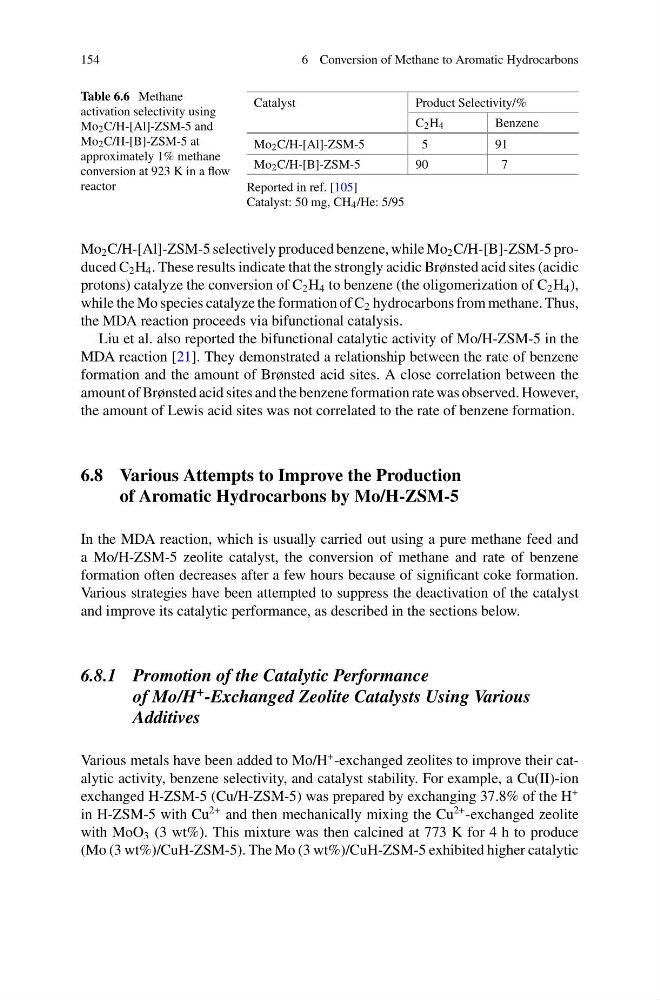
Mo 2 C/H-[Al]-ZSM-5 selectively produced benzene, while Mo 2 C/H-[B]-ZSM-5 produced C 2 H 4 . These results indicate that the strongly acidic Brønsted acid sites (acidic
protons) catalyze the conversion of C 2 H 4 to benzene (the oligomerization of C 2 H 4 ),
while the Mo species catalyze the formation of C 2 hydrocarbons from methane. Thus,
the MDA reaction proceeds via bifunctional catalysis.
Liu et al. also reported the bifunctional catalytic activity of Mo/H-ZSM-5 in the
MDA reaction [21]. They demonstrated a relationship between the rate of benzene
formation and the amount of Brønsted acid sites. A close correlation between the
amount of Brønsted acid sites and the benzene formation rate was observed. However,
the amount of Lewis acid sites was not correlated to the rate of benzene formation.
6.8 Various Attempts to Improve the Production
of Aromatic Hydrocarbons by Mo/H-ZSM-5
In the MDA reaction, which is usually carried out using a pure methane feed and
a Mo/H-ZSM-5 zeolite catalyst, the conversion of methane and rate of benzene
formation often decreases after a few hours because of significant coke formation.
Various strategies have been attempted to suppress the deactivation of the catalyst
and improve its catalytic performance, as described in the sections below.
6.8.1 Promotion of the Catalytic Performance
of Mo/H + -Exchanged Zeolite Catalysts Using Various
Additives
Various metals have been added to Mo/H
+ -exchanged zeolites to improve their catalytic activity, benzene selectivity, and catalyst stability. For example, a Cu(II)-ion
exchanged H-ZSM-5 (Cu/H-ZSM-5) was prepared by exchanging 37.8% of the H
+
in H-ZSM-5 with Cu
2+ and then mechanically mixing the Cu
2+ -exchanged zeolite
with MoO 3 (3 wt%). This mixture was then calcined at 773 K for 4 h to produce
(Mo (3 wt%)/CuH-ZSM-5). The Mo (3 wt%)/CuH-ZSM-5 exhibited higher catalytic
6 Conversion of Methane to Aromatic Hydrocarbons
Table 6.6 Methane
activation selectivity using
Mo 2 C/H-[Al]-ZSM-5 and
Mo 2 C/H-[B]-ZSM-5 at
approximately 1% methane
conversion at 923 K in a flow
reactor
Catalyst
Product Selectivity/%
C 2 H 4
Benzene
Mo 2 C/H-[Al]-ZSM-5
5
91
Mo 2 C/H-[B]-ZSM-5
90
7
Reported in ref. [105]
Catalyst: 50 mg, CH 4 /He: 5/95
Mo 2 C/H-[Al]-ZSM-5 selectively produced benzene, while Mo 2 C/H-[B]-ZSM-5 produced C 2 H 4 . These results indicate that the strongly acidic Brønsted acid sites (acidic
protons) catalyze the conversion of C 2 H 4 to benzene (the oligomerization of C 2 H 4 ),
while the Mo species catalyze the formation of C 2 hydrocarbons from methane. Thus,
the MDA reaction proceeds via bifunctional catalysis.
Liu et al. also reported the bifunctional catalytic activity of Mo/H-ZSM-5 in the
MDA reaction [21]. They demonstrated a relationship between the rate of benzene
formation and the amount of Brønsted acid sites. A close correlation between the
amount of Brønsted acid sites and the benzene formation rate was observed. However,
the amount of Lewis acid sites was not correlated to the rate of benzene formation.
6.8 Various Attempts to Improve the Production
of Aromatic Hydrocarbons by Mo/H-ZSM-5
In the MDA reaction, which is usually carried out using a pure methane feed and
a Mo/H-ZSM-5 zeolite catalyst, the conversion of methane and rate of benzene
formation often decreases after a few hours because of significant coke formation.
Various strategies have been attempted to suppress the deactivation of the catalyst
and improve its catalytic performance, as described in the sections below.
6.8.1 Promotion of the Catalytic Performance
of Mo/H + -Exchanged Zeolite Catalysts Using Various
Additives
Various metals have been added to Mo/H
+ -exchanged zeolites to improve their catalytic activity, benzene selectivity, and catalyst stability. For example, a Cu(II)-ion
exchanged H-ZSM-5 (Cu/H-ZSM-5) was prepared by exchanging 37.8% of the H
+
in H-ZSM-5 with Cu
2+ and then mechanically mixing the Cu
2+ -exchanged zeolite
with MoO 3 (3 wt%). This mixture was then calcined at 773 K for 4 h to produce
(Mo (3 wt%)/CuH-ZSM-5). The Mo (3 wt%)/CuH-ZSM-5 exhibited higher catalytic