

112
5 C–C Bond Formation via the Condensation …
of CH 4 to CO x (Path 2 in Scheme 5.1) was faster than those of C 2 H 6 and C 2 H 4 to
CO x (Path 3 and Path 5 in Scheme 5.1). In Run 3, the reactant pressure of C 2 H 4 was
adjusted to be nearly the same as its product pressure in Run 1 and Run 2. The rates
of CO x formation in Run 3 were much slower than in Run 1 and Run 2. Therefore,
CO x (CO and CO 2 ) were concluded to be produced mainly from CH 4 at low methane
conversion using Sm 2 O 3 as the catalyst. Ito et al. also reported that CO x was formed
directly from methane rather than via the further oxidation of C 2 H 6 when either CH 4
or C 2 H 6 was added to the reactant feed over Li/MgO catalysts [27].
5.5.2 Estimation of the First-Order Rate Constant of Each
Reaction Path
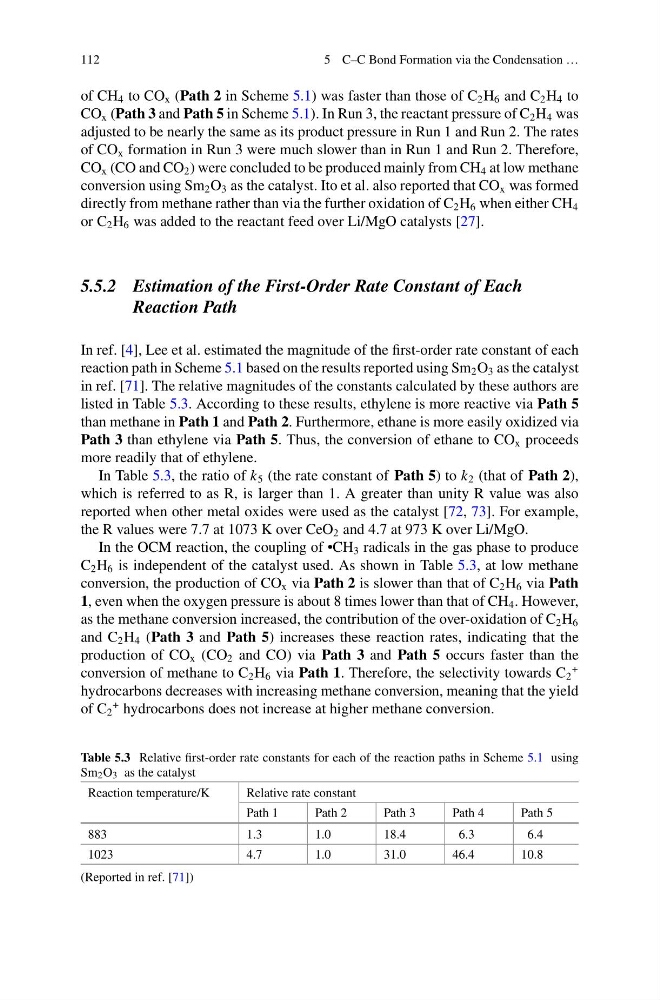
In ref. [4], Lee et al. estimated the magnitude of the first-order rate constant of each
reaction path in Scheme 5.1 based on the results reported using Sm 2 O 3 as the catalyst
in ref. [71]. The relative magnitudes of the constants calculated by these authors are
listed in Table 5.3. According to these results, ethylene is more reactive via Path 5
than methane in Path 1 and Path 2. Furthermore, ethane is more easily oxidized via
Path 3 than ethylene via Path 5. Thus, the conversion of ethane to CO x proceeds
more readily that of ethylene.
In Table 5.3, the ratio of k 5 (the rate constant of Path 5) to k 2 (that of Path 2),
which is referred to as R, is larger than 1. A greater than unity R value was also
reported when other metal oxides were used as the catalyst [72, 73]. For example,
the R values were 7.7 at 1073 K over CeO 2 and 4.7 at 973 K over Li/MgO.
In the OCM reaction, the coupling of •CH 3 radicals in the gas phase to produce
C 2 H 6 is independent of the catalyst used. As shown in Table 5.3, at low methane
conversion, the production of CO x via Path 2 is slower than that of C 2 H 6 via Path
1, even when the oxygen pressure is about 8 times lower than that of CH 4 . However,
as the methane conversion increased, the contribution of the over-oxidation of C 2 H 6
and C 2 H 4 (Path 3 and Path 5) increases these reaction rates, indicating that the
production of CO x (CO 2 and CO) via Path 3 and Path 5 occurs faster than the
conversion of methane to C 2 H 6 via Path 1. Therefore, the selectivity towards C 2
+
hydrocarbons decreases with increasing methane conversion, meaning that the yield
of C 2
+ hydrocarbons does not increase at higher methane conversion.
Table 5.3 Relative first-order rate constants for each of the reaction paths in Scheme 5.1 using
Sm 2 O 3 as the catalyst
Reaction temperature/K
Relative rate constant
Path 1
Path 2
Path 3
Path 4
Path 5
883
1.3
1.0
18.4
6.3
6.4
1023
4.7
1.0
31.0
46.4
10.8
(Reported in ref. [71])
5 C–C Bond Formation via the Condensation …
of CH 4 to CO x (Path 2 in Scheme 5.1) was faster than those of C 2 H 6 and C 2 H 4 to
CO x (Path 3 and Path 5 in Scheme 5.1). In Run 3, the reactant pressure of C 2 H 4 was
adjusted to be nearly the same as its product pressure in Run 1 and Run 2. The rates
of CO x formation in Run 3 were much slower than in Run 1 and Run 2. Therefore,
CO x (CO and CO 2 ) were concluded to be produced mainly from CH 4 at low methane
conversion using Sm 2 O 3 as the catalyst. Ito et al. also reported that CO x was formed
directly from methane rather than via the further oxidation of C 2 H 6 when either CH 4
or C 2 H 6 was added to the reactant feed over Li/MgO catalysts [27].
5.5.2 Estimation of the First-Order Rate Constant of Each
Reaction Path
In ref. [4], Lee et al. estimated the magnitude of the first-order rate constant of each
reaction path in Scheme 5.1 based on the results reported using Sm 2 O 3 as the catalyst
in ref. [71]. The relative magnitudes of the constants calculated by these authors are
listed in Table 5.3. According to these results, ethylene is more reactive via Path 5
than methane in Path 1 and Path 2. Furthermore, ethane is more easily oxidized via
Path 3 than ethylene via Path 5. Thus, the conversion of ethane to CO x proceeds
more readily that of ethylene.
In Table 5.3, the ratio of k 5 (the rate constant of Path 5) to k 2 (that of Path 2),
which is referred to as R, is larger than 1. A greater than unity R value was also
reported when other metal oxides were used as the catalyst [72, 73]. For example,
the R values were 7.7 at 1073 K over CeO 2 and 4.7 at 973 K over Li/MgO.
In the OCM reaction, the coupling of •CH 3 radicals in the gas phase to produce
C 2 H 6 is independent of the catalyst used. As shown in Table 5.3, at low methane
conversion, the production of CO x via Path 2 is slower than that of C 2 H 6 via Path
1, even when the oxygen pressure is about 8 times lower than that of CH 4 . However,
as the methane conversion increased, the contribution of the over-oxidation of C 2 H 6
and C 2 H 4 (Path 3 and Path 5) increases these reaction rates, indicating that the
production of CO x (CO 2 and CO) via Path 3 and Path 5 occurs faster than the
conversion of methane to C 2 H 6 via Path 1. Therefore, the selectivity towards C 2
+
hydrocarbons decreases with increasing methane conversion, meaning that the yield
of C 2
+ hydrocarbons does not increase at higher methane conversion.
Table 5.3 Relative first-order rate constants for each of the reaction paths in Scheme 5.1 using
Sm 2 O 3 as the catalyst
Reaction temperature/K
Relative rate constant
Path 1
Path 2
Path 3
Path 4
Path 5
883
1.3
1.0
18.4
6.3
6.4
1023
4.7
1.0
31.0
46.4
10.8
(Reported in ref. [71])