

5.5 Reaction Network in the Oxidative Coupling of Methane
113
As discussed above, the coupling of the methyl radical mainly proceeds in the gas
phase to produce C 2 H 6 . This reaction is rather different from the partial oxidation of
CH 4 to CH 3 OH, in which the CH 3 OH is produced on the surface of a solid catalyst
or biological catalyst, even though the •CH 3 radical is an intermediate in both cases.
Further details of the partial oxidation reaction are given in Chapters 2–4.
5.6 Relationship Between the Conversion of Methane
and the Selectivity Towards C 2
+ Hydrocarbons
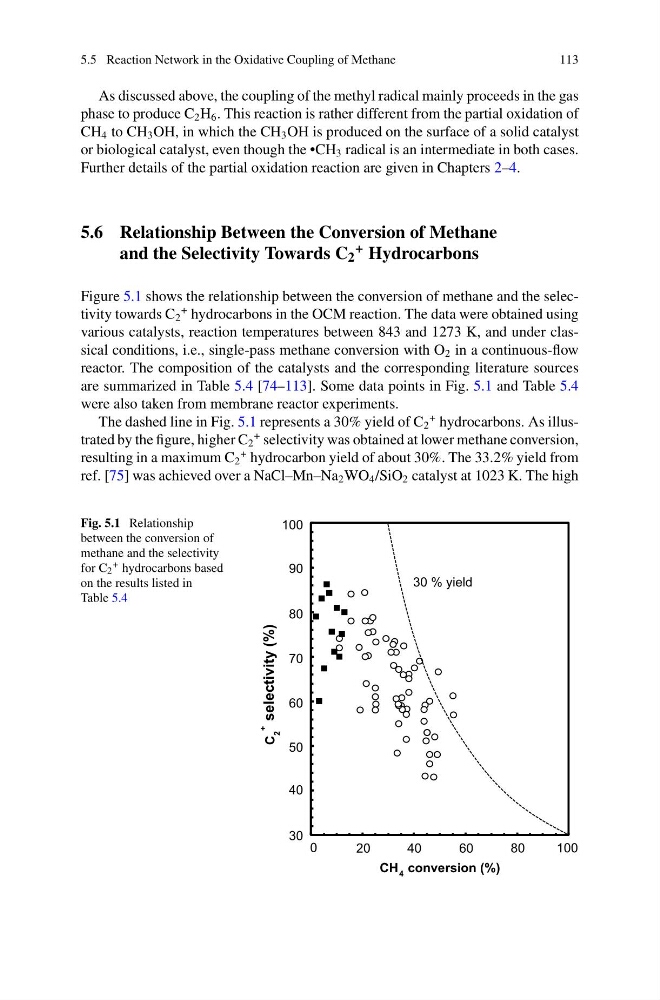
Figure 5.1 shows the relationship between the conversion of methane and the selectivity towards C 2
+ hydrocarbons in the OCM reaction. The data were obtained using
various catalysts, reaction temperatures between 843 and 1273 K, and under classical conditions, i.e., single-pass methane conversion with O 2 in a continuous-flow
reactor. The composition of the catalysts and the corresponding literature sources
are summarized in Table 5.4 [74–113]. Some data points in Fig. 5.1 and Table 5.4
were also taken from membrane reactor experiments.
The dashed line in Fig. 5.1 represents a 30% yield of C 2
+ hydrocarbons. As illustrated by the figure, higher C 2
+ selectivity was obtained at lower methane conversion,
resulting in a maximum C 2
+ hydrocarbon yield of about 30%. The 33.2% yield from
ref. [75] was achieved over a NaCl–Mn–Na 2 WO 4 /SiO 2 catalyst at 1023 K. The high
Fig. 5.1 Relationship
between the conversion of
methane and the selectivity
for C 2
+ hydrocarbons based
on the results listed in
Table 5.4
0
20
40
60
80
100
30
40
50
60
70
80
90
100
CH 4 conversion (%)
C
2
+
selectivity (%)
30 % yield
113
As discussed above, the coupling of the methyl radical mainly proceeds in the gas
phase to produce C 2 H 6 . This reaction is rather different from the partial oxidation of
CH 4 to CH 3 OH, in which the CH 3 OH is produced on the surface of a solid catalyst
or biological catalyst, even though the •CH 3 radical is an intermediate in both cases.
Further details of the partial oxidation reaction are given in Chapters 2–4.
5.6 Relationship Between the Conversion of Methane
and the Selectivity Towards C 2
+ Hydrocarbons
Figure 5.1 shows the relationship between the conversion of methane and the selectivity towards C 2
+ hydrocarbons in the OCM reaction. The data were obtained using
various catalysts, reaction temperatures between 843 and 1273 K, and under classical conditions, i.e., single-pass methane conversion with O 2 in a continuous-flow
reactor. The composition of the catalysts and the corresponding literature sources
are summarized in Table 5.4 [74–113]. Some data points in Fig. 5.1 and Table 5.4
were also taken from membrane reactor experiments.
The dashed line in Fig. 5.1 represents a 30% yield of C 2
+ hydrocarbons. As illustrated by the figure, higher C 2
+ selectivity was obtained at lower methane conversion,
resulting in a maximum C 2
+ hydrocarbon yield of about 30%. The 33.2% yield from
ref. [75] was achieved over a NaCl–Mn–Na 2 WO 4 /SiO 2 catalyst at 1023 K. The high
Fig. 5.1 Relationship
between the conversion of
methane and the selectivity
for C 2
+ hydrocarbons based
on the results listed in
Table 5.4
0
20
40
60
80
100
30
40
50
60
70
80
90
100
CH 4 conversion (%)
C
2
+
selectivity (%)
30 % yield